
Volkswagen's Vision for Future Automotive Creation | Volkswagen
Volkswagen Group
Germany's Vision for Sustainable Energy
Volkswagen's Future of Car Manufacturing
The Volkswagen Group is accelerating its commitment to sustainable energy. This direction is seen as a rational solution, both technologically and commercially. Tatsuya Otani, who received an explanation from Dr. Steiger of the Group during his visit to Japan at the invitation of NEDO (New Energy and Industrial Technology Development Organization), was impressed by Germany's comprehensive vision and felt a sense of crisis regarding Japan's situation.
Text by OTANI Tatsuya
Is the Global Trend "EVs for City Commuting, FCVs as the Next Generation"?
When covering next-generation automobiles, particularly in Japan, one frequently encounters the assertion from Japanese automakers that "electric vehicles (EVs) with limited range and long charging times will remain confined to specific uses in the future, and fuel cell vehicles (FCVs) will become the mainstream for next-generation automobiles." This often leads one to believe it is the global trend.
From this perspective, one might worry about European manufacturers who have only recently begun to focus on EVs and plug-in hybrids (PHEVs) and do not seem to be enthusiastically developing fuel cell vehicles (FCVs).
However, Dr. Wolfgang Steiger, who is responsible for future technology communications at Volkswagen, asserts that there are clear reasons why German manufacturers are focusing on EVs and PHEVs, and that EVs will become the mainstream of next-generation automobiles, at least in Europe. Conversely, Dr. Steiger predicts that FCVs will remain a niche market.

Prof. Dr. Wolfgang Steiger
Why do Japan and Germany have such different ideas about next-generation automobiles? Listening to Dr. Steiger's explanation, I felt a sense of crisis that Japan's industry and market might become 'Galapagosized' even in the realm of next-generation vehicles.
Volkswagen Group
Germany's Vision for Sustainable Energy
Volkswagen's Future of Car Manufacturing (2)
Battery Advancements Drive Change
"By 2022 or 2023, EVs with a range of over 400 km will be commercially available."
Dr. Steiger stated this at the beginning of the discussion. Currently, the range of EVs on the market is about 160-170 km at best, depending on driving style. The prospect of EVs with more than double this range being released within a decade is a great boon for EVs, for whom limited range has been an Achilles' heel.
Although extending the range has been an urgent priority, it has only improved by about 10% annually so far. Therefore, Dr. Steiger's statement might seem somewhat abrupt, but it was, of course, well-supported.
"The third generation of batteries will be available soon. These batteries have a higher energy density than conventional ones, and simply replacing the existing EV battery with one of these will extend the range to 200-250 km. Furthermore, we plan to release EVs with dedicated platforms in 2022-2023, which will allow us to carry more batteries while controlling weight increases, enabling a range of 400 km."
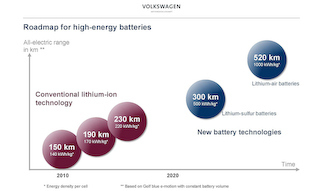
Roadmap for high energy battery
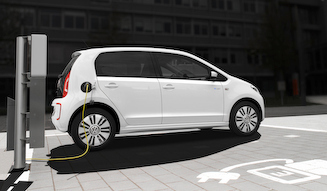
Volkswagen e-up!
This raises concerns about cost and charging time. However, the cost of the third-generation battery is said to be lower than conventional ones, so even if the range exceeds 400 km, the price will likely not be double that of current EVs. Moreover, with zero emissions and running on electricity, which is overwhelmingly cheaper than gasoline, the product's appeal is considered extremely high.
Regarding charging time, another concern for EVs, Dr. Steiger mentioned, "Using rapid charging, a 30-minute charge can provide a range of about 400 km."
In other words, if you were to travel from Tokyo to Okayama by EV, you could drive along the Tomei, Shin-Tomei, Isewangan, and Tomeihan expressways, stop for a 30-minute charge and lunch at the Gosho Service Area on the Tomeihan (approximately 370 km from Tokyo), and then easily cover the remaining 300 km, arriving in Okayama City 9 hours after departure. How many users would require a longer range than this?
Volkswagen Group
Germany's Vision for Sustainable Energy
Volkswagen's Future of Car Manufacturing (3)
Economic Benefits as Well
Now, even if EVs with long ranges and affordable prices become available, it cannot be considered environmentally friendly if the power plants supplying them burn coal or oil, and the generation cost would also be considerable. The ideal scenario is power generation using renewable energy that does not produce CO2, and at a low cost.
However, according to Dr. Steiger, Germany has already completed feasibility studies for a complete transition to renewable energy for power generation, and implementing this would result in electricity being available at virtually no cost.
"The initial investment for power plant construction over the first 10 years will be 90 billion euros (approximately 13 trillion yen), but over the subsequent 10 years, 50 billion euros (approximately 7 trillion yen) will be recouped, and by 2030, 180 billion euros (approximately 25 trillion yen) will be returned."
Unfortunately, Dr. Steiger's comments do not clarify when this project will start (or started). Nevertheless, if the projected returns over a 30-year period are more than three times the initial investment, the business case can be considered sufficiently strong.
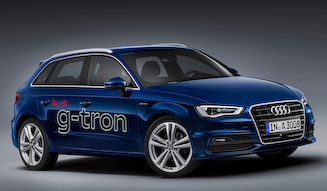
Audi A3 g-tron
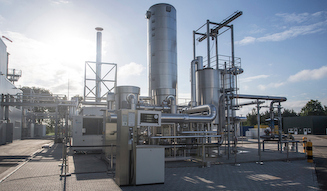
Audi e-gas plant
Thorough Cost Consciousness with Existing Infrastructure
The professor also argued:
"The electricity network is already complete throughout Germany. Also,Audiis experimenting with generating methane gas using surplus electricity from renewable sources and feeding it into the natural gas supply network. The conversion efficiency is a respectable 75 percent, and the network is already established across Germany. Furthermore, there are storage facilities capable of meeting Germany's demand for two months. In any case, the infrastructure for supplying electricity generated from renewable energy, or natural gas produced from this electricity, nationwide is already in place, so the required cost is zero."
"On the other hand, there is no hydrogen supply network for fuel cell vehicles (FCVs). In contrast, the German government has clearly stated its position: 'We will not permit a single euro to be wasted under the guise of constructing a hydrogen supply network.' Moreover, FCVs require a significant amount of precious metals to manufacture their core components, the stacks, and advanced technology is needed for the onboard high-pressure gas tanks, both of which are major factors driving up the cost of FCVs."
Volkswagen Group
Germany's Vision for Sustainable Energy
Volkswagen's Future of Car Manufacturing (4)
Isn't Now the Time to Discuss?
"Considering the points above, it is likely that EVs will become mainstream within Europe, with FCVs remaining products for a niche market. Of course, Japan is an island nation, and its situation differs from Europe's, so FCVs might become widespread there. However, our prediction is that this will not happen in Europe."
I have no intention here of debating which is superior, EVs or FCVs. Nor do I intend to discuss the merits of Japanese versus European engineers.
However, it is not inconceivable that while Japanese government agencies and manufacturers are focused on FCVs, Europe is vigorously advancing EV technology development, and Japan may find itself significantly lagging in the product competitiveness of EVs, which are becoming the global standard. In other words, this is the 'Galapagosization' of the Japanese market and industry.
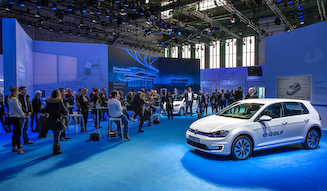
Currently, Japan is said to be leading in areas such as motors, batteries, and control technology. However, there are numerous examples, such as in home appliances, mobile phones, and smartphones, where industries have declined due to misjudging market trends and failing to leverage existing technological advantages. It seems that the time has come to carefully assess the trends in each country and discuss how the Japanese industry should respond, even for next-generation automobiles.