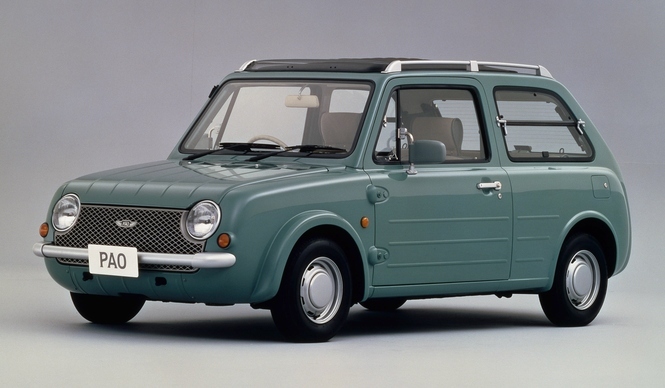
The Untold Story of NISSAN's Pike Cars: The PAO and FIGARO | NISSAN
NISSAN Pao
NISSAN Figaro
NISSAN S-Cargo
The Story Behind Nissan Pike Cars: The Final Installment
The Cars That Followed the Be-1
──The Nissan "Be-1," released in 1987, is said to have changed automotive design. In our previous and second-to-last installments, we spoke with the individuals who were in charge of its planning and development to understand how this car, whose popularity became a social phenomenon, was brought to market. How, then, were the subsequent Pike Cars developed after the challenging creation of the Be-1? This is the final installment, delving into the behind-the-scenes story of the legendary series.Be-1In our previous and second-to-last installments, we spoke with the individuals who were in charge of its planning and development to understand how this car, whose popularity became a social phenomenon, was brought to market. How, then, were the subsequent Pike Cars developed after the challenging creation of the Be-1? This is the final installment, delving into the behind-the-scenes story of the legendary series.previous installment,second-to-last installmentHow, then, were the subsequent Pike Cars developed after the challenging creation of the Be-1? This is the final installment, delving into the behind-the-scenes story of the legendary series.
Text by OGAWA Fumio
To The Story Behind Nissan Pike Cars: Part 2
A Boom Far Exceeding Expectations
Jun Shimizu (hereinafter Shimizu)I was involved as Nissan Motor's design director at the time. To summarize what I've discussed so far, we identified market potential in one of the March's design studies, persuaded the company to produce it, and it became a huge hit.
Akira Yamamoto (hereinafter Yamamoto)I come from an engineering background, but I was involved in product planning at the time. I was impressed by how interesting the proposals from the fashion industry were, as they came from a completely different perspective.
Naoki Sakai (hereinafter Sakai)As I've discussed before, there were many twists and turns,as discussed beforebut ultimately, the "Be-1" received a response far exceeding Nissan Motor's internal expectations. The boom the Be-1 created was truly remarkable.
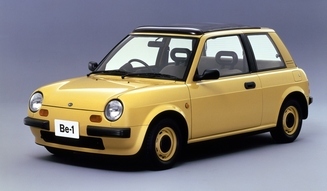
NISSAN Be-1
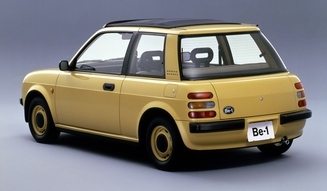
NISSAN Be-1
YamamotoIt was incredible. We were surprised ourselves.
ShimizuInternally, there were those who held negative views towards Pike Cars, considering them unrelated to the "essence of a car." However, the demand shifted to wanting the next Pike Car to be launched quickly, rather than focusing on the March's model change.
Yamamoto(Laughs)
ShimizuI wasn't sure what to do, but I felt that the post-Be-1 needed a completely different concept, not just a follow-up. So, Sakai and I began meeting with the Nissan team.
NISSAN Pao
NISSAN Figaro
NISSAN S-Cargo
The Story Behind Nissan Pike Cars: The Final Installment
The Cars That Followed the Be-1 (Part 2)
Next Up: Banana Republic and Paris-Dakar!
YamamotoFollowing the great success of the Be-1, which established the "Pike Car" genre, we reorganized Nissan's product lineup. We decided to focus on five pillars: "luxury cars," "mass-produced cars," "sports cars," "RVs (Recreational Vehicles)" represented by the Terrano, and "Pike Cars." This shows the high expectations we had.
ShimizuDuring our numerous meetings, Sakai proposed the keyword: "a fusion of Banana Republic and Paris-Dakar."Banana RepublicAnd the keyword: "a fusion of Banana Republic and Paris-Dakar."
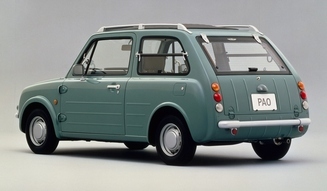
NISSAN Pao
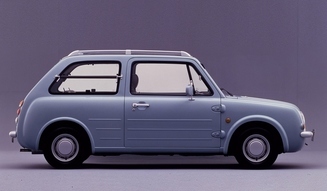
NISSAN Pao
──Banana Republic was a popular American clothing brand in Japan, often called "Banari-pa." Founded in the late 1970s in the US, it was later acquired by GAP and was characterized by its safari-like image.
YamamotoIt was quite forward-thinking to focus on that at the time.
SakaiWe found Africa intriguing.
──The Paris-Dakar Rally, which began in 1978 with a French initiator, was a grueling event known as a rally raid, starting in Paris at the New Year and traversing Africa. Many car manufacturers worldwide took it very seriously.
SakaiThat was just one analogy. We need to be careful not to cause misunderstandings, but I found the functionality of vehicles designed for the African desert, combined with a retro aesthetic evoking a certain nostalgia for Africa during the colonial era, to be fascinating.
ShimizuAlthough the actual design was executed by Nissan's in-house designers, the concept of ribbed sheet metal was likely something only Sakai could have conceived.

SakaiI also thought the image of the "Kübelwagen" used during World War II would resonate well.
YamamotoAs a result, the Nissan "PAO" was developed and released in 1989. This time, instead of a limited production run, we opted for a limited reservation period. The mechanism was the same as the Be-1, using the K10 March's 1-liter carbureted engine, and we sold 42,000 units in three months.
SakaiThere's an industrial designer named Marc Newson who achieved global recognition from the 2000s onwards. He designed a groundbreaking concept car for Ford called the "021C," which generated significant buzz at the 1999 Tokyo Motor Show. He once told me that the "PAO" was a design he loved.
NISSAN Pao
NISSAN Figaro
NISSAN S-Cargo
The Story Behind Nissan Pike Cars: The Final Installment
The Cars That Followed the Be-1 (Part 3)
Pike Cars Gained Global Acclaim
──Alongside the PAO, the commercial van "S-Cargo" was announced, and in 1991, the third Pike Car, the Nissan "Figaro," was released. This was also during the peak of the bubble economy, and it generated considerable buzz, including the creation of Figaro movies featuring film director Kaizo Hayashi, known for the "Makoto-chan" series. We also heard that the car-loving Eric Clapton purchased one.
YamamotoAlthough both Sakai and I had moved on from our direct responsibilities by then, it's truly gratifying that the series continued to be popular.
SakaiDuring the concept-making phase, I was involved to some extent and suggested that it should be something enjoyable for women to drive.
ShimizuIt was wonderful to gain the confidence that Japanese sensibilities were at the forefront of the world, thanks to the global recognition of the Pike Cars.
SakaiThis might be presumptuous of me to say,
Volkswagen'sBeetle,
Audi'sTT,
BMW's
MINIMINI,
and Fiat's500.
Can we not deny that the influence of Pike Cars can be seen in all of them?
ShimizuHowever, Pike Cars did not continue after that. When launching a product, it must be at the forefront of its time. This means we need to anticipate the trends of the era when development begins.
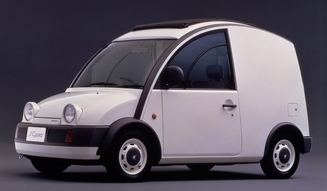
NISSAN S-Cargo
YamamotoAdvertising agencies, in collaboration with planning companies, brought us proposals, but none of them resonated with us.
ShimizuPerhaps having the mindset of being at the forefront of creativity provides the confidence and vitality to create compelling products.
YamamotoI believe EVs (electric vehicles) hold that potential.
ShimizuEVs are part of our corporate DNA, starting with the "Tama" electric car completed in 1947. We were early to market with the Nissan "Hypermini" in 1999.
YamamotoEVs and cars using new fuels are areas that engineers find rewarding, so we want to pursue those and aim for the forefront of the world once again.
SakaiIn any case, Japanese companies must strive harder.
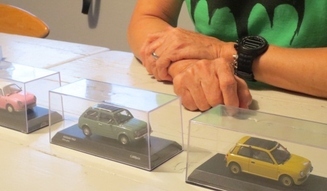

The creators of the Pike Cars. From left: Jun Shimizu, Naoki Sakai, and Akira Yamamoto.
NAOKI SAKAI(NAOKI SAKAI)
Currently a director at Water Design. Professor at Keio University Shonan Fujisawa Campus. Moved to the US in the 1960s and started a fashion business in San Francisco. His starting point was textile design, but after the Be-1 project, he became widely involved in product design.
JUN SHIMIZU(JUN SHIMIZU)
Joined Nissan Motor in 1962. At the time, there was no design department, so he worked in the modeling division and was involved in the first-generation "Sunny." He also designed the "Cedric/Gloria 230" (1971-75), which surpassed the Toyota "Crown" in sales volume. During his tenure as Head of Design, he oversaw the design division for eight years and was responsible for the design of all models.
AKIRA YAMAMOTO(AKIRA YAMAMOTO)
Joined Nissan Motor in 1962. Worked in the design and development department, focusing on suspension and body design, before moving into technology development planning and product planning. During this time, he was involved with the "Fairlady Z" (Z32) (released in 1989) and the highly successful "Silvia" (S13) (released in 1988). He later held positions such as head of the product planning office and head of the electronics technology division.
To The Story Behind Nissan Pike Cars: Part 2