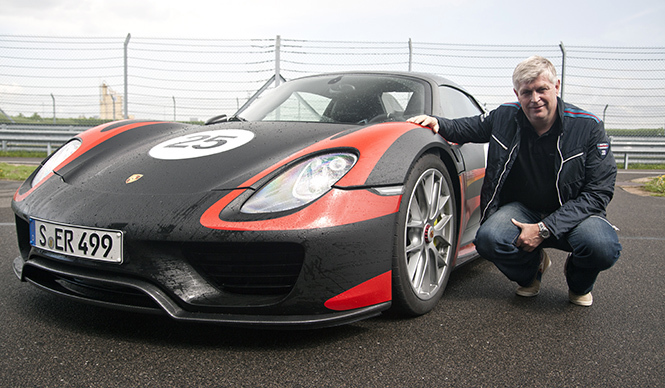
The Benchmark for a New Generation of Super Sports Cars, the 918 Spyder | Porsche
Porsche 918 Spyder | The Benchmark of a New Generation of Super Sports
Production Start Set for September 18
The Benchmark of a New Generation of Super Sports
“LaFerrari” and “McLaren P1” – this year has seen a simultaneous debut of super sports cars equipped with hybrid systems. Porsche, too, is set to begin production of the “918 Spyder” which combines an internal combustion engine with electric motors. However, Porsche insists that its approach is entirely different from that of LaFerrari and the P1. Why is that? Motor journalist Motohiro Yamazaki asked Wolfgang Hatz, head of the Weissach R&D Center, for the reasons.
Text by YAMAZAKI Motohiro
What Porsche Aims to Convey with the 918 Spyder
991 Generation” – the Geneva Motor Show this year saw the unveiling of the “911 GT3” which has evolved into the “Panamera” which, with a significant minor change, has evolved into what Porsche itself calls the second generation, unveiled at the Shanghai Motor Show.
At motor shows around the world, Wolfgang Hatz, Vice President and Executive Board Member for Research and Development, consistently and actively responds to our interviews as Porsche's spokesperson.
Geneva Show,Shanghai Showinterviews, the topics, within the limited time, were naturally the 911 GT3 and the Panamera. However, an event of extreme importance for Mr. Hatz is also planned for this autumn.
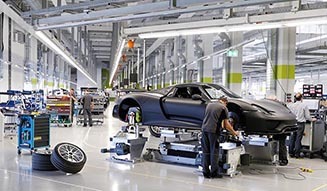
Specifically, it is the production of the “918 Spyder,” set to commence on September 18.
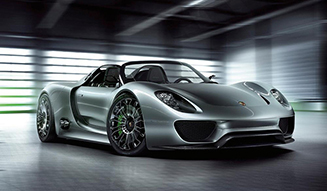
The 918 Spyder, a concept car unveiled at the 2010 Geneva Motor Show without any prior announcement or media speculation, will finally begin its limited production run of 918 units, over two years after its debut.
Shortly beforeThe World of High-End Super Sportsnew hybrid models like the “LaFerrari” and “McLaren P1” will also debut as limited editions. However, Mr. Hatz consistently claims that these are not direct rivals to the 918 Spyder.
“What do we at Porsche want to convey with the 918 Spyder? In other words, I believe the concept of the 918 Spyder is entirely different from that of LaFerrari and the P1. Certainly, by combining the continuously evolved internal combustion engine with electric motors, we aim to elevate both performance and environmental efficiency to higher levels, so the development direction is aligned. However, our thinking with the 918 Spyder is that it should be a pure EV capable of zero-emission driving, alongside being a super sports car.
This concept is most strongly asserted by the capacity of its lithium-ion battery. The battery installed in the 918 Spyder weighs approximately 200 kg. This enables acceleration up to 160 km/h and a zero-emission driving range of over 25 km.”
Porsche 918 Spyder | Porsche 918 Spyder
Production Start Set for September 18
The Benchmark of a New Generation of Super Sports (2)
Choosing with Your Own Will
According to the latest specifications for the 918 Spyder announced by Porsche recently, the capacity of the lithium-ion battery mounted in the rear floor is 6.8 kWh.
The electric motors, in addition to a 612 ps maximum output from the 4.6-liter V8 DOHC engine, consist of a 156 ps hybrid module and a 129 ps unit on the front axle. The total system output reaches 897 ps, enabling a 0-100 km/h acceleration in 2.8 seconds, 0-200 km/h in 7.9 seconds, and 0-300 km/h in 23 seconds. The top speed exceeds 340 km/h.
Meanwhile, tests conducted under the New European Driving Cycle recorded a fuel economy of 3.3 liters/100 km, achieving CO2 emissions of 79g.
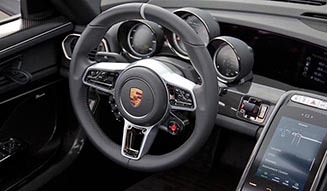
“The 918 Spyder offers driving modes such as 'E-Power' for EV driving, 'Hybrid,' 'Sport Hybrid,' 'Race Hybrid,' and 'Hot Lap.' However, the customer at the wheel will always start in 'E-Power' mode, unless the battery charge level is critically low.
Considering the possible driving range, if used for daily commuting, one could reach their destination without the engine ever starting. Once you leave the city and reach country roads or the autobahn, you can enjoy the performance of the 918 Spyder in your preferred hybrid mode, while the battery is recharged with sufficient power.
The 'Hot Lap' mode is, of course, for unleashing the full performance of the 918 Spyder on the circuit. Customers can choose the versatility of the 918 Spyder with their own will.”
Porsche 918 Spyder | Porsche 918 Spyder
Production Start Set for September 18
The Benchmark of a New Generation of Super Sports (3)
What is the Greatest Benefit of Rear-Wheel Steering?
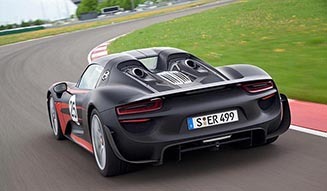
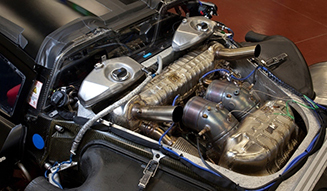
In addition to its hybrid system, the 918 Spyder boasts various other technical highlights. These include the body design, meticulously refined for aerodynamics, and the exhaust system, which features an upward exit to manage heat from the lithium-ion battery mentioned earlier. And, of course, the chassis, a source of Porsche's pride, is no exception.
“The development of the 918 Spyder occurred almost concurrently with that of the 911 GT3, so there are many commonalities in chassis engineering between the two cars. The most symbolic example of this is the adoption of rear-wheel steering.
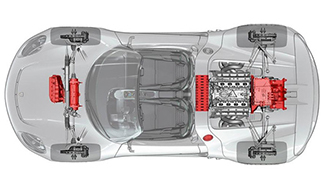
Porsche's engagement with rear-wheel steering dates back to the 'Weissach axle' used in the 928. The greatest benefit of steering the rear wheels is the ability to achieve effects similar to extending or shortening the wheelbase, depending on the vehicle speed. For the 918 Spyder, the effect of rear-wheel steering is particularly evident in high-speed stability.”
With the final specifications of the production model announced and the start of limited production just moments away, the Porsche 918 Spyder is poised to be a model with a significant impact on the world of high-end super sports. As both a super sports car and, of course, an EV, the 918 Spyder will undoubtedly be considered a direct benchmark by competitors.
It remains to be seen what kind of reception the 918 Spyder will receive in the market. Along with its rivals, whose sales will also commence shortly, its trajectory is one to watch closely.

Wolfgang Hatz
Wolfgang Hatz worked as an engine development engineer and project leader at BMW AG and BMW Motorsport from 1983 to 1989. He joined Porsche in 1989, where he was involved in F1 engine development. He currently heads the Weissach R&D Center and is also a member of Porsche's Executive Board.

Porsche 918 Spyder | Porsche 918 Spyder
Body Dimensions | Length 4,643 x Width 1,940 x Height 1,167 mm
Wheelbase | 2,730 mm
Tread Front/Rear | 1,664 / 1,612 mm
Weight | 1,640 kg (with Weissach package)
Engine | 4.6-liter V8
Maximum Output | 612 ps / 9,150 rpm
Maximum Torque | 530 Nm / 6,600 rpm
Rear Motor Output | 115 kW
Front Motor Output | 95 kW
System Maximum Output | 897 ps
System Torque | 800 Nm / 800-5,000 rpm
1,275 Nm (at 7th gear)
1,086 Nm (at 3rd gear)
Transmission | 7-speed automatic (PDK)
Drivetrain | 4WD
Tires Front/Rear | 265/35R20 / 325/30R21
0-100 km/h Acceleration | 2.8 seconds
Maximum Speed | 340 km/h (150 km/h on electric motor alone)
Fuel Consumption (NEDC) | Approx. 3.3 ℓ/100km
CO2 Emissions | Approx. 79 g/km
EV Driving Range | Approx. 30 km