The Electric Porsche Era Begins | Porsche
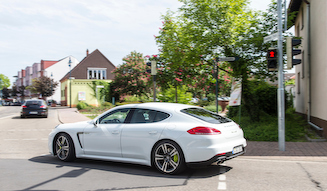
Porsche Panamera S e-hybrid
The Electric Porsche Begins
Shanghai Motor ShowatPorschePanamera Gets First Model ChangeThe Panamera has undergone its first model change. The model drawing attention is the "Panamera S e-Hybrid," which has taken the path of becoming a plug-in hybrid with enhanced eco-performance. This report is from Yasuhiko Kawamura, who attended a workshop explaining the "Panamera S e-Hybrid." What does Porsche consider to be the ideal eco-car?
Text by KAWAMURA Yasuhiko
It Can't Just Be a Plug-in
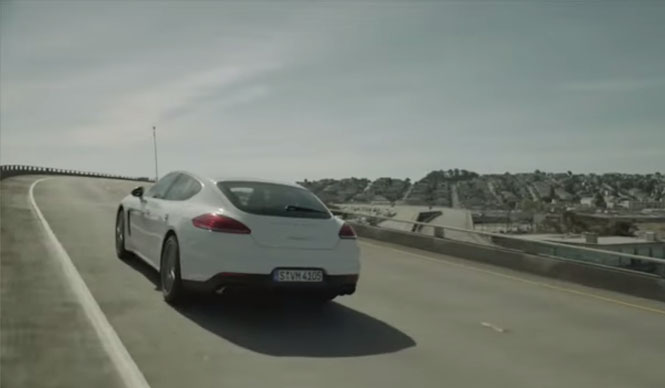
The Panamera, which received a minor model change, was first unveiled at the Shanghai Motor Show held in April.
The major highlights of this refinement include the addition of the "Executive" grade, with extended length and wheelbase to strongly appeal to the growing Chinese market, and the new installation of a twin-turbo 3.0-liter 6-cylinder engine in the S and 4S grades, replacing the previous naturally aspirated 4.8-liter 8-cylinder engine. Alongside these, the plug-in electrification of the hybrid model became a significant topic.
However, as expected from Porsche, a "group of engineers," it's safe to say that the content was not limited to merely "upgrading the existing S Hybrid to support external charging."
In fact, the new system doubles the output of the drive motor and increases the battery capacity by more than five times. All of this is housed within a packaging that is fundamentally unchanged from before.
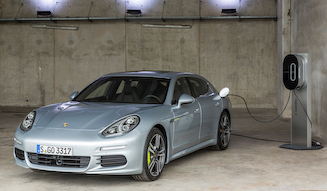
To explore what Porsche's "electrification" entails and how it differs from other brands' approaches, we visited Germany, where a technology workshop was held.
Porsche Panamera S e-Hybrid
The Electric Porsche Begins (2)
Why Hybrid?
Since the release of the first "Prius," Toyota has achieved the remarkable feat of selling over 5 million units worldwide. In Japan's automotive market, hybrid models have long been commonplace, with data showing they account for about 30% of new passenger car sales, excluding minicars (which do not have hybrid variants).
The popularity of hybrid cars is undoubtedly due to both their excellent fuel economy, offering "economy," and their environmentally friendly nature, providing "ecology."
Furthermore, it is a widely shared perception among many Japanese that these "two aspects of eco-performance" can be further enhanced by increasing battery capacity, and ultimately by eliminating the engine altogether to create a pure EV. Nissan's strong promotional activities for the "Leaf," currently the world's best-selling EV that proudly proclaims "zero emissions while driving," likely play a significant role in this perception.
It is undeniable that the new Panamera model, now named "S e-Hybrid" instead of the conventional "S Hybrid" and supporting external charging, has "strengthened its EV elements" as evident from the specifications mentioned earlier.
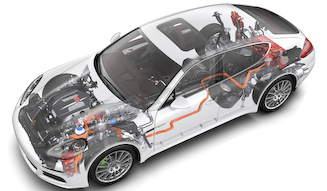
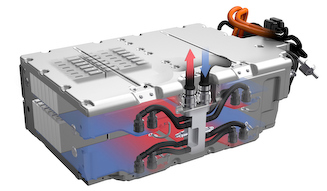
The battery equipped in the Panamera S e-Hybrid
Indeed, the EV driving range, which was said to be about 2 km for the conventional model, has dramatically increased to 36 km in the new model under the latest European fuel consumption measurement mode (NEDC). With a 0-50 km/h acceleration of 6.1 seconds in EV mode and a top speed of 135 km/h, it's fair to say this vehicle possesses capabilities that could be described as "semi-EV."
The Answer Derived from the Indicator 'rpm/km'
Consequently, by "significantly increasing the opportunities to drive without using the engine,"Porschethe new Panamera also shows a significant reduction in the new indicator 'rpm/km' (engine revolutions per kilometer driven), adopted as a new metric to indicate the "lowering of engine revolutions" in line with Porsche's fuel efficiency concept.
On the "Stuttgart Circuit," a 65 km route composed of city, suburban, and autobahn driving used for internal testing at Porsche, the new model achieved 318 rpm/km, compared to the conventional hybrid model's data of 524 rpm/km.
For comparison, the regular "Panamera S" records 1,432 rpm/km, or 1,350 rpm/km with the idling stop function engaged. Furthermore, by extending the coasting distance when the accelerator is released using the transmission's "coasting" function, it's possible to reduce this to 1,239 rpm/km without utilizing the hybrid system.
This demonstrates the fundamental concept that "improved fuel efficiency can be achieved by reducing engine operating time."
In other words, one conclusion is that the plug-in model achieves significantly better fuel efficiency than the conventional hybrid because "the engine operating time has been greatly reduced."
Porsche Panamera S e-Hybrid
The Electric Porsche Begins (3)
Why Isn't Rapid Charging Necessary?
However, after receiving this "classroom learning" at the workshop, what was particularly interesting was that the new Panamera Hybrid deliberately avoided "rapid charging."
On the center console of the new hybrid model, two unfamiliar driving mode selection switches are arranged.
One is the "E-Power" mode, which prioritizes EV driving as long as the battery charge is sufficient. The other is the "E-Charge" mode, which prioritizes charging by replenishing the battery while driving.
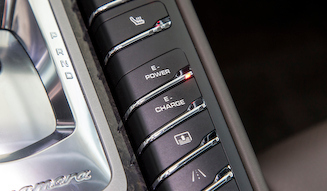
In fact, the EV driving range of 36 km in the new model was determined based on the judgment that "for most people's daily use, 90% of scenarios fall within this range, and considering current battery technology, installing a larger capacity would not be advantageous." Simultaneously,Porschethe development team recognizes the significant effect of EV driving on fuel efficiency, but they do not have the mindset of "forcibly extending" it through rapid charging, which is also a characteristic.
One manifestation of this thinking is the aforementioned "E-Charge" mode. This is intended for use primarily during autobahn driving, where the engine can be operated efficiently.
They explain, "Even if EV driving is desirable after exiting the autobahn, this mode allows for efficient charging in a short time while driving, so there is no need for rapid charging by stopping the car."
Indeed, the highlight of this model is not about extending EV driving distance at all costs. Instead, it's about a more realistic "segregation" where EV driving is reliably performed in areas where emission reduction is truly necessary, such as specific city centers or the "zero-emission zones" being considered in Europe, while efficient hybrid driving is permitted elsewhere.
Porsche Panamera S e-Hybrid
The Electric Porsche Begins (4)
CO2 Emissions from EVs
Fundamentally, even with pure EVs, as long as the electricity charged is generated using thermal power, it cannot achieve "true zero emissions." Moreover, if the goal of CO2 reduction is to mitigate global warming, then "zero emissions while driving" is clearly meaningless.
In fact, I hear that advertising with such claims is prohibited in the UK to avoid misunderstandings. In China, where thermal power generation using low-quality coal is prevalent, there are even reports stating that "hybrid models, rather than pure EVs, not only emit less CO2 but are also more effective in reducing air pollution, which has recently drawn attention with 'PM2.5.'"
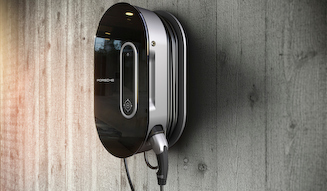
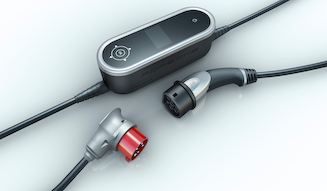
Therefore, except for some regions (and Japan is no longer among them...) where it's possible to charge electricity generated through "zero-emission power sources like wind, hydro, or nuclear power," the current reality is that "there is no CO2 reduction benefit from EV driving through external charging."
Given this, the approach of the new Panamera Hybrid, which supports external charging but deliberately omits the rapid charging system requiring extensive infrastructure development, seems like a "realistic solution for the current era."
Porsche Panamera S e-Hybrid
The Electric Porsche Begins (5)
Experiencing Porsche's Hybrid
Incidentally, the new Panamera model naturally also emphasizes its "Porsche hybrid character."PorscheThis means it pursues not only "economy" and "ecology" but also the high performance characteristic of this brand's creations.
By selecting the "Sport" mode with a switch located separately from the two aforementioned switches on the console, "high performance and more direct handling, unique to Porsche cars," are achieved.
The system output of 416 ps, resulting from the combination of the 3-liter supercharged engine and the new hybrid system, along with a 0-100 km/h acceleration time of 5.5 seconds, significantly surpasses the previous hybrid model's figures of 380 ps and 6.0 seconds, respectively.
During a "co-drive" from the passenger seat, which was offered at the end of the workshop, we were able to experience a part of this high performance.
The test car, with the accelerator pedal pressed deeply, accelerated powerfully to merge onto the autobahn. The sensation was aptly described as "being pressed back into the seat," and the digital speedometer rapidly climbed past "200 km/h."
On the other hand, the smoothness during city and suburban driving, where the engine frequently started and stopped, was also quite remarkable. Although it was a brief experience, it was evident that the refinement was far beyond the level of a test vehicle, feeling like a thoroughly developed "product."
Porsche Panamera S e-Hybrid
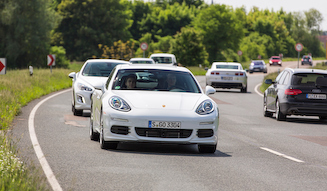
The test car, with the accelerator pedal pressed deeply, accelerated powerfully to merge onto the autobahn. The sensation was aptly described as "being pressed back into the seat," and the digital speedometer rapidly climbed past "200 km/h."
On the other hand, the smoothness during city and suburban driving, where the engine frequently started and stopped, was also quite remarkable. Although it was a brief experience, it was evident that the refinement was far beyond the level of a test vehicle, feeling like a thoroughly developed "product."
Not a Passing Fad
For residents of apartment buildings in particular, how to prepare for external charging equipment may not be an easily solvable problem. Furthermore, given that this model costs over 15 million yen, it is true that it is "a vehicle for only a select few fortunate individuals."
However, at the same time, it is also a "dream Porsche that freely utilizes two power sources," priced at only "a slight 360,000 yen more than the conventional hybrid model."
For Porsche, hybrid models are not just a passing trend; they are certain to become an important variation for the brand as a whole going forward.

Porsche Panamera S e-Hybrid
Body Dimensions | Length 5,015 x Width 1,931 x Height 1,418 mm
Wheelbase | 2,920 mm
Tread Front/Rear | 1,658 / 1,662 mm
Weight | 2,095 kg
Engine | 2,995 cc V6 Direct Injection DOHC Supercharged + Electric Motor
Maximum Engine Output | 245 kW (333 ps) / 5,500-6,500 rpm
Maximum Engine Torque | 440 Nm / 3,000-5250 rpm
Maximum Motor Output | 70 kW (95 ps) / 2,200-2,600 rpm
Maximum Motor Torque | 310 Nm / below 1,700 rpm
System Maximum Output | 306 kW (416 ps) / 5,500 rpm
System Maximum Torque | 590 Nm / 1,250-4,000 rpm
Transmission | 8-speed Automatic (Tiptronic S)
Drivetrain | FR
Tires Front/Rear | 245/50R18 / 275/45R18
0-100 km/h Acceleration | 5.5 seconds
Fuel Consumption (ECE R 101) | 3.1 ℓ/100km
Electricity Consumption | 162 Wh/km
CO2 Emissions | 71 g/km
Electric Motor Range | Approx. 18-36 km
Price | 15,340,000 yen