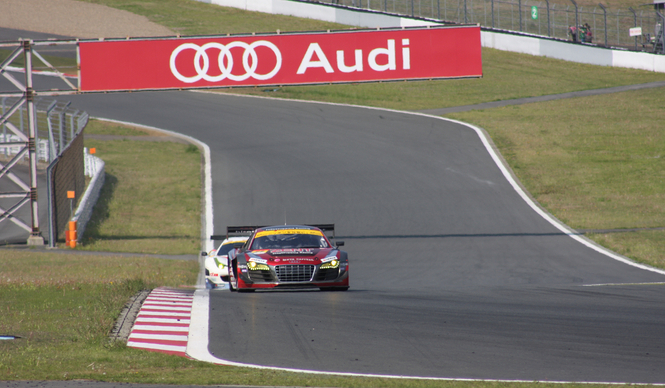
Audi: The Joy of Race Day Spectacles on Your Day Off
Audi Super GT Fuji Round
A Choice for Enjoying Race Spectacles on a Holiday
Audi's Commitment to Racing
Currently, "Super GT," Japan's most popular auto race in terms of spectator numbers. We interviewed two teams that support the "R8 LMS" in this popular race.AudiThere, we witnessed not only team support but also various initiatives by Audi to invigorate motorsports in Japan. The "event" of auto racing is now beginning to change dramatically.
Text & Photographs by OTSUKI Takuma (OPENERS)Photographs by OKADA Kazuyuki (OPENERS)
Two R8s Competing in Japan's Top Race
This is "Super GT," an auto race where closed-body racing cars compete, often called a "box car race."
Similar to Germany's "Deutsche Tourenwagen Masters (DTM)" and the FIA- (Fédération Internationale de l'Automobile) sanctioned "World Touring Car Championship (WTCC)," all competition vehicles are characterized by being based on production cars. In terms of being based on or inspired by production cars, America's "NASCAR" is perhaps a similar existence.
Given the immense popularity of each of the aforementioned races in their respective regions, it's understandable why "Super GT" is so popular in Japan. The fact that cars we see daily or hear about frequently are competing on the circuit might be one element contributing to its popularity.
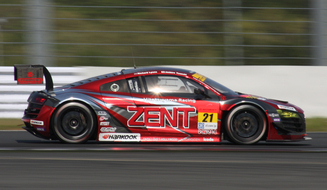
ZENT Audi R8 LMS ultra
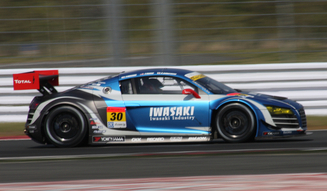
IWASAKI apr R8
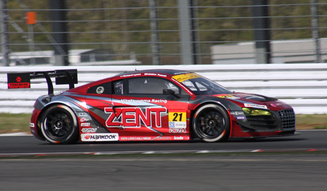
In this race, two Audi "R8 LMS" cars are participating in the "GT300" class from two different teams. These are the "ZENT Audi R8 LMS ultra" from "Team Unayama Racing" with car number 21, and the "IWASAKI apr R8" from "apr" with car number 30.
Team Unayama Racing has introduced the latest 2013 model, which boasts increased combat power from this season. Meanwhile, apr will compete in the 500km race at Fuji with the more refined 2012 model.
The GT300 Class is Further Divided into Two Categories
Super GT is currently broadly divided into the "GT500 Class" and the "GT300 Class." It's a unique "mixed race" where racing cars from two categories with different performance levels run on the same course simultaneously. Even among the top teams, there's a difference of several seconds per lap, leading to a chaotic scramble where GT500 and GT300 cars frequently mix. This is one of the charms of SUPER GT.
Furthermore, in the GT300 class, which has a larger number of entries, there are two different types of racing vehicles entered: those conforming to the "JAF-GT standard" and those conforming to the "FIA-GT standard."
JAF-GT vehicles have a wider range of modification allowances, permitting significant changes to the body and chassis, as well as the use of electronic control systems like "ABS" and "TCS." These are, in essence, "high-tech machines." While their power output is lower than FIA-GT cars, their aggressively designed aerodynamic bodies generate strong downforce, allowing them to achieve higher cornering speeds than FIA-GT cars. They are also known for their fuel efficiency and tire longevity, which reportedly gives them an advantage in longer races due to stable cornering performance towards the end.
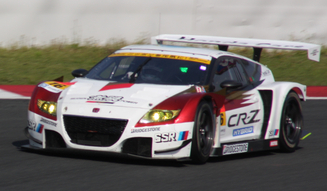
The FIA-GT, as the name suggests, are machines built to the global standards set by the FIA. These have a narrower scope for modification, and substantial changes to the body and chassis are not permitted. Consequently, they often retain a closer resemblance to their original production forms. Some machines achieve engine power figures comparable to the higher-tier GT500 class, overwhelming JAF-GT cars in straight-line speed. However, their aerodynamic performance is somewhat inferior, which can lead to slower cornering speeds. As tire wear directly impacts cornering performance, they tend to struggle in the latter stages of longer races.
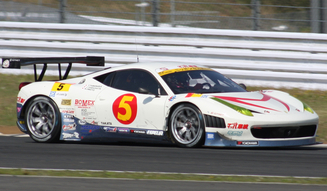
Both Audi R8s participating in the race are FIA-GT vehicles. In this 500km endurance race, attention was focused on how they would compete against the JAF-GT machines, which have an advantage in this format.
Audi Super GT Fuji Round
A Choice for Enjoying Race Spectacles on a Holiday
Audi's Commitment to Racing (2)
Enjoying the Race, But Not Just That
At this Super GT event,Audiprepared an "Audi Hospitality" in the Crystal Room within the pit building, similar to what they did at the "FIA World Endurance Championship (WEC)" held last October.FIA World Endurance Championship (WEC)Audi invited its customers and media to the race. They offered drinks, lunch, and sweets, and also hosted a talk show featuring drivers Yuki Iwasaki and Fairuz Fauzy from "Team apr," who were competing in the final race that day. Even after the race started, services were provided to entertain Audi fans and users, including live commentary and analysis of the race by professional drivers.
The appeal of this program also lies in the valuable experiences it offers. These include "pit tours" of the Audi teams, guided by Audi staff, and the "grid walk" held just before the Super GT final race in the afternoon. Although guided by staff, general visitors are allowed into areas that are normally restricted, offering opportunities for commemorative photos with drivers and direct conversations with team engineers and mechanics.
On this particular day, as a special treat, they even performed an engine start demonstration so close to the machines during the pit tour that participants could almost touch them. The participants were thrilled by the tremendous exhaust note, unlike anything they had heard before, and their reactions, covering their ears and laughing in amazement, were memorable. Incidentally, perhaps for this occasion, Audi had distributed earmuffs to all invited guests in advance. It was truly a service that left nothing to be desired.
At the Super GT Fuji Round, which covers a distance of 500km, comparable to an endurance race, it takes about three hours for the leading cars to cross the finish line in the main event alone. Moreover, the Super GT final race starts late at 2 PM. Many spectators who arrive at Fuji Speedway in the morning will spend approximately nine hours at the circuit, and various efforts are made to keep them entertained throughout this time.
For those who primarily come to the circuit "to watch the race itself," the existence of support races is a welcome addition. Before the Super GT final race, two other races are held: the "GAZOO Racing Netz Cup Vitz Race" and the "Porsche Carrera Cup Japan 2013." These are what are commonly referred to as "under card races."
Including the Super GT free practice and warm-up laps, there are machines running on the course almost all the time. This should satisfy fans who want to "watch many races."
For those who prefer a more casual experience, enjoying auto racing as an "event," the event space set up behind the main grandstand would be a source of enjoyment. This area features a variety of attractions, including a special stage, food stalls offering "B-grade gourmet" foods that are often featured on television, shops selling race merchandise, and booths from various automobile manufacturers. Exploring these would be quite enjoyable. Even for someone unfamiliar with racing, this area alone could likely provide a full day's worth of entertainment.
Audi Super GT Fuji Round
A Choice for Enjoying Race Spectacles on a Holiday
Audi's Commitment to Racing (3)
This Time, the Circuit Becomes a Test Drive Venue
While many manufacturers set up relatively compact booths with temporary tents and stage cars,Audiestablished a remarkably grand and conspicuous booth spanning the entire end of the space, featuring an enormous screen. Inside, they displayed models such as the "R8 GT Spyder" and "RS4 Avant," drawing a crowd.
What was truly astonishing was that behind this booth, they had lined up a fleet of test drive vehicles and were conducting a "test drive event" where attendees could actually drive Audi's lineup on the roads surrounding Fuji Speedway. Following their previous WEC event where they transformed the circuit's event space into a showroom, Audi had now turned the circuit itself into a venue for test drives.
Interest was high, and the limited slots were filled early on. By the time the final race reached its midpoint, a sign indicating that registration had closed was already posted at the reception counter. The Audi representatives were surprised by the unexpectedly strong response. What was interesting to hear was that many families visited, with the wives often showing interest in Audi first and then persuading their husbands to come for a test drive.
A relatively large number of women also found Audis appealing.
Audi's booth, which featured two "R8s" (one being the GT Spyder) among the displayed vehicles that day, consistently attracted many children. Although initially locked, once they were allowed to enter the cars in the afternoon, the sight of children eagerly taking the driver's seats made one think, "Ah, children, then and now, they still love supercars."
Experiences like these in childhood must be incredibly important. These children will surely remember the feeling of sitting in the driver's seat of an Audi R8 on this day. This, in turn, could influence whether they aspire to own cars or desire them as they grow from children to young adults. It becomes one of those "turning points."
Providing opportunities for children to encounter dream cars that inspire them at a young age might actually be quite significant. Perhaps someday, someone might see an Audi driving by in the city and recall, "I remember when I was a child, at the race track with my family..."
Audi Super GT Fuji Round
A Choice for Enjoying Race Spectacles on a Holiday
Audi's Commitment to Racing (4)
Has the Audience Changed? No, the Audience Has Grown.
The first thing you notice upon arriving at the circuit is, as mentioned earlier, the large number of families with children. While there may have been families attending with children in the past, what I've noticed every time I've visited a race circuit for the past few years is the sheer number of children. The event space behind the main grandstand, for instance, is as bustling as an amusement park.
Along with this, the participation of race machines known as "itasha" has become noticeable recently. This generally refers to cars with large depictions of game or anime characters on their bodies. In the context of race machines, these designs often appear when companies that handle those characters, such as game developers, anime production studios, publishers, or agencies, become sponsors.
These machines also attract many fans. However, these fans are somewhat different from the traditional race fans who support machines, manufacturers, or drivers. Yes, they are fans of the game and anime characters depicted on the cars.
These fans also come to the circuit and support the teams. This is an example of successfully acquiring new fans through the efforts of each team.
Among these "itasha teams," some have adopted a system called "individual sponsorship." This is a system where individual fans of a popular character become sponsors supporting the team.
With the slogan "A racing team that runs with its fans," this team competes throughout the season. The affordable price point, starting from 3,000 yen per sponsorship, has enabled them to attract tens of thousands of individual sponsors last season.
By transforming the "team to support" into a "team to fight alongside," the distance between fans and the team shrinks. Their support becomes more passionate, and the joy of victory is amplified. Perhaps due to such fan dedication, this team is actually quite fast. Not only have they won races, but they were also the series champions in the 2011 season. It turns out that even itasha can be incredibly fast these days. This certainly gives fans a reason to cheer.
Traditional motorsports fans continue to visit circuits and enjoy watching races as before. On the other hand, new fans are also coming to the circuit and enjoying races as an "event." Both are valid ways to enjoy motorsports. Both coexist harmoniously at the venue. It's not that the fan base has changed; rather, new fan demographics have "increased" alongside the traditional fans, enjoying races together.
Japan's motorsports scene is gradually regaining its momentum.
Audi Super GT Fuji Round
A Choice for Enjoying Race Spectacles on a Holiday
Audi's Commitment to Racing (5)
Spectacle! Before the Start of the Final Race
After 1 PM, as the start time for the Super GT final race approaches, the atmosphere throughout the circuit begins to change. Photographers in the press room head to their vantage points in preparation, and spectators who were in the event space return to the main stands to witness the start.
It is at this time that the grid walk takes place. Here again,Audiunder the guidance of Audi staff, invited guests are allowed onto the final grid, that is, the main course.
The machines, having completed their warm-up laps and poised for battle. The intense, almost frightening focus of the drivers preparing for the fierce competition. And the radiant smiles of the race queens. The contrast is almost absolute. The tension is palpable, and there is no other way to feel it than by standing in this very spot. There is a certain "barrier" that makes one hesitate for a moment to point a camera at the drivers.