Akihisa Hirata's "amazing flow" and Lexus Design | Lexus
LEXUS DESIGN AMAZING 2013 MILAN
Lexus Enters a New Stage at Milan Salone
An Interview with Architect Akihisa Hirata on "Amazing Flow"
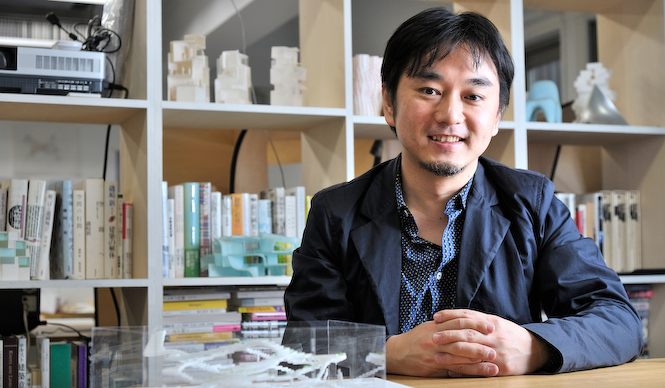
A festival of design, emphasizing concepts and ideas that form the core of design.Milan SaloneLexus returns for the first time in four years. This time, there are no cars on display. Instead,Previewed at TOKYO DESIGNERS WEEKas previewed at TOKYO DESIGNERS WEEK, works by creators selected by Lexus will be exhibited, along with an installation created by young architectAkihisa HirataMr. Hirata. What is Lexus's aim in this? Just before the exhibition in Milan, OPENERS had the opportunity to interview Mr. Hirata at his office.
Text by SUZUKI Fumihiko (OPENERS)Photographs by ABE Masaya & LEXUS
An Idea Centered on Flow
──First, could you tell us about the background leading to the creation of this work?
Lexus RepresentativeWe wanted to express a new brand worldview for Lexus together with creators who resonate with Lexus's philosophy of enriching society through design and who can propose new value in the design field. Mr. Hirata's unique perspective on harmony with nature, and his view that nature and artificial objects are not opposites, resonated with Lexus, leading us to extend this offer.
HirataWhat I found interesting was their statement, "We are not exhibiting cars this time; we want to showcase Lexus's worldview." While improving the design of cars themselves is important, the environment in which cars run, the fact that cars run on roads, and roads are built on natural terrain. I imagined it was an awareness of a broader world and environment connected to cars, rather than just the cars themselves, and I found that interesting.
──It's a basic question, but people can actually walk on this work, can't they?
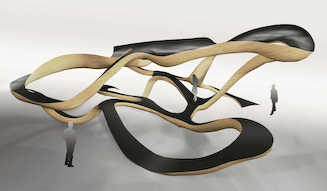
Yes. About 30 percent of the entire space is designed for people to walk on.
I usually approach architecture from a different perspective than cars, but I've always wanted to think about how things connect with their surroundings, or how the environment in which people live changes, rather than just designing buildings in isolation. I thought that if these ideas could connect well with what Lexus is thinking, it would lead to a new kind of exhibition.
The Transformation of Mobility
To put it on a larger scale, I believe the changes in mobility will transform cities.
Essentially, buildings rise vertically, elevators connect vertical spaces, and cars connect horizontal spaces – this is the basic structure of today.
In many cases, accessibility issues dictate the interior spaces of buildings, leading to flat floors, and movement is constrained to flat floors via elevators. While this is unavoidable in current society, it would change if modes of transportation were to change. Perhaps we could move through cities more three-dimensionally.
Regarding cars, I believe we need to consider their relationship with urban infrastructure, the relationship between infrastructure and nature, and the interactive relationship between natural terrain and human-made terrain. If we don't consider these, it won't be interesting, nor will it lead to anything new.

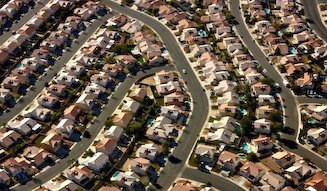
Naturally, roads are built on terrain, but natural terrain is formed by the flow of water. Wind flows over this terrain. If a valley forms, the wind blows along the valley, and water flows there again. The environment is formed by the interaction of various flowing elements.
Human-made structures, such as roofs, are shaped to direct water. From a certain perspective, artificial objects are also part of the system where water and wind flow. Just as fish swim in the sea, cars run on roads. I thought it would be interesting to consider this as part of the interaction of flowing things.
LEXUS DESIGN AMAZING 2013 MILAN
Lexus Enters a New Stage at Milan Salone
An Interview with Architect Akihisa Hirata on "Amazing Flow" (2)
An Organic Network of Three Terrains
For this exhibition, I wanted to create a three-dimensional network of paths within the venue. Normally, paths are created in two dimensions, as I mentioned earlier. But if we imagine three terrains within the venue, let's call them A, B, and C, and then move from terrain A to B, and then to C,──this creates an overpass network of paths. I imagined what such a network of paths, forming the foundation of a city, might look like, and created this work based on that vision.
Since cars cannot drive in the exhibition space, I started thinking about whether people could walk, or if wind and water could flow. Ultimately, I created areas where people could walk and areas where wind was controlled to create flow. Since wind is invisible, there is a space where mist is used to visualize its movement, allowing visitors to feel the wind on their bodies. This might evoke a sense of physical sensation similar to being in a vehicle.
Japanese and Futuristic
──Could you please tell us why you chose wood as the material for this work?
When considering Lexus, the concept of "Japanese-ness" inevitably comes to mind. That is, Lexus's strength lies in being something that originates from Japan but possesses a certain universality as a global standard.
I believe Japan is often perceived in Europe as being about monochrome, minimalism, and simplicity. But isn't there another side to Japan? Rather than a focus on aesthetic form, I think Japan's way of perceiving the world – how flowing things interact, blend, and influence each other – is something that Japan can export as a way of thinking with a certain universality to the world today. There are different facets to Japan, perhaps on the level of having Jomon pottery in addition to Yayoi pottery. Ancient strength is also inherited in Japan's long history, and I believe there is more to Japan than what we typically perceive.
I have a desire to inherit these aspects as a Japanese person, and I hope they will spread to the world, bringing with them a different kind of value.
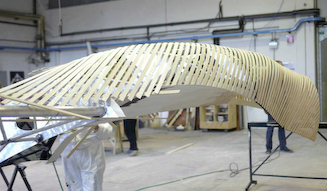
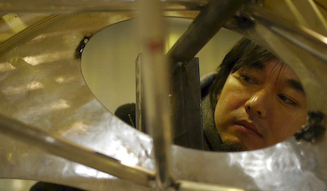
When we think of the futuristic, things tend to be smooth and shiny. But aren't such things unappealing? If the future is built solely on the "futuristic," I fear it will be a very dull future. Therefore, I want to create something that combines a seemingly new concept with something ancient and familiar, like wood, which is simple and feels pleasant to the touch.
For this project, I'm working at a factory in Venice that builds boat hulls. I wanted to bring in the sense of meticulous craftsmanship and hand-making that exists in such places.
When crafting a car, I believe there are issues concerning how to create parts that come into contact with the human body, and what materials to use and how.
Today, when we create a shape on a computer, we can print it out in 3D using a 3D printer. In the near future, such technologies will undoubtedly advance further. However, printed objects are made of a single material, simply replicating the shape from the computer, without incorporating the process or meaning of creation.
However, in cases like this project, the process of considering how to use the materials, along with information about the technology and where it was made, is incorporated into the object itself.
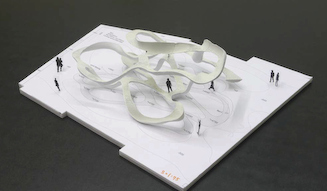
I believe the accumulation of such elements enriches our cities, homes, and living spaces.
While I wasn't overly focused on the material this time, I've taken care to create something that is simple yet profound, appeals to the senses, and carries various layers of information.
LEXUS DESIGN AMAZING 2013 MILAN
Lexus Enters a New Stage at Milan Salone
An Interview with Architect Akihisa Hirata on "Amazing Flow" (3)
Intertwining Potential
──Could you tell us about the "futuristic" elements incorporated into this work?
Natural objects are not created with a single purpose. Their characteristic is that we don't know why they took on their current form.
An object appears poor the moment its purpose becomes clear. I call this "intertwining potential" – I want to create opportunities for human activities and various events to become entangled with the surroundings. Once completed and its purpose is understood, it doesn't invite other uses or ways of engagement. Therefore, I believe that enigmatic objects with potential are desirable.
On the other hand, when a network of paths is created as a structure, it must be meticulously crafted not just as an abstract concept, but as a tangible object. It must be structurally self-supporting, and it must allow people to walk and wind to pass through. While the rules are not overly strict, I am creating the form within several constraints.
Once a basic form is established, I then create countless variations of it within the computer while maintaining that basic form, and compare them.
Using a method called a genetic algorithm, I repeat the process of selecting the structurally stronger variations, thereby eliminating the weaker ones. Although the forms are almost identical, a slight difference can make one structurally much stronger.
Therefore, while not starting from a predetermined purpose, I believe that the method of modifying the initial creation from different angles to give it a certain rationality is an organic approach to creating something that can be explained from any starting point, yet cannot be pinned down to a single origin.
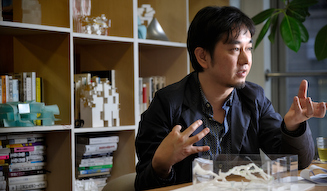
Rather than simply creating organic forms expressively, the form also signifies other things. For example, structural strength, efficient wind flow, or ease of pedestrian movement.──I am creating something where these aspects are simultaneously present.
The Role of Design
──What do you consider to be the shared worldview between this work and Lexus?
Lexus RepresentativeLexus continuously evolves in a more progressive and emotional manner, consistently exceeding customer expectations and delivering moving experiences. Based on Lexus's brand concept of proposing "AMAZING" that brings inspiration to people's lifestyles, this exhibition offers experiences filled with wonder and emotion beyond car design.
HirataSpecifically, Lexus requested that I create something that emerged from discussions with architect Toyo Ito, who is supervising this exhibition, "-amazing flow-".
At that time, the elements that were decided upon included creating something vibrant, rather than a monochrome Japan (though my personal biases are quite strong here), an exhibition that engages the senses beyond sight, and expressing things akin to natural states, such as the flow of wind and water.
Furthermore, hearing about Lexus's philosophy regarding meticulous craftsmanship was significant. In recent models, the grille has become larger to consider airflow. The same grille achieves two types of solutions for airflow. While it might seem like a grille whose form is determined by a single reason, it's not.
Also, the sensation of cutting through the wind as you drive. This work translates those elements into a different form, not a car, essentially turning Lexus's front and back inside out and expanding it.
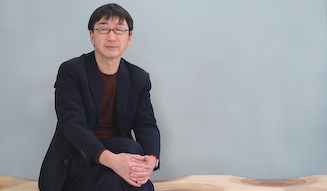

Design is no longer about adding value to basic forms like televisions. It's about how to give visible form to existing technology. The job of design is to create the archetype.
Therefore, we must consider technology, the overall perspective, the city, and the environment together. Is the purpose of architecture solely to create individual buildings? Isn't there a role for architects beyond that? The entire architectural world is rethinking these questions. In such times, I find Lexus's current stance relatable and interesting. I believe so.
And since Lexus is a global company, it has the potential to change real landscapes. Without a sense of urgency that it might truly change our lives, it risks becoming mere decoration. I believe that this strength, this Japanese approach on a global standard, will determine whether it gains traction worldwide.