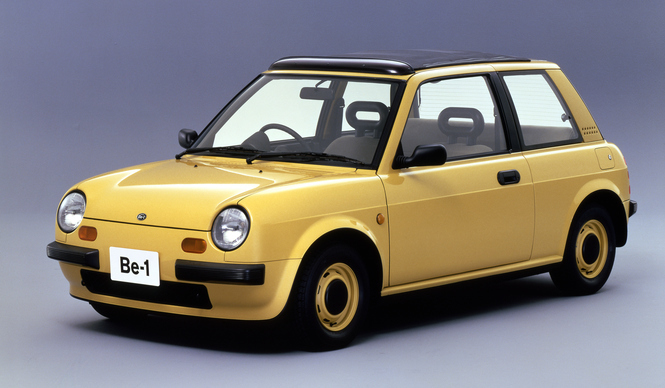
The Untold Story of Nissan's Pike Cars: The Birth of the Be-1, Part 2 | NISSAN
NISSAN Be-1 | Nissan Be-1
The Untold Story of the Nissan Pike Car Be-1: Part 2
And Thus, a Masterpiece Was Born
1985, Tokyo Motor Show. In the centenary year of the automobile's invention, a small, yellow concept car appeared. This was the "Be-1," a masterpiece that would later cause a social phenomenon. We spoke with those who dedicated themselves to its creation, overcoming numerous hardships, to hear the untold story of its birth.
Text by OGAWA Fumio
 To the Untold Story of the Nissan Pike Car Production: Part 1
Consensus Was Hard to Come By
Naoki Sakai (Sakai)Last time, we discussed the process of getting the "Be-1" approved for release within Nissan Motor Corporation.
Jun Shimizu (Shimizu)Then, Nissan's then-Vice President of S gave us positive feedback regarding production. However, to bring it to market, we also needed to gauge market reaction. Mr. Sakai, you proposed various ideas, like building a prototype and displaying it on the streets of Harajuku.
SakaiMy thinking was that for a new car, it was important to present it in a new way.
ShimizuThe usual route would be the Tokyo Motor Show, held in odd-numbered years. Since the 1985 show was in late October, we had to get company approval by August. So, we quickly decided to build a prototype based on the March. We removed the body panels and covered it with plastic.
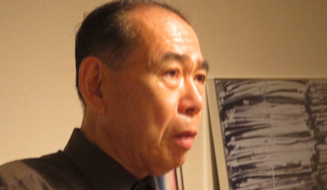
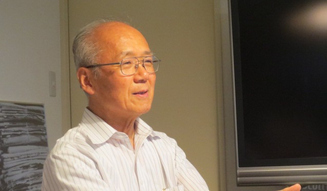
Jun Shimizu
Akira Yamamoto (Yamamoto)Nissan Motor Corporation's slogan was "Technology Nissan," but the then-Vice President's new policy was to also demonstrate excellence in design. The Be-1 was supposed to align with that idea, but we struggled to gain internal consensus for its production.
ShimizuAnother challenge we faced was design control. What I mean is, once we handed over our initial design drafts for the Be-1 to Nissan's professional car designers, they began to steer it in a direction quite different from what Mr. Sakai and I had envisioned.
SakaiI had a clear image of the final form in my mind, but my approach has always been not to interfere midway. Once I entrust something, I observe its progress. That's still my way. However, thanks to Mr. Shimizu's careful attention, it progressed in a very positive direction.
NISSAN Be-1 | Nissan Be-1
The Untold Story of the Nissan Pike Car Be-1: Part 2
And Thus, a Masterpiece Was Born (2)
The Inspiration Behind It Was That Famous Car
ShimizuFrankly, the British "Mini" was the inspiration behind the Be-1.
SakaiIn the fashion world where I was working at the time, trend-conscious people were buying and driving used Minis. Seeing that, I thought a wave like this was coming.
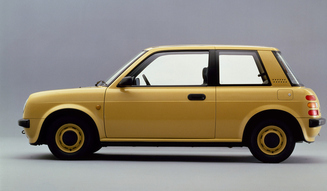
ShimizuHowever, that doesn't mean we could just easily create a car that looked like it. For example, what I particularly emphasized with the Be-1 was the headlights. Both their shape and diameter required immense attention to detail. They drastically change the car's impression.
YamamotoIt received an overwhelmingly positive reception at the Motor Show, and suddenly, the company wanted to know if we could release it within a year. I was beyond surprised; I found it laughable.
SakaiI believe that's what it means to read the zeitgeist, which also applies to fashion. Car designers at the time thought imitation was defeat. But retro was a new sensibility that was being sought in design.
ShimizuAfter the Be-1 was announced, Simon Le Bon of the then-hugely popular British rock band Duran Duran contacted Nissan, saying he desperately wanted to acquire one. It proved how correct Mr. Sakai's intuition was.
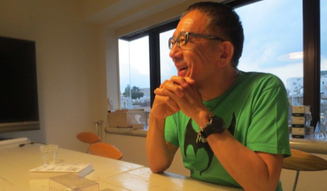
SakaiWe received criticism, with some saying, "This isn't a car." But just as the first "iMac" was successful, there are many things that appeal to the general public even if professionals dislike them. At the Tokyo Motor Show, it felt like people were only gathering in front of the Be-1. People don't want to evaluate things they don't understand, but perhaps you can't achieve a hit without overcoming that hurdle.
NISSAN Be-1 | Nissan Be-1
The Untold Story of the Nissan Pike Car Be-1: Part 2
And Thus, a Masterpiece Was Born (3)
The Real Reason for Limited Production
YamamotoAfter receiving such a great response at the 1985 Tokyo Motor Show, there was a strong internal push to release it a year later. So, limited production seemed feasible. At the time, even with a base car, mass-producing exterior steel panels and interior parts would take nearly two years. The production team explored various methods for small-batch production, concluding that by using plastic materials, they could produce around 10,000 units within a year.
SakaiThat was the real reason for the limited production of 10,000 units, wasn't it?
ShimizuIdeally, we should have used the production line at Nissan's Oppama plant in Kanagawa Prefecture, but it didn't align with the production schedule. So, we decided to outsource production to Takada Kogyo, which could handle small-batch production, including manual labor.
YamamotoThe engineering with flexible panels and ABS synthetic resin outer panels also became a topic of discussion, but in reality, production issues like preparation time were significant.
ShimizuWhat I remember most is how the Be-1 changed the perception within Nissan. Designers were previously seen as mere "artists" who handled car styling, but the Be-1 established that designers are those who "create the meaning of a car."
SakaiDesigners are actually better at observing the market.
YamamotoThe pricing process was also interesting. The sales department determines the price, but they carefully reviewed each item, comparing it with vehicles like the March and Mini. Ultimately, the base price was set just under 1.3 million yen. Personally, I thought it was cheap, but the Vice President of S, who was listening, said, "Listen, you guys, people who buy cars like this don't fuss too much about the price. They'd pay 1.8 million yen." It was an eye-opening moment, realizing that was how it worked.
ShimizuAfter the Be-1 was announced, I became the head of Nissan's design division, overseeing all design. What was fascinating was that Toyota Motor Corporation's design department contacted us repeatedly. They seemed very interested in the Be-1's success. It was a car that even Toyota respected. We even held social gatherings between the design departments of Toyota and Nissan. I was impressed by Toyota's approach; they asked us about the challenges we faced during development, showing a willingness to openly communicate with rivals in pursuit of a similar hit.
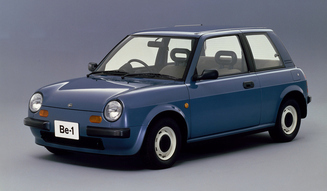
SakaiThe Be-1 was named a "Pike car," and "playing with design" was recognized within Nissan Motor Corporation.
And so, plans for a second model quickly emerged. I was also asked to lead that project.
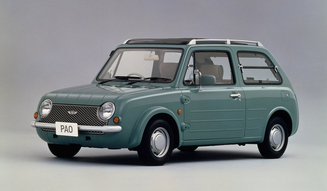
The result was the "PAO."
To be continued—
SAKAI Naoki(Sakai Naoki)
Currently a director at Water Design and a professor at Keio University Shonan Fujisawa Campus. In the 1960s, he moved to the US and established a fashion business in San Francisco. While his starting point was textile design, after the Be-1 project, he became broadly involved in product design.
SHIMIZU Jun(Shimizu Jun)
Joined Nissan Motor Corporation in 1962. At the time, there was no design department, but in the modeling section, he was responsible for the first-generation "Sunny." He also worked on the design of the "Cedric/Gloria 230" (1971-75), which surpassed the Toyota "Crown" in sales. During his tenure as Head of Design, he oversaw the design division for eight years and was responsible for the design of all models.
YAMAMOTO Akira(Yamamoto Akira)
Joined Nissan Motor Corporation in 1962. After working in the design and development department, focusing on suspension and body design, he moved into technology development planning and product planning. During this time, he worked on models such as the "Fairlady Z" (Z32) (released in '89) and the highly successful "Silvia" (S13) (released in '88). He later held positions such as head of the Product Planning Office and head of the Electronic Technology Division.