The Future of Mercedes Design | Mercedes-Benz
Mercedes-Benz TecDay Intelligent Drive|
Mercedes-Benz TecDay Intelligent Drive
The Future of Mercedes Design
Tatsuya Otani attended Mercedes-Benz's TecDay Intelligent Drive event. The event itself focused on the upcoming 2013 model,New S-Classof theLecture on Safety Featuresbut it also offered a preview of future Mercedes-Benz models' design. This first report delves into Mercedes design, past and future.
Text by OTANI Tatsuya
From "E" to "CLS"
Have you noticed that Mercedes-Benz design is changing?
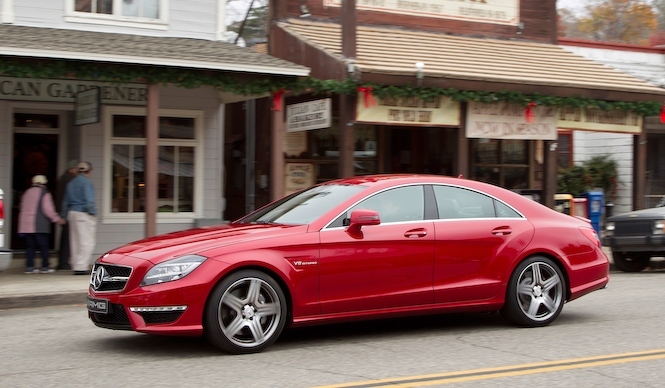
Signs of this change can be seen in the four-door coupeCLS, and its derivative model,CLS Shooting Brake.
The Mercedes-Benz model positioned similarly to the CLS is theE-Class Sedan, but while the current E-Class has a linear and sharp impression, the CLS is composed of more elegant and rounded lines. Along with these directional differences, the overall sense of unity and consistency that runs through the exterior design is noteworthy.
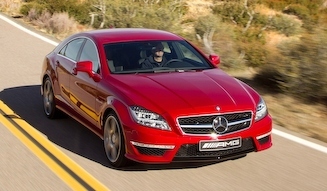
Mercedes-Benz CLS 63 AMG
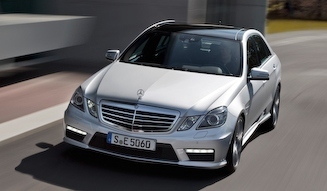
Mercedes-Benz E-class
Elements common to both the E-Class and CLS include the powerful shoulder line, the kick-up line surrounding the rear fender, and the lines flowing from both ends of the front grille towards the windshield over the hood.
However, when comparing the two, the CLS, where one line connects to the next in exquisite balance, feels more cohesive than the E-Class, where individual design elements seem to stand out. Simply put, the CLS has a more unified and well-integrated design. This, above all, speaks to the skill of the designers responsible for each model.
Mercedes-Benz TecDay Intelligent Drive|
Mercedes-Benz TecDay Intelligent Drive
The Future of Mercedes Design (2)
The End of the Wedge Shape
There is another crucial difference between the E-Class and CLS: their proportions.
The E-Class has a proportion where the lines forming the entire body rise linearly from the front grille to the rear end. This is the so-called wedge shape. It has been about 30 years since the wedge shape became the mainstream in automotive design. In other words, the E-Class adopts a philosophy that aligns with the conservative mainstream of automotive design.
In contrast, the CLS's proportions show an upward trend from the front grille to the midpoint of the body, after which they gently descend. This concept is more clearly expressed in the CLS Shooting Brake. The design, where not only the roofline but the entire window graphic slopes downwards towards the rear, is unusual today. This is further emphasized by the almond-shaped taillights and the compact tailgate positioned low. It is clear that the designer intended a "downward-sloping rear" design.
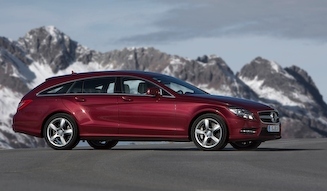
Mercedes-Benz CLS Shooting Brake
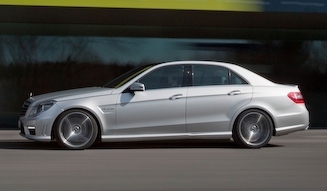
Mercedes-Benz E-class
There are several reasons why the wedge shape has been mainstream. A low front and high rear give the impression that the car is about to surge forward even when stationary, creating a sense of dynamism. Furthermore, a higher rear end is convenient for increasing rear headroom and luggage space. It was also thought that the wedge shape, with its sharper image of cutting through the air, could reduce air resistance.
Considering these factors, a "downward-sloping rear" design seems to have many disadvantages. The most significant drawback was the "lack of dynamism." In fact, "downward-sloping rear" designs have historically been associated with cars that don't look like they'd move well, and few have become hits. The Jaguar saloon might be an exception.
Despite this, the CLS boldly adopts this "downward-sloping rear" proportion and succeeds. In fact, the previous generation CLS was already slightly "downward-sloping," but the new model seems to consciously emphasize this even more. So, who brought this proportion to Mercedes and refined it into a "beautiful design"?
I suspect Gordon Wagener, who became Chief Design Officer at Mercedes in 2008, is the mastermind behind it.
Mercedes-Benz TecDay Intelligent Drive|
Mercedes-Benz TecDay Intelligent Drive
The Future of Mercedes Design (3)
From the 540K Sports Car
This preamble has been long, but I recently attended an event called TecDay Intelligent Drive, held near Mercedes-Benz's headquarters in Stuttgart. In a nutshell, it was an event to introduce theNext-Generation S-Class Safety Featuresscheduled for debut in early 2013, and to hint at its design direction. I will cover its advanced safety features in a separate report; here, I will focus on the design.
The design of the next-generation S-Class was also presented at the2012 Paris Motor Showunder the title"Aesthetics S", where three-dimensional reliefs were used to express the roofline and character lines on the body side. At TecDay, however, Wagener alone presented the history, philosophy, and future direction of Mercedes design.
In fact,The Debut of the Current E-Classat a TecDay just before the debut of the current E-Class, we were treated to a highly confidential 3D CG rendering of the design. Compared to that, this presentation, which didn't reveal concrete shapes, perhaps stimulated the imagination even more. Conversely, it means the presentation was that rich and substantial.
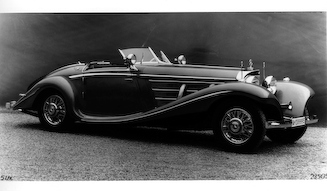
One of the images Wagener showed at the beginning of his presentation was a large 1930s sports car named the Mercedes-Benz "540K." At that moment, I instantly understood why Wagener adopted the downward-sloping rear design for the CLS.
Many luxury cars from before and shortly after World War II featured a downward-sloping rear design similar to the 540K. It was, in a sense, a symbol of elegance. However, as time progressed through the 1950s, 60s, and 70s, that elegance was forgotten, and the more aggressive and modern wedge shape became mainstream.
Mercedes-Benz TecDay Intelligent Drive|
Mercedes-Benz TecDay Intelligent Drive
The Future of Mercedes Design (4)
Turning Away from Trends
If this is the case, then what Wagener, who leads Mercedes design, is aiming for is a departure from these automotive design trends, a grand challenge. Of course, a less skilled designer would not be able to gain widespread empathy even if they tackled this theme.
Creating a design that is genuinely beautiful while turning away from current trends requires considerable skill. Wagener is likely blessed with the abundant talent needed to confront this difficult task. This is evident in the CLS and CLS Shooting Brake.
Another point Wagener emphasized was design consistency within the brand. During the tenure of his predecessor, Peter Pfeiffer, Mercedes' design lacked clear consistency. The previous generationS-Class, the E-Class, and theC-Classhad a loose commonality in their generally soft lines, but the assertion of being products of the same brand was not strong. Wagener explained this as "respecting the individuality of the designers responsible for each model," but he himself stated that he would emphasize design consistency across the entire brand going forward.
However, enforcing design uniformity while ignoring the character and positioning of individual models is somewhat impractical. In reality, the current Mercedes lineup is so diverse that a single design cannot possibly cover it all. Therefore, Wagener has devised a concept to establish design themes for sedans, sports models, and compact models, and to determine the design of each model based on its distance from these three elements.
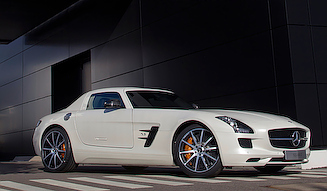
Mercedes-Benz SLS AMG
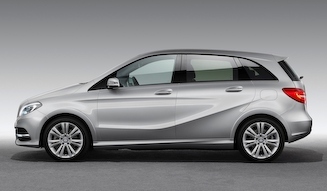
Mercedes-Benz B-class
According to this, the character line on the body side for sedans would be a combination of an upper horizontal line and a lower rising line; for sports models, a single upper horizontal line extending long; and for compact models, two lines: an upper line that slopes slightly downward towards the rear and a lower line that clearly rises from the midpoint. If we apply theSLS AMGandB-Class, this can be well understood.
So, what about the next-generation S-Class? Since it is naturally a sedan type, it will likely have a two-line configuration similar to the CLS. However, as seen in "Aesthetics S," the two character lines flowing along the body side are expected to be even more powerful and refined than those on the CLS. How these will harmonize with the roofline and window graphics will also be a major point of interest.
Frankly, recent Mercedes designs have felt somewhat behind Audi and BMW in terms of completeness and uniqueness. However, with Wagener's arrival, Mercedes is poised for significant change. We can expect Wagener to achieve success comparable to Bruno Sacco, his predecessor, who brought innovation to Mercedes design.