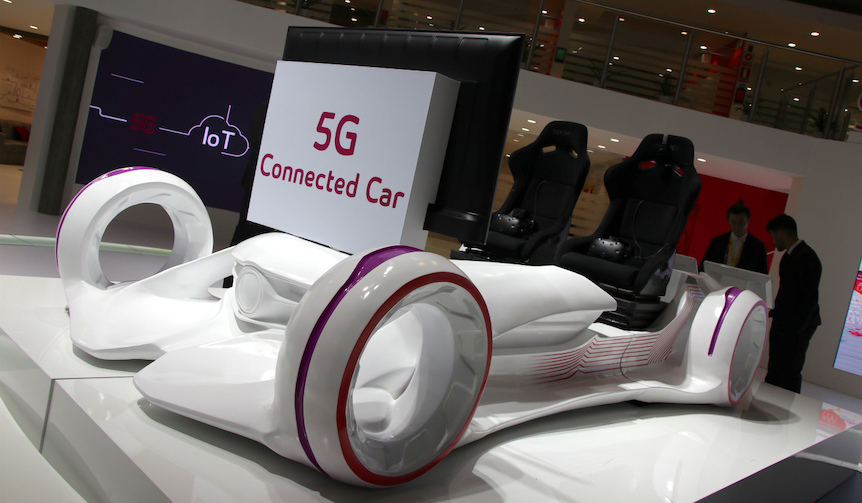
Human Pilots vs. Robot Cars: Is the Day of Battle Near? | MOBILE WORLD CONGRESS 2018
MOBILE WORLD CONGRESS 2018 | MOBILE WORLD CONGRESS 2018
Human Pilots vs. Robot Cars: Is the Day of Battle Near?
From February 26 to March 1 this year, the international electronics show "Mobile World Congress (MWC)" was held in Barcelona, Spain. While many infrastructure devices related to 5G communication were introduced, as it is organized by a telecommunications carriers' association, exhibits of mobility such as sky taxis and fully autonomous vehicles were also prominent. The collaboration between mobile IT and the automotive industry is progressing, and MWC seems to be increasing its presence as a venue for showcasing advanced technologies.
Photographs & Text by Akio Lorenzo OYA
Exploring "CASE"
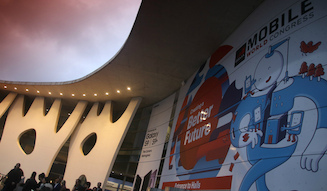
The international electronics show "Mobile World Congress (MWC)" was held in Barcelona, Spain, from February 26 to March 1, 2018. Over 2,300 companies and organizations from around the world participated, with more than 100,000 visitors.
In the electronics field, "CES" is famous, held annually in Las Vegas, USA. As its former name, "Consumer Electronics Show," suggests, it primarily focuses on home appliances and consumer AV equipment.
In contrast, MWC is primarily focused on mobile-related technologies, as it is organized by the "GSM Association," an organization of mobile carriers. This year, many infrastructure devices related to 5G communication, for which services are finally set to begin in some countries from 2019, were showcased.
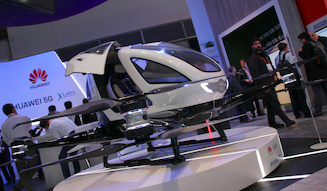
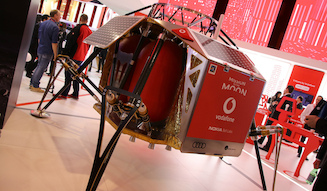
In recent years, a common exhibit at both events has been sky taxis, which can be seen as an extension of drones. At this MWC, Huawei, along with a startup company, exhibited its prototype. Incidentally, the Dubai's Roads and Transport Authority, which welcomes sky taxi trials, has declared its intention to "switch a quarter of transportation to unmanned aerial vehicles by 2023."
Another sector that spans both events is "automobiles." With the rapid advancement of CASE (Connected, Autonomous, Shared, Electric) technologies, car brands and related manufacturers have increasingly chosen CES and MWC as stages to showcase their advanced technologies. As the appeal of traditional motor shows has declined, these events have become suitable alternatives.
Meanwhile, mobile IT companies have also begun to make proactive approaches to explore collaborations with the automotive industry. Consequently, this MWC also resulted in the display of numerous automotive-related technologies.
MOBILE WORLD CONGRESS 2018 | MOBILE WORLD CONGRESS 2018
Human Pilots vs. Robot Cars: Is the Day of Battle Near? (2)
Mercedes Proposes "Sharing"
BMW unveiled its concept for a fully autonomous vehicle and conducted test drives outdoors. The vehicle, designed for "Autonomous Driving Level 5" as defined by the US organization SAE, was based on the "i3".
When I operated the digital key using a smartphone app at the venue, the car arrived autonomously at the designated parking area. It likely recognized my MWC NFC pass, as the welcome message, along with my name, was displayed on the rear quarter window.
Although a staff member accompanied me in the passenger seat, the driver's seat remained empty. When I pressed the start button on the display in the rear seat, the concept car quietly began to move, skillfully maneuvering the steering wheel as it completed laps within the field.
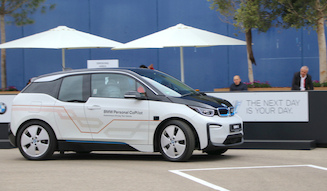
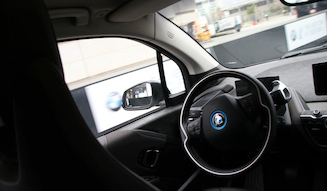
According to the staff, the onboard computer consumes 600W of power, placing a minimal load on the battery. Judging from its smooth acceleration, deceleration, and handling, it seems highly likely that this technology could be practically implemented in limited areas in the near future.
Daimler, on the other hand, exhibited the new Mercedes-Benz "A-Class," which was just announced in early February. At the same conference, they unveiled "Private Car Sharing," a new service for the first time globally. This service allows the new A-Class to be "shared" within a specific group, such as family or friends.
The owner selects individuals to share with via the dedicated "Mercedes Me" application. When family or friends wish to use the A-Class, they send a request through the same "Mercedes Me" app. Once the owner approves the loan, the borrower can unlock the doors via the app. This is made possible by the "Digital Vehicle Key" and "Built-in NFC Sticker" equipped in the new A-Class for the German market.
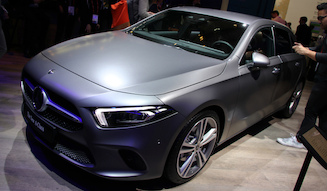
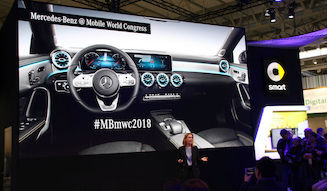
The borrower uses the key located in the glove compartment to start the engine. After use, they leave the key inside the car and lock it again via the app. The efforts of German automotive brands towards a sharing society continue to accelerate at a pace beyond our imagination.
Meanwhile, how are startups approaching the automotive industry? Azavi, a company based in Ireland, provided an example. While primarily specializing in IoT-based security, the company is also looking to enter the connected car security sector.
According to the staff, the product is currently being tested in rally competitions. This provides an excellent opportunity to expose the product to harsh weather conditions and vibrations.
Thinking back, the 24 Hours of Le Mans race, when it began in 1923, aimed to improve the quality of the then-rudimentary electrical systems. Even as technology evolves, motorsport remains the ultimate test bench for reliability.
MOBILE WORLD CONGRESS 2018 | MOBILE WORLD CONGRESS 2018
Human Pilots vs. Robot Cars: Is the Day of Battle Near? (3)
More Intelligent Than Talented
As the event name includes "Congress," various lectures were also held. On the second day of the event, Fernando Alonso, a two-time F1 World Champion who has also competed in the Indy 500 and the 24 Hours of Daytona, made an appearance.
Alonso explained that all aspects of F1 today are based on computer data, from engineer testing and simulations to analysis of race-day weather and second-by-second driving data feedback. He also cited the benefit of constant connection with fans through the development of networks.
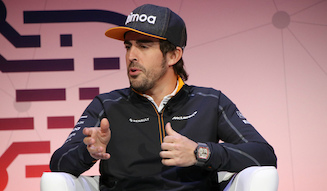
Zak Brown, Executive Director of McLaren, who also spoke, stated, "Today's F1 drivers are required to be more intelligent than talented."
As racing machines become increasingly computerized, what will be the role of the driver?
Thinking back,CES in Januaryfeatured NVIDIA, a semiconductor memory company, exhibiting an unmanned machine for "Roborace" at its booth. The day when we can watch races between human pilots and autonomous machines, much like computer matches in Shogi or Chess, may not be far in the future.