The Day Driving Becomes a 'Game' | CES 2018
CES 2018: The Cars
The Day Driving Becomes a 'Game'
CES (Consumer Electronics Show) was held again in Las Vegas. Akio Oya, who visited the event, reports on the trends focusing on automotive innovations.
Photographs & Text by Akio Lorenzo OYA
Cars Are Now 'Smartphones on Wheels'
The world's largest electronics trade show,CESwas held in Las Vegas, USA, in January 2018.
Autonomous vehicles, the stars of recent shows, have moved beyond being mere objects to observe and are now meant to be ridden in.
Parts supplier Aptiv, in collaboration with ride-sharing giant Lyft, actually operated autonomous taxis between the convention center and the city. Rides were free, and reservations were made through the usual Lyft app.
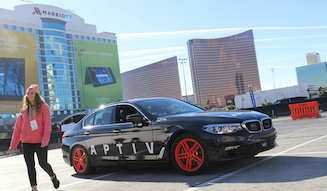
Aptiv × Lyft : Self-Driving BMW
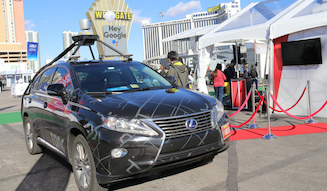
Torc Robotics
Several other suppliers offered similar ride services. Even for those not offering test rides, autonomous vehicles were frequently spotted driving around the streets of Las Vegas during the show as part of demonstrations.
Most automotive exhibits aligned with the CASE trend (Connectivity, Autonomous driving, Sharing, and Electrification).
The integration of AI assistants, exemplified by Amazon's 'Alexa,' into vehicles is rapidly advancing.
Several companies also presented systems using biometric data such as facial or iris recognition, and payment systems that use the car itself as a 'wallet' at various locations.
Furthermore, Denso proposed a large-scale network connecting traffic information, traffic signal control, and actual moving vehicles.
Cars are connecting with people, receiving information from external sources, and transmitting their own data.
It's no exaggeration to say that cars are becoming smartphones that can drive themselves.
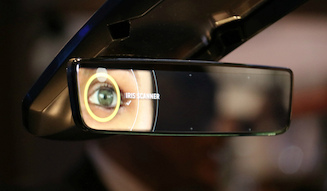
GENTEX Iris identification system
CES 2018: The Cars
The Day Driving Becomes a 'Game' (Part 2)
In the Shadow of New Tesla Killers
Japanese automakers Toyota, Nissan, and Honda all had booths.
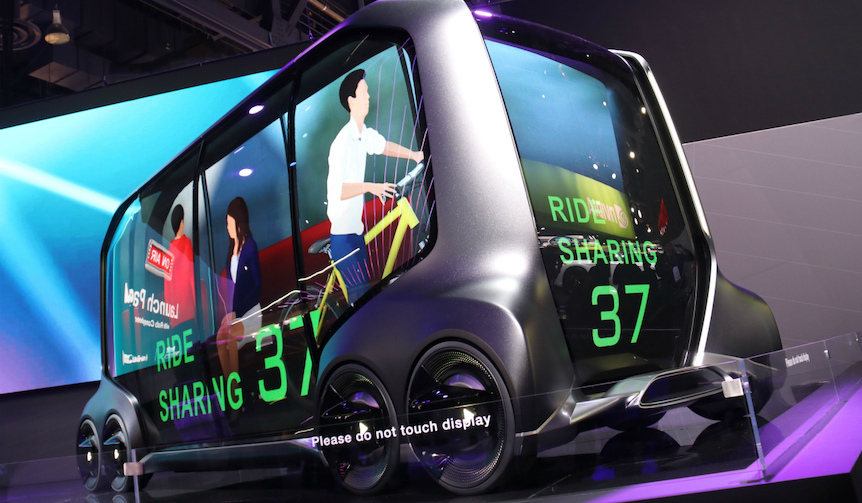
Toyota's 'e-Palette Concept' is a commercial EV for autonomous driving.
The manufacturer defines it as 'an open and flexible platform that supports a wide range of applications, from ride-sharing, logistics, and transportation to retail, hotels, and personal services.'
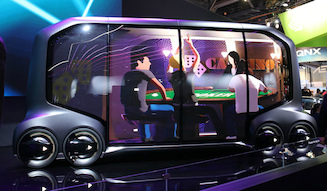
Toyota e-Palette Concept
As a first step toward realizing this, they announced alliances with Amazon, Mazda, ride-sharing services Didi and Uber, and Pizza Hut.
Nissan showcased technology that detects human brainwaves to instantly control vehicle behavior. Honda demonstrated the '3E-A18' robot that communicates with people, the '3E-C18' robot that evolves through interaction with people, and the '3E-D18' robot that can be used for tasks like firefighting by swapping attachments.
Meanwhile, at CES, electric vehicle concept cars from startups have annually generated buzz as potential 'Tesla killers.' This year's star was an EV with autonomous driving capabilities from BYTON.
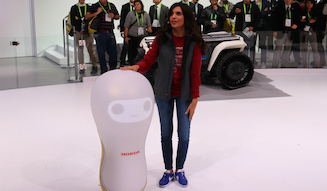
Honda 3E-A18
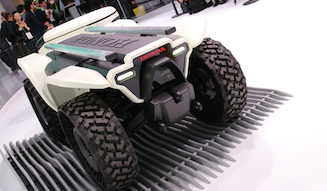
Honda 3E-D18
This emerging brand, headquartered in Nanjing, China, boasts six global locations, including Santa Clara, USA, and Munich, Germany. Both its chairman and president are former BMW executives.
The Vice President of Design, Benoit Jacob, also began his career at Renault and led the design of the BMW i3 and i8. Investors include the major Chinese luxury import car dealer Harmony Auto and the Jiangsu Provincial Industrial Investment Fund.
Like many recent autonomous concept cars, the BYTON dashboard is dominated by a nearly full-width display measuring 125 x 25 cm. Furthermore, there's a display in the center of the steering wheel. However, according to Jacob himself, it also houses an airbag, ensuring sufficient crash safety.
BYTON set up an outdoor booth separate from its indoor display, offering rides to visitors and demonstrating their seriousness. Production is planned at their Nanjing factory, with prices starting at $45,000 (approximately 5 million yen). They aim for a launch in China in 2019 and in Europe in 2020.
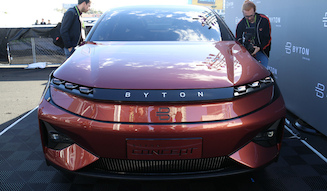
BYTON SUV concept
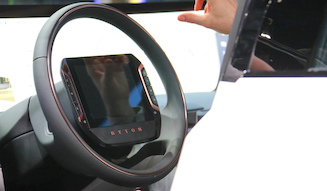
BYTON SUV concept
Meanwhile, Faraday Future, which garnered attention in 2016-2017 with its successive autonomous EV concepts, touted as potential rivals to Tesla, was absent this year. This brand, backed by Beijing-based LeEco, announced the construction of a factory in North Las Vegas last year, but the plan remains suspended due to a lack of funding.
Brands that had set up elaborate booths comparable to major manufacturers simply vanished like a mirage. This is a phenomenon not seen at traditional auto shows.
CES 2018: The Cars
The Day Driving Becomes a 'Game' (Part 3)
A Great Wave of Change for the World's Oldest Brand
While the currently popular semiconductor company NVIDIA demonstrated autonomous driving with Audi last year, this year they announced they would provide AI to Volkswagen and the ride-sharing service Uber.
NVIDIA also displayed a car from the "Roborace" series, an autonomous racing series they partner with, as an eye-catcher. CEO Jen-Hsun Huang and race car designer Daniel Simon posed for photographers. Roborace is set to accelerate its full-scale testing this year.
The style of manual driving in autonomous vehicles may also change.
This was foreshadowed by the "Surfing Car" concept cockpit developed by Body Control Systems in collaboration with a Silicon Valley company. Driving is controlled not by a steering wheel, but by controllers with sensors extending from the driver's left and right.
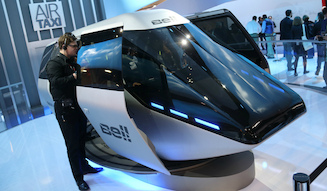
Bell Helicopter Air Taxi
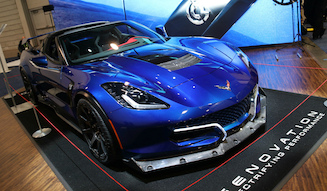
Genovation GXE electric supercar based on he Corvette
The idea of eliminating the steering wheel has appeared in American dream cars since the 1960s, proposed many times but never realized. However, the staff stated they are aiming for practical application in 5 to 10 years.
They also emphasized that 'eliminating the cumbersome steering wheel, combined with rotating seats, will make the car's interior more spacious.'
A concern is the time required to learn the new driving controls. However, research in this area appears to be progressing, as the response was immediate: 'Generations accustomed to video games will learn it extremely naturally.'
Meanwhile, audio manufacturer Bose unveiled its technology concept 'CarWear,' a system designed to enhance both in-car entertainment and communication.
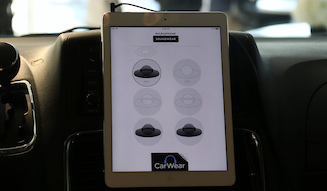
CarWear(prototype)

Marc Mansell, VP, Bose Automotive Systems Division
Bose predicts that in the era of autonomous driving, car entertainment will receive even more focus, and people will enjoy their own gadgets and devices in the car, much like they do in their living rooms.
With this in mind, 'CarWear' allows passengers to converse with each other using built-in microphones, even when wearing headphones to enjoy music or games. The driver can also speak to all or specific passengers via the microphone.
The company is also developing 'ClearVoice,' a system to clarify phone call audio, anticipating an increase in users enjoying conversations with the outside world during autonomous driving.
The word 'game' actually came up at another brand's presentation: Mercedes-Benz's press event.
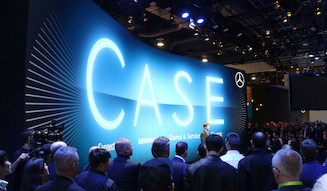
Mercedes-Benz
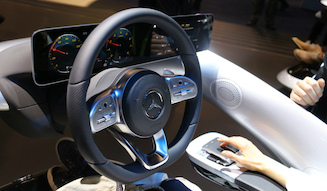
Mercedes-Benz MBUX (Mercedes-Benz User Experience)
The company previewed its in-car infotainment system, 'MBUX (Mercedes-Benz User Experience).'
Displayed on dual touch screens, it allows various commands via the voice prompt 'Hey, Mercedes.'
The beautiful 3D vehicle graphics rendered by the aforementioned NVIDIA processor are also a highlight. The presentation used the phrase 'truly a gaming experience.'
Looking back, two years ago at the same CES, they exhibited research results with NVIDIA. Now, it's about to be implemented in mass-produced vehicles. Specifically, it will be installed in the fourth-generation 'A-Class,' which Mercedes will unveil in Amsterdam this year. Equipping an entry-level model with the most advanced system in the lineup shows a speed and flexibility unimaginable for Mercedes in the past.
This year's CES showcased a Big Bang in the automotive world, transforming even the oldest of brands.