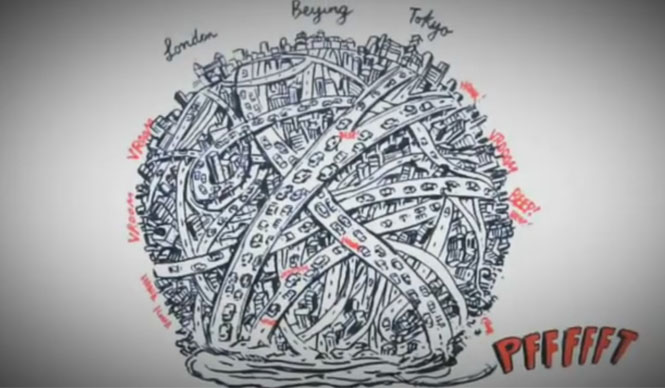
Audi's City of the Future | Audi
Audi Urban Future Initiative
Audi Future City
As OPENERS has already reported,,Audiis hosting a competition to consider the future of cities and transportation. The awards ceremony was held on October 18, 2012. The winner was Hever & Yoon Architecture. Their new proposal for transportation infrastructure in the rapidly growing Boston/Washington area was highly praised by the judges.
Text by OGAWA Fumio
What is the Audi Urban Future Initiative?
The "Audi Urban Future Initiative" is an award that, unusually for an automobile manufacturer, looks to the future of cities. It involves architects, sociologists, and futurists, selects one contender (or team) that presents effective solutions to the problems faced by various cities worldwide, and also awards a prize money described as "the highest in German architectural awards" (according to Audi's press release).
"Global knowledge is said to double every 12 years. (Omitted) We want to collaborate to shape and explore the future of transportation."
said Rupert Stadler, Chairman of the Board of Management of Audi AG.
Proposals were solicited for five cities worldwide facing unique transportation issues, and the projects deemed "most innovative and future-oriented" were honored.
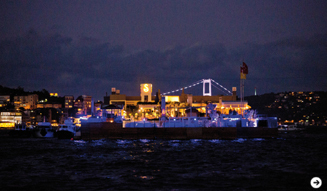
The venue, Suada Island in Istanbul
Istanbul was chosen as the venue for the award ceremony. Taking advantage of the first Istanbul Design Biennial held in 2012, presentations by each contender and the subsequent announcement of the winners took place here.
Audi Urban Future Initiative
Audi Future City (2)
The Concept of Share-Way
John Sakkara, a British design theorist and one of the judges, told the audience at a restaurant venue, "The winning project is a visual prophecy of what is needed for future cities. It is also an excellent research paper on how to prevent overpopulation and redevelop large cities."
Hever & Yoon Architecture proposed a transportation system for expanding cities. They advocate for the importance of a system that enables smooth and rapid transfers and movement by constructing infrastructure named "Share-Way."
As a concrete solution, they propose building platforms for various modes of transport on top of current roads and buildings. Aircraft would land and take off at the highest level. The core concept is to achieve "efficient movement."
Urban dwellers would benefit from the public transportation system while exchanging location information using smartphones (orAudiConnect).
While there is no specific mention of the modes of transport, the illustrations prepared by the architects depict layered levels for cars, trains, and aircraft. Users would be able to access each mode of transport by moving vertically. The complex traffic flow is referred to as "bundle."
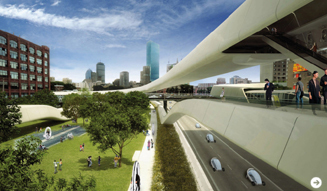
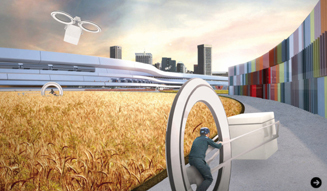
"The winning project is a visual prophecy of what is needed for future cities. It is also an excellent research paper on how to prevent overpopulation and redevelop large cities," said Rupert Stadler, Chairman of the Board of Management of Audi AG.
Hever & Yoon Architecture states, "Distances will be overcome by accessibility, and convenience of life will be improved by new ways of moving." Furthermore, the need for personal ownership of transportation will disappear.
Audi Urban Future Initiative
Audi Future City (3)
The Basic Form of Future Cities
The architects and planners participating this time are based in areas facing urban transportation challenges, including the Boston/Washington area, Istanbul, Mumbai, the Pearl River Delta, and São Paulo.
For example, the "Share-Way" by Hever & Yoon Architecture, which won the award, is based on the idea of building other transportation platforms on top of wide highways. However, the same system cannot be adopted in Istanbul, which has many hills and few wide roads.
However,AudiAG continues,
"Even in projects proposed as solutions for regions with extreme characteristics, many clues for solving future transportation problems can be found."
This is the significance of promoting such projects, according to the company's public relations.
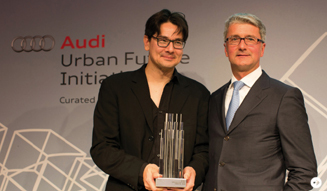
Stadler, Chairman of the Board, and Erik Hever
The basic concepts that Audi identified as applicable to any city are as follows:
• In megacities, space is diminishing, so cars must be used efficiently.
• In urban areas, housing costs tend to rise, putting pressure on household budgets and making it difficult to afford a car. Therefore, car sharing becomes increasingly important.
• Cities always have room for digital revolution, and cars will play a role as a type of interface.
• Seamless connection of various transportation modes, known as intermodal mobility, will be the basis for sustainable transportation.
Audi Urban Future Initiative
Audi Future City (4)
What is Personal Mobility in the Future?
"In what form will personal mobility be possible in the future?"
Audi believes this is a very important theme for us today, and the answer lies within the nature of the city itself. Audi's stance of viewing the development of future cities as a path to survival for automobile manufacturers is quite understandable.
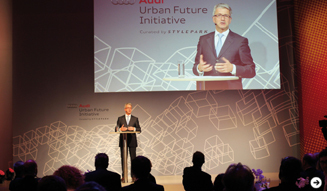
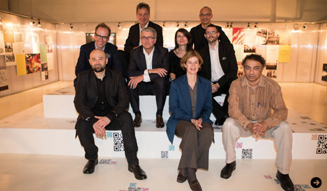
The presentations by other participants were as follows.
What will transportation be like in Mumbai, India, which has seven times the population density of Berlin, with 28,000 people per square kilometer?
Mumbai-based architectural firm CRIT (Collective Research Initiatives Trust) states, "Movement is not just a matter of transportation. It involves migration, gentrification of lower-income housing, and will affect not only space but also human relationships, the nature of work and leisure, and productivity."
CRIT's proposal is therefore a tool that guides users through the increasingly complex transportation ecosystem and the city of Mumbai. It includes a smartphone-like device that connects to a central hub.
Solving the problems of the Pearl River Delta, a triangle connecting China, Hong Kong, and Macau, was also one of the themes of the "Audi Urban Future Initiative." This project was undertaken by a local entity.
This area, densely packed with small factories, has seen its population swell from 26,000 to 15 million in the last 30 years. Urgent measures are needed for roads, including logistics systems, transportation systems, and sidewalks.
NODE Architecture & Urbanism's proposal aims to organize and reorganize the transportation network, which can be described as "fitting the solution to the situation."
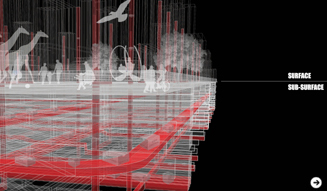
For example, logistics and sidewalks are separated, and the road network is constructed using both ground and underground levels. This aims to create free space, not chaotic space, and to realize gardens and wildlife sanctuaries within it.
Audi Urban Future Initiative
Audi Future City (5)
Leave the Ground, or Return to It?
São Paulo, which accounts for about 10% of Brazil's population and continues to expand, is so congested that it is difficult to travel by car. Since the 1930s, the government has focused on developing infrastructure for car travel. However, this focus has led to a lack of public transportation development within the city, and due to the ever-increasing population, residents are deprived of freedom of movement.
The São Paulo urban think tank proposed a way of life in the city that is convenient and comfortable without relying on car travel.
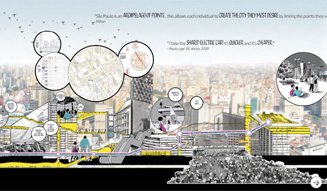
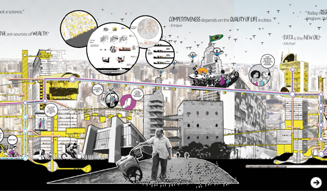
Currently, about 20 high-rise buildings in the city are under government management with no residents. They focused on these buildings and proposed a project to enable horizontal movement by connecting buildings with cable cars. Vertical movement is handled by escalators. The advantage of this three-dimensional transportation system is that it can solve problems without interfering with the chaotic ground-level traffic system.
The fifth proposal comes from Superpool, an architectural design firm in Istanbul.
Although severe traffic jams occur during commuting hours, extending the subway is considered difficult due to the city's location in an earthquake-prone zone. How can cars and residents coexist as the population continues to grow? This was the theme for Superpool, which operates locally.
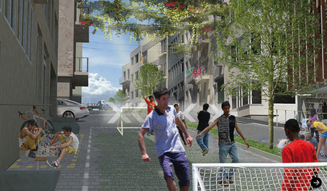
Superpool's proposal is surprisingly to give the streets back to the residents. To achieve this, they propose increasing the number of taxis and implementing efficient transportation such as ride-sharing.
According to Superpool, "One taxi has a transport efficiency equivalent to 20 private cars. This creates more space on the roads."
Traffic flow will be organized, and roads and squares where car traffic is prohibited will be created in various parts of Istanbul. These will be open to the public, and what happens there on weekends, from sports events to political rallies, will be decided by vote using a smartphone app.
"The large squares, once places where rulers displayed their power, will thus be entrusted to the public," says Superpool.