The Untold Story of Nissan's Pike Cars: Be-1 | NISSAN
NISSAN Be-1 | NISSAN Be-1
The Untold Story of the Birth of Nissan's Pike Car, the Be-1
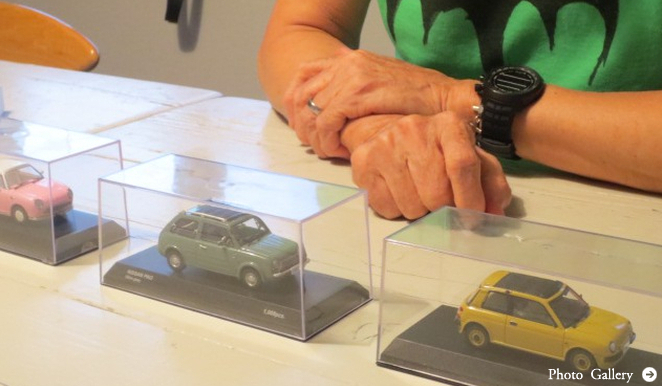
It was 25 years ago. In January 1987, a "special car" was born from Nissan Motor Corporation. It was a small, underpowered car, but as soon as it was released, it sparked a minor boom in Japan and dramatically changed the future of Nissan Motor Corporation. Even now, a quarter of a century after its release, it has become a "masterpiece" that is still talked about among car enthusiasts. We asked the people involved in the creation of this "little giant" to look back on those days.
Text by OGAWA Fumio
“No one in the auto industry knows how to do business.”
SAKAI Naoki (hereinafter referred to as Sakai)Sometimes, even work you do professionally becomes a cherished memory in life. For us, the Nissan "Be-1" was one such job.
Mr. AKIRA YAMAMOTO (hereinafter referred to as Yamamoto)Even though it was a car produced in a limited run of only 10,000 units when it was released in 1987. We who developed the Be-1 together back then still have reunions sometimes.
SHIMIZU Jun (hereinafter referred to as Shimizu)It all started around 1985, when we were planning the second-generation model change for the "March." I was promoted to Design Manager (Deputy General Manager) in 1984, and the March was among the models I was responsible for. So, separately from the March model change, I conceived an experimental project to see how many diverse designs we could create using the March's chassis. It was a plan I personally initiated as manager. While there were always designers stationed in the March design studio, for this project, I sought collaboration with individuals who had a strong external influence.
YamamotoAt the time, there was a sentiment within the company, which was in a bit of a slump, that "Nissan can't continue like this." We felt that we couldn't create appealing cars without taking on new challenges.
ShimizuSo, when planning the new model, we decided to invite external individuals to join the project. While we were considering who to approach, Yamamoto, who was a classmate from university, a close friend, and working in a department that planned company-wide technological development, suggested, "There's an interesting person named Naoki Sakai."
YamamotoAt that time, a lecture was held in Tokyo where the mastermind behind Wacoal's hit product, "Shape Pants," Mr. Mitamura, spoke about the secrets of its success. I attended, thinking that car manufacturing also needed a sense of the times from other fields. That led to Mr. Mitamura introducing me to Mr. Sakai. Mr. Sakai was involved in producing the color coordination for those Shape Pants, wasn't he?
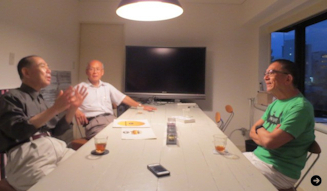
From left, Mr. Shimizu, Mr. Yamamoto, and Mr. Sakai, who we interviewed for this story.
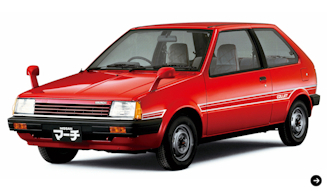
The base for the "new car" was the first-generation "March," which debuted in 1982.
SakaiShape Pants were released in 1981 and became a huge hit, selling 3 million pairs a year. One reason for its success was the wide range of colors offered. I proposed the concept of color marketing, differentiating products through color. At the time, I was working in the fashion industry.
YamamotoWhen I first met Mr. Sakai, the first thing he said was, "There's no industry that doesn't know how to do business like the auto industry." He pointed out things like, "They occupy large spaces in prime real estate, but they're empty on weekdays."
SakaiHahaha. I probably could say such bold things precisely because I had no prior involvement in the car industry.
YamamotoAfter that, Mr. Sakai expressed interest in car design and development, and visited the Nissan Technical Center (Atsugi City, Kanagawa Prefecture), where vehicle development took place. When I was waiting for him, I received a call from the security guard at the entrance saying, "We have a strange person here."
SakaiHahaha.
YamamotoMr. Sakai was dressed entirely in black, and the woman accompanying him was in stark contrast, dressed in red. They were the kind of people who never visited Nissan. Mr. Sakai, in turn, pointed at the security guard and quipped, "He's like a Red Guard, being so strict."
ShimizuMy first meeting with Mr. Sakai was in the spring of 1984, when I visited his "Water Studio" in Naka-Meguro, Shibuya. Immediately after, I prepared a concrete proposal. The outline of the proposal was: 1. Consolidate three distinct designs based on the March. 2. The first proposal would be designed by an in-house team, the second by an external concept developed by Water Studio and then designed in-house, and the third would be commissioned to Italy for design. 3. A special budget would be allocated. The proposal was deliberated and approved by the executive committee for development. There were comments at the committee meeting like, "This is the kind of proposal we've been waiting for." The meeting reports from Water Studio were distributed to relevant departments, including the executive officers, and generated considerable interest.
YamamotoIt was thanks to the strong support of Vice President Sonoda that this project moved forward. There were also other superiors who agreed, saying, "We've been waiting for something like this! Nissan needs new proposals. Let's do it right away!"
ShimizuWhat was shocking when I started working with Mr. Sakai was his approach to manufacturing, which involved narrowing down the target and concept before creating the design, much like in the apparel industry. In our meetings, we focused the target user for the March on individuals similar to highly sensitive users in the fashion world, and to experience their sensibilities, we repeatedly took Nissan designers on town-watching excursions.
NISSAN Be-1 | NISSAN Be-1
The Untold Story of the Birth of Nissan's Pike Car, the Be-1 (Part 2)
Cars back then were boxy, so I wanted to break away from that trend.
ShimizuThe design for what would later become the "Be-1" progressed through a competition format involving three studios. Team A was from within Nissan, Team B was Mr. Sakai's "Water Studio," and Team C was Paolo Martin from Italy. Martin, who came from Pininfarina, had worked on the Lancia "Beta Montecarlo," the Ferrari "Modulo", and the Rolls-Royce "Camargue". He was quite a designer.
SakaiWater Studio submitted two proposals, didn't we? Under the distinct themes of "Nostalgic Modern" and "City Modern."
ShimizuOur final target for completion was set for December 1984. In June, July, and August, we worked diligently on concept development and creating scale models to match. By December, we had four full-size models ready: Team A's proposal from within Nissan, Mr. Sakai's concept B-1 and B-2 proposals, and the outsourced Italian proposal, C.
YamamotoBoth of Mr. Sakai's proposals even had clay models made, didn't they?
ShimizuBecause the two proposed concepts were so different, we decided to present both as full-size models.
SakaiMy proposal aimed to break away from the trend of cars being boxy at the time.
ShimizuA design proposal with "cute" as the keyword was unprecedented. Mr. Sakai presented the B-1 and B-2 proposals, using panels and merchandise to illustrate the lifestyle of the target audience, accompanied by music. It was an internal presentation unlike any seen before.
SakaiIt's what you'd call design thinking today.
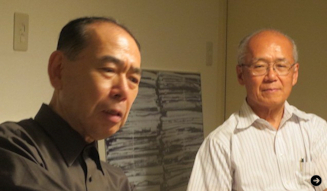
Mr. Shimizu (left) and Mr. Yamamoto (right)
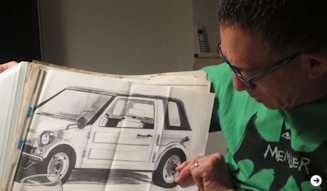
Mr. Sakai
ShimizuAfter the four models were completed, we solicited feedback from within the company by displaying them for relevant departments. It became clear that everyone was strongly drawn to Mr. Sakai's B-1 model. We received letters from within the company saying, "We've never seen a car like this. Please build it."
SakaiWe also received comments like "It's cute." It was an adjective that had never been associated with car design before.
ShimizuYamamoto was also very open-minded in his acceptance.
YamamotoI believed that Nissan needed boldness at that time.
ShimizuI remember Vice President S, who was in charge of products, exclaiming in surprise, "What is this?!" upon seeing the B-1 model display and explanation. However, he considered it positively for realization. Later, the then-president also saw it and commented, "Interesting. Let's consider building it."
SakaiI heard there was considerable opposition within parts of the company.
YamamotoAt the time, Nissan's slogan was "Technology Nissan," so some argued that building a car without new technology would compromise the pride of the engineers.
ShimizuWithin the design department, there were opinions that it lacked "advanced features." However, I disregarded the internal opposition and decided to strive for production, taking into account the general internal desire to "have it built" and the strong feelings of Vice President S. I then began working on internal coordination to bring it to market.
To be continued──
SAKAI Naoki(Sakai Naoki)
Currently Director of Water Design. Professor at Keio University SFC. In the 1960s, he moved to the United States and established a fashion business in San Francisco. While his starting point was textile design, after the Be-1 project, he became widely involved in product design.
SHIMIZU Jun(Shimizu Jun)
Joined Nissan Motor Corporation in 1962. At the time, there was no design department, so he worked in the styling section and was responsible for the first-generation "Sunny." He also designed the "Cedric/Gloria 230" (1971-75), which surpassed the Toyota "Crown" in sales. As Head of Design, he oversaw the design division for eight years and was responsible for the design of all models.
YAMAMOTO Akira(Yamamoto Akira)
Joined Nissan Motor Corporation in 1962. He worked in the design and development department, focusing on suspension and body design, before moving into technology development planning and product planning. During this time, he was involved in models such as the "Fairlady Z" (Z32) (released in '89) and the highly successful "Silvia" (S13) (released in '88). He subsequently held positions such as head of the product planning office and head of the electronics technology division.