The Guardian of Bentley Quality.
BENTLEY | The World of Leather and Wax Crayons
The Guardian of Bentley Quality
The interior of a luxury model is a crucial area that owners constantly see and touch. Leather, in particular, is directly linked to the overall quality of the material itself, making meticulous quality control essential from the material stage. Bentley employs specialist craftspeople for this very purpose, ensuring the maintenance of Bentley quality.
Text by SAKURAI Kenichi
Exceptional Quality Born from Craftsmanship
As you may know, the French luxury shoe brand Berluti offers a loafer named after the modern pop art master, Andy Warhol. This line, also called Andy, originated from a bespoke order Andy Warhol placed with the current head of the company, Olga Berluti, when she was still an apprentice in 1962.
Olga designed a modern loafer with a pointed toe, but one of the shoes had a flaw: a prominent streak in the leather. She explained this defect to Andy, saying it was made from "leather from a brave, spirited bull that is not afraid of barbed wire." Andy, charmed by Olga's anecdote, declared thereafter that he would "only wear shoes made from the leather of spirited bulls"—or so the story goes.
Whether this anecdote is true or not, generally, if a customer isn't Andy Warhol, leather with such streaks is considered unusable for products. Naturally, at Bentley, where only the finest materials are used, the selection and management of these materials are extremely stringent.
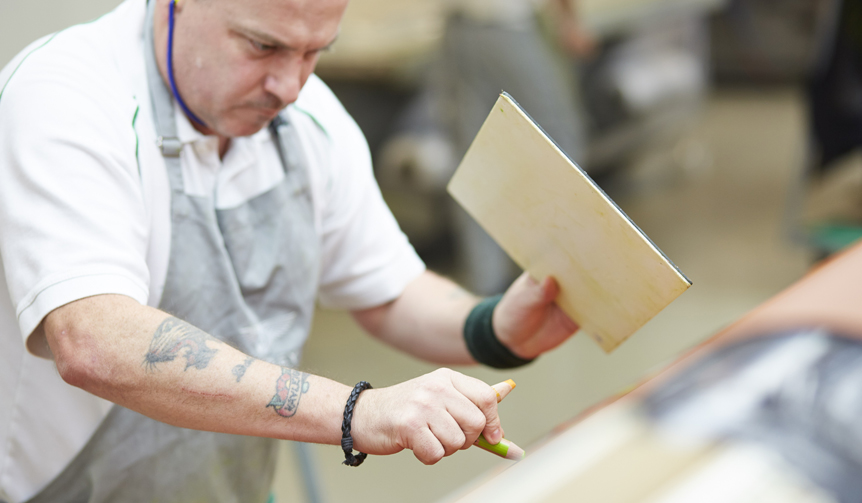
The control of this Bentley quality is in the hands of two leather inspectors, Alan Ryder and Dave Legg. They meticulously check not only for minor stretch marks but also for the faint lines of veins that appear on the leather's surface.
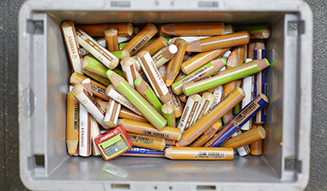
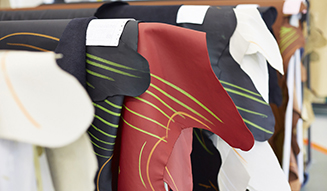
Wax crayons are used for this process. Areas marked with an orange crayon are deemed unusable under any circumstances. Faint lines, barely noticeable and perhaps not even qualifying as scratches, marked with a light green crayon, may still be used in parts of the interior that are not visible to the owner.
Wouldn't it be even more luxurious to simply discard any leather that causes even the slightest concern? While that might seem logical, minimizing waste and utilizing limited resources effectively is also part of the Bentley ethos.
BENTLEY | The World of Leather and Wax Crayons
The Guardian of Bentley Quality (2)
Work Directly Linked to Bentley Quality
Each year, Bentley uses leather from approximately 70,000 cattle. The hides, cut to the specific interior designs of each Bentley model, stitched, and fitted, come from contracted ranches in Northern Europe. These ranches are located in temperate climates, which helps reduce insect bites and stress on the cattle. A notable feature is the absence of barbed wire fences, which effectively minimizes scratches on the leather. Much like Andy Warhol's preferred loafers, with no barbed wire, one can't even tell if the cattle are particularly spirited.
The leather inspectors operate a saddle-shaped inspection table, scrutinizing the hides under powerful lights and marking problematic areas with crayons. "A good eye is really the main tool we have," explains Dave. Of course, years of experience and accumulated know-how are also crucial.

Dave and Alan rotate the hides they are working on 360 degrees, pointing out subtle imperfections that we would never have noticed. "Shading techniques are also important," he adds. Particularly with lighter-colored leather, strong reflections can occur, requiring caution against what's known as snow blindness—the same condition that makes it hard to see on a snowy mountain slope.
They inspect the raw hides and identify over 80 imperfections daily, yet this is only half of a leather inspector's job. The true skill lies in assessing how the leather will stretch and what appearance it will present when fitted to each part of the interior. Ensuring uniformity in the grain is also vital for seamless trim junctions.
Alan states, "Even though we are working with the highest quality leather, meticulously selected from the production stage, it's impossible to completely eliminate natural variations like stretch marks, scratches, or blemishes. Our role is to identify these hidden flaws and determine how to use the leather as a uniform, high-quality material in the interior. This discernment is directly linked to Bentley's quality."
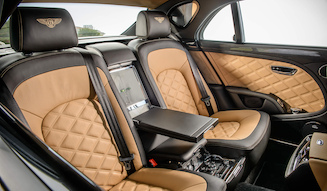
Bentley Mulsanne Speed
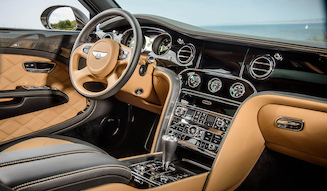
Once checked, the leather is detected by a laser-guided cutting machine, which uses the most efficient method to extract the required shapes, and the crayon marks are cut away. Once the leather enters the interior production process, re-inspecting its precision is difficult and irreversible. Despite being a natural product, users would not expect to find defects within the interior. Leather with minor creases might not be placed in the center of a seat where the owner's eye would fall, but it is used without waste for structural underparts or securing straps.
The two leather inspectors' dedication to quality sometimes impacts their personal lives. Alan laughs as he recounts, "One day, my wife and I went shopping for a sofa. We spent the entire day visiting furniture stores, but I couldn't find a sofa I liked. In fact, I pointed out so many defects to the salespeople that my wife has since forbidden me from accompanying her on shopping trips."