
CES 2017 Report: Part 1 | Consumer Electronics Show 2017
CES 2017: Part 1
In Las Vegas, Autonomous Driving is Already the Default
The Consumer Electronics Show (CES), held annually in January in Las Vegas, North America, is the world's largest trade show for the consumer electronics industry. While home appliances are naturally the stars of the show, the automotive industry, where cutting-edge electronic technologies like autonomous driving and connectivity are key, has also become an important venue in recent years, with companies eagerly showcasing their latest innovations. What key technologies were presented at this year's CES? We bring you our report.
Photographs Akio Lorenzo OYA / BOSE AutomotiveText by Akio Lorenzo OYA
This Year's Keywords: AI, Big Data, and Autonomous Driving
The "CES 2017," one of the world's largest consumer electronics shows, was held in Las Vegas, USA, from January 4th to 8th, 2017.
The biggest talking point at CES, which celebrated its 50th anniversary this year, was the proactive participation of car manufacturers. Notably, Japanese brands Toyota, Nissan, and Honda were all present. Toyota and Honda, in particular, brought world-premiere concept cars, creating vibrant booths. It's no exaggeration to say that the North Hall, the main venue for automotive brands, felt like a mini motor show.
If we were to pick keywords from what we saw, they would be "Artificial Intelligence (AI)," "Big Data," and the theme of the past few years, "Autonomous Driving."
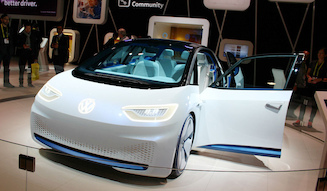
VOLKSWAGEN highlighted its US-premier EV concept "I.D." while demonstrating a seamless network between car and home using Amazon's voice recognition device "Echo."
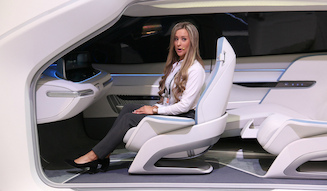
At the HYUNDAI stage, explaining the integration of smart homes and automobiles. The company is researching cloud-based connectivity with CISCO and also showcased the world's first in-car CO2 sensor, which automatically adjusts the air conditioning and plays relaxing music when carbon dioxide levels rise.
Looking at Europe, where I am based, automatic transmission (AT) vehicles accounted for a quarter of passenger cars sold in France in 2016 (according to CCFA). In Italy, this figure only reached 15 percent in recent years (according to UNRAE 2013). This is due to lingering perceptions that ATs are "not fuel-efficient," "not fun to drive," and have "low resale value for their price."
Therefore, crossing the Atlantic from Europe to Las Vegas each year feels like Xuanzang embarking on his journey to the West, heading towards a land of dreams.
CES 2017: Part 1
In Las Vegas, Autonomous Driving is Already the Default (2)
Focus on the Booths of Three Japanese Manufacturers
A brief digression. Let's take a look at the actual booths. Most of the vehicles displayed were based on or envisioned for electric and autonomous driving. Yes, at CES, cars mean these technologies – they are the default.
TOYOTA's concept car,Concept-i"Concept-i," predicts the car of 30 years from now. It begins with naming your car through AI, gradually building a partnership with the vehicle.
By conversing with the car, it accumulates user preferences as big data. It remembers favorite songs and plays them automatically according to the situation, or automatically sets the driving route based on the driver's emotions.
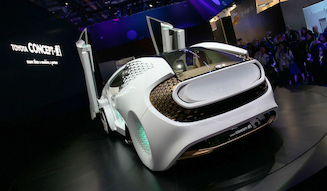
TOYOTA Concept-i. The design was handled by CALTY, Toyota's design studio in California.
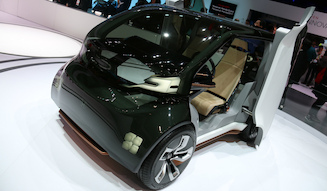
HONDA NeuV concept. An EV commuter equipped with an AI "emotion engine" that reads the occupant's mind using various devices and sensors. It's also designed for car-sharing use, utilized for commuting in the mornings and evenings and for deliveries during the day.
HONDA's "NeuV concept" also learns and accumulates user preferences using the AI "emotion engine" developed by "cocoro SB," a company affiliated with SoftBank.
While NISSAN did not present flashy world-premiere concept cars, they offered a presentation of their steady research, which can be seen as a result of their partnership with NASA (National Aeronautics and Space Administration) formed in 2015.
This system, called "SAM (Seamless Autonomous Mobility)," allows an autonomous vehicle encountering an accident or construction site to report to a command center. The center's computer then feeds back instructions to the car, such as obeying a police officer's hand signals instead of traffic lights. This data is accumulated in the cloud, shared with other vehicles in the area, and the vehicle itself learns how to resolve similar situations when encountered.
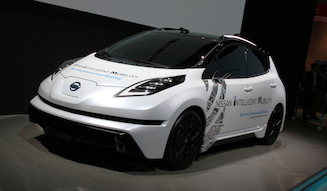
NISSAN's "SAM (Seamless Autonomous Mobility)" experimental vehicle. Through joint research with NASA, it uses big data to make situational judgments, such as "prioritizing a police officer's hand signals over traffic lights."
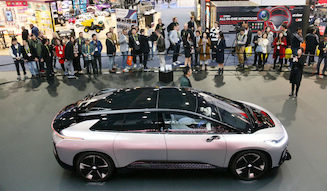
The Faraday Future FF91, already hailed as a Tesla killer.
Meanwhile, Faraday Future, which garnered attention last year in 2016 by unveiling the eccentric concept car "FF Zero1," exhibited the prototype EV "FF91" equipped with autonomous driving functions.
The design, like the FF Zero1, was by Richard Kim, who previously served as the design lead for BMW'si8. Positioning TESLA as a direct rival, the company boasted various advantages at the venue, such as a faster 0-60 mph acceleration than TESLA'sModel S.
For reference, Faraday Future is a US company supported by China's LeEcho. The FF91 is scheduled to begin production in 2018 at a factory in northern Nevada. However, with lingering issues such as unpaid bills to suppliers, its future cannot be viewed with optimism.
CES 2017: Part 1
In Las Vegas, Autonomous Driving is Already the Default (3)
BOSE Unveils Seat Suspension System
Beyond the vehicles themselves, there were other interesting exhibits. For example, BOSE, known for its car audio systems, unveiled a seat suspension system called "Bose Ride" at a special venue.
Research began in the early 1980s with founder Dr. Amar G. Bose's work on automotive suspension. Building on this, Bose Ride was first commercialized for trucks in North America in 2010. It detects vertical motion from the road surface via sensors and transmits this information to an electromagnetic actuator in microsecond units, thereby reducing vibration.
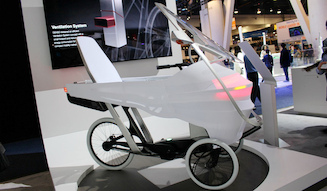
A city commuter developed by DENSO in collaboration with the Massachusetts Institute of Technology (MIT). This compact vehicle is equipped with autonomous driving functions.
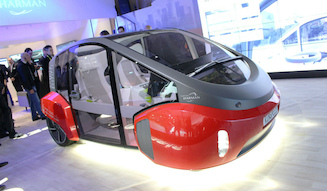
The "Oasis," an autonomous driving EV commuter proposed by the Swiss engineering company Rinspeed. It's also designed for car-sharing, utilized for commuting in the mornings and evenings and for deliveries during the day, similar to HONDA's NeuV.
The improved version announced this time features a two-axis system that handles not only vertical motion but also lateral sway. BOSE aims to resolve challenges such as miniaturization for passenger cars and promote the system to automakers as a suitable solution for the era of autonomous driving, where ride comfort is paramount.
As vehicles become more electrified and autonomous, the number of parts will decrease, and the traditional enjoyment of driving will undoubtedly transform. Some enthusiasts may feel a sense of melancholy, akin to mechanical watches being replaced by quartz.
However, when we consider that ideas like Bose Ride might open up new possibilities in the world of automotive parts, it's hard not to feel a sense of excitement.