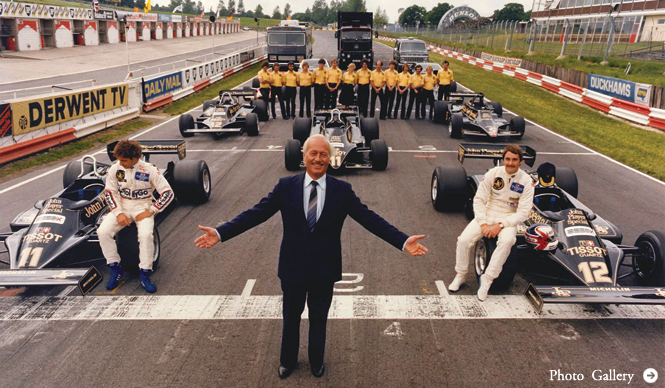
The Heart of British Motorsport, by Tatsuya Otani
What is the British Motorcar?|What is a British Car?
By OTANI Tatsuya
Britain, the Center of Motorsport
Britain, the nation that achieved the Industrial Revolution and expanded its colonial empire across the globe, is also a cultural powerhouse that gave us Shakespeare and The Beatles. What role has it played in car culture? Here, we offer a glimpse into British car culture through the lens of motorsport.
Text by OTANI Tatsuya
Britain is the Heart of F1
When one speaks of motorsport, F1 immediately comes to mind. While it is widely known that the FIA (Fédération Internationale de l'Automobile), the governing body of the series, is headquartered at 8 Place de la Concorde in Paris, it would be hard to argue that Britain is not the true center of F1.
The first race of the F1 World Championship, which began in 1950, was the British Grand Prix held at Silverstone. The winner that day was Nino Farina driving an Alfa Romeo, who went on to win the championship that year. Alfa Romeo's early success in F1 was due to their ability to field pre-war machines. Looking at the entire history of F1, British teams like Williams, McLaren, and Lotus have won a remarkable 33 Constructors' Championships combined. (While Ferrari leads with 16 titles as a single team, this is largely due to their six titles won between 1999 and 2004 during Michael Schumacher's dominant era).

The Lotus 49, which brought the DFV its first victory
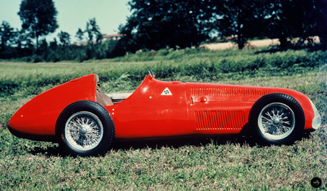
The Alfa Romeo 158 Alfetta, winner of the first F1 race in 1950
While Britain dominates in chassis manufacturing for the Constructors' Championship, when it comes to F1 engines, the Ford Cosworth DFV's contribution to seven Constructors' titles stands out, but European continental manufacturers like Ferrari (16 titles) and Renault (10 titles) have been more dominant. Traditionally, European continental entries in F1 are primarily car manufacturers, whereas Britain has a majority of small and medium-sized constructors. This undeniably creates a trend of "Engines from Europe, Chassis from Britain." However, in terms of engine development, our own Honda has also contributed to six title wins, so it's not exclusively a European continental forte.
What is the British Motorcar?|What is a British Car?
By OTANI Tatsuya
Britain, the Center of Motorsport (Part 2)
The Essence of British Motorsport
Why are the British so adept at developing F1 chassis and running F1 teams?
While the explanation becomes somewhat complex, let's use the example of the Ford Cosworth DFV engine, mentioned earlier, to illustrate this point.
Although called the Ford Cosworth DFV, Ford was merely the sponsor providing development funds, while the actual development was undertaken by Cosworth, an independent British engine constructor. The Cosworth DFV debuted in 1967. The previous year, F1 regulations had changed, increasing engine displacement from 1.5 liters to 3.0 liters. Ferrari and Honda, believing this would usher in an era of power wars, introduced 12-cylinder engines which offered a power advantage. In contrast, Cosworth, aware of the potential power disadvantage, deliberately developed the 8-cylinder DFV. Why?
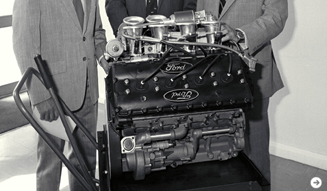
The 400th Ford Cosworth DFV F1 engine, 1986
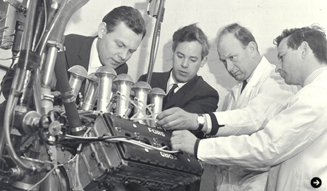
The Ford Cosworth DFV engine and its developers, 1967
An 8-cylinder engine, being more compact, facilitated easier development of a well-balanced chassis. In fact, Ferrari and Honda's cars were excessively heavy due to their engines, exceeding the minimum weight limit and negating their considerable power. In contrast, the compact DFV was fitted into Lotus's equally lightweight and compact chassis, winning the title the year after its debut in 1968. It went on to dominate the series for seven consecutive years until 1974, marking an era.
The Cosworth DFV was not only lightweight and compact but also fuel-efficient, and its power output was reportedly not significantly inferior to that of Ferrari or Honda. It is also said to be the first engine to fully adopt the stress-bearing method, where the engine itself serves as a structural component of the car (though there are various theories on this).
Looking back, Cosworth's design philosophy makes perfect sense. However, the fact that an engine developer, rather than a chassis engineer, conceived this idea reveals the freedom of thought characteristic of the British. Typically, an engine developer would prioritize engine output, making it difficult to focus on the overall balance when installed in a chassis. Yet, the Cosworth engineers, in a sense, set aside their specific roles and adopted the perspective of "How can we build a faster F1 car?" leading them to the flexible solution of an 8-cylinder engine. It's hard not to see this as a distinctly British approach.
What is the British Motorcar?|What is a British Car?
By OTANI Tatsuya
Britain, the Center of Motorsport (Part 3)
Balance and Originality
What about F1 chassis development? For engines, the number of factors to consider is limited: power, size, weight, fuel efficiency, reliability, and so on. However, F1 chassis development requires a comprehensive consideration of various conflicting conditions, such as strength versus weight reduction, and suspension versus aerodynamics, to find the optimal compromise. Furthermore, differentiation from rivals is achieved by introducing novel ideas. Without both a keen sense of balance and innovation, one cannot become an excellent F1 chassis developer.
Turning our attention to British-made road cars, models with exceptionally powerful engines are somewhat rare. Instead, I feel there are many models that boast exquisite overall balance or were born from unconventional ideas. Lotus, Jaguar, Rolls-Royce, Bentley, and Mini, as road cars, are all examples of this.
A sense of balance and originality. These are the two qualities I would attribute to the British contribution to car culture.
OTANI Tatsuya
Born in Kanagawa Prefecture in 1961. After graduating from university, he worked as an engineer at an electric manufacturer's research institute. In 1990, he joined Nigensha and became an editor for the monthly automotive magazine "Car Graphic." Since then, he has been responsible for planning, interviewing, writing, and editing for the magazine as Sports Editor and Deputy Editor-in-Chief. In March 2010, he became an independent freelance writer, broadly introducing the enjoyment and depth of automobiles, not only through new car reports but also through the latest technology and motorsport. He is the Vice Chairman of the Japan Motorsport Journalists Association.