Interviews with Key Figures at the Tokyo Motor Show | Porsche
Porsche
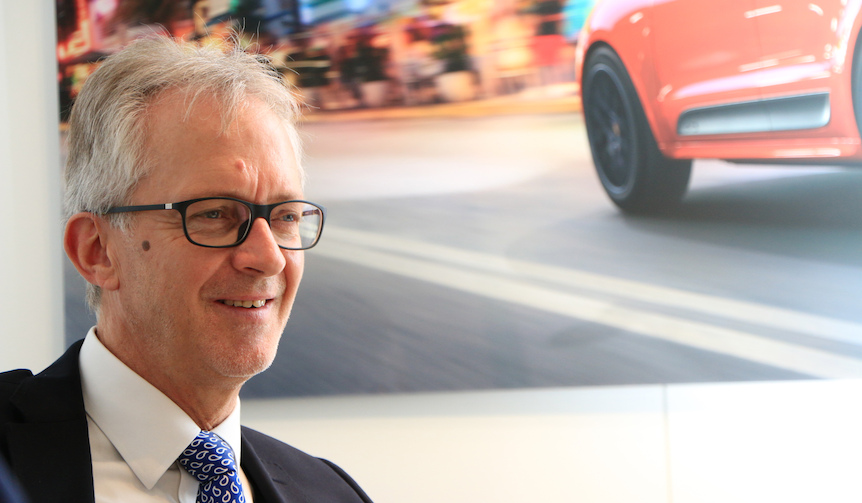
911 Carrera 4 Director Dr. Erhard Mossle
The Purpose of Turbocharging: Improved Fuel Economy and Increased Power (1)
Porsche unveiled the new generation "911 Carrera 4" at the Tokyo Motor Show. The biggest highlight is the downsizing and turbocharging of the flat-six engine. With the "911 Turbo" already in the lineup, why turbocharge the Carrera as well? What is Porsche thinking? Dr. Erhard Mossle, Director of the 911 Carrera 4, discussed their "2020 strategy."
Text by OGAWA FumioPhotographs by ARAKAWA Masayuki
The 911 Carrera and 911 Turbo are Different Cars
The 911 is entering a new era. Ahead of the Tokyo Motor Show, the "911 Carrera" was unveiled at the Frankfurt Motor Show in September 2015. The press release at the time stated: "Thanks to over 40 years of turbo technology expertise accumulated by Porsche, the engine in the new 911 Carrera sets a new standard for performance, driving pleasure, and efficiency." I began by asking about the meaning behind this somewhat cryptic explanation.
—Could you start by explaining the reason for turbocharging the 911 Carrera?
Our goal was to improve fuel economy. At the same time, we wanted to increase engine power. However, it is difficult to achieve both of these objectives by tuning a naturally aspirated boxer (horizontally opposed) engine. That's why we decided to install turbochargers.
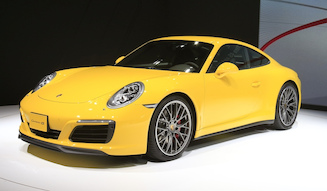
911 Carrera 4S
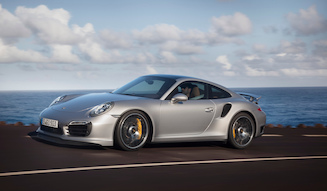
911 Turbo S
—Were there any dissenting opinions within the company?
When you try to do something new, there are always opposing arguments. We had similar debates when we switched from air-cooled to water-cooled engines. But after the successful transition to water cooling, the majority said, "Okay, well done" (laughs). That's how it is. Mercedes and Ferrari also use turbochargers, so I didn't think there would be resistance from the market.
—With this turbocharging, the displacement has decreased to 3 liters, while the output has increased by 15 kW and torque by 60 Nm. How will you differentiate it from the "911 Turbo"?
The customers for the 911 Carrera and the 911 Turbo are entirely different segments. The cars themselves are completely different. The 911 Turbo has a larger body, and its spoilers and air intake shapes are also different. Its performance is far superior. While the Carrera 4S now has 309 kW, the 911 Turbo has 383 kW, and the Turbo S has 412 kW. The engine also employs variable turbine geometry for even higher performance.
Does Porsche feel threatened by Mercedes now?
Porsche
911 Carrera 4 Director Dr. Erhard Mossle
The Purpose of Turbocharging: Improved Fuel Economy and Increased Power (2)
We are always conscious of competing with powerful models like the "AMG GT"
What is Porsche thinking right now? We asked Dr. Erhard Mossle, Director of the 911 Carrera 4, who visited Japan coinciding with the Tokyo Motor Show.
—The European Commission has set a target of 95 grams or less of CO2 emissions per kilometer by 2020, with penalties for exceeding it. Some sports car manufacturers seem to be giving up on achieving this goal. How about Porsche?
While I can't say anything definitive at this moment, of course, we are considering it. It may be a separate target from our parent company, Volkswagen, but achieving these figures is also important for the environment.
—Is the four-door EV called "Mission E" that you exhibited at the Frankfurt Motor Show a realistic prospect? Or perhaps, would you consider installing a four-cylinder turbo engine in the 911?
We are exploring all possibilities. It will be difficult to meet the 2020 targets with naturally aspirated engines. In the future, we will likely consider expanding plug-in hybrids (PHVs) and EVs. However, we will not put a four-cylinder engine in the 911.
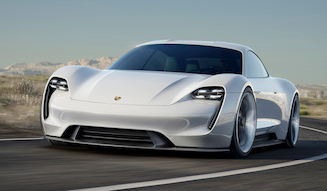
Porsche Mission E
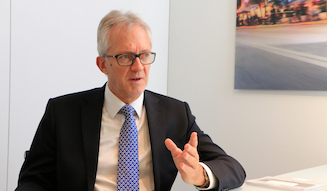
911 Carrera 4 Director, Dr. Erhard Mossle
—While the displacement of the 911 Carrera series has been downsized to 3 liters, rivals seem to be sticking with larger displacements. Won't moving to smaller displacements put you at a disadvantage in the market?
It's true that there are users worldwide who prefer large-displacement sports cars. However, Porsche has traditionally not used excessively large engines. Even the 911 Turbo has a 3.8-liter engine. What Porsche has always strived for is to find the optimal balance. We believe it's more important to transmit torque to the road through the tires without waste, rather than simply increasing output and torque figures.
—So, there's no risk of the 911 being phased out of the product lineup due to efficiency concerns?
That will not happen. The 911 is a very important model. In addition to the coupe, we have the Cabriolet and Targa, the Carrera, Carrera S, Turbo, Turbo S, and also the GT3. You can choose between rear-wheel drive and all-wheel drive. With about 25 variations, we believe it's important to enhance its appeal with modern technology.
—If new models are to be introduced from now on, in what direction will they go? Will they be sports cars, or environmentally friendly vehicles?
The key point is whether there is a business opportunity. We don't just launch new models for the sake of it; we need to determine if they can generate appropriate profits and contribute to the overall model range. Of course, powerful models like Mercedes-AMG's "AMG GT" are appearing in the market. We are always conscious of competing effectively with them.