918 Spyder Test Vehicle Unveiled | Porsche
PORSCHE 918 Spider | Porsche 918 Spyder
918 Spyder Test Vehicle Unveiled
Announced as a concept car at the 2010 Geneva Motor Show, and with reservations beginning in 2011, this limited-production model of 918 units worldwide, the Porsche “918 Spyder” has finally had footage of its development test vehicle released.
Text by SUZUKI Fumihiko (OPENERS)
Successor to the Carrera GT
Launched in 2003, the Porsche Carrera GT was a supercar featuring a Targa top, an all-carbon body, a 5,733cc V10 engine, a light curb weight of 1,380kg, and suspension and brakes on par with racing cars, yet it also offered the comfort of a luxury road car.
Positioned as its successor is the 918 Spyder, announced in 2010, for which production has already been decided and reservations are underway.
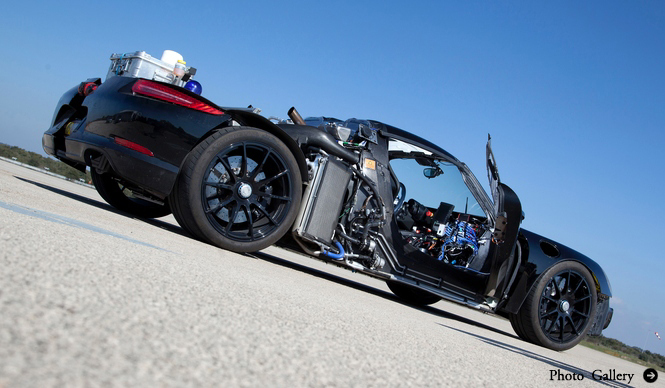
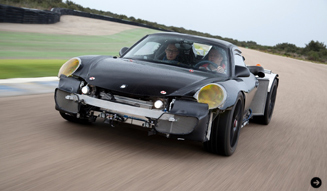
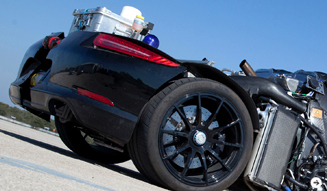
This time, Porsche invited members of the press to the Nardò circuit in southern Italy for a test drive of the 918 Spyder test vehicle. While aerodynamic devices are not yet fitted and the chassis is only partially covered by a dummy body, the car's basic structure appears to be largely complete.
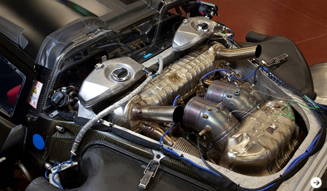
The engine is a 4.6-liter V8 based on the unit used in the two-seater prototype racing car "RS Spyder" that competed in the 24 Hours of Le Mans and the American Le Mans Series. It is a dry-sump unit that allows revs up to 9,000 rpm and produces over 570 ps, befitting a racing engine. This is positioned ahead of the rear axle, driving the rear wheels. Further back from the clutch behind it is an electric motor with an output of approximately 90 kW. Following this is the PDK, based on the 911 Turbo's but inverted vertically for a lower center of gravity, and then the LSD.
An electric motor is also present on the front axle. This is independent of the rear hybrid powertrain and has an output of approximately 80 kW. It has a fixed gear ratio and is disconnected during high-speed driving to prevent over-revving.
The battery powering these two motors is located low in the center of the vehicle, directly behind the driver. The exhaust direction has been changed from the concept's side-mounted to upward-facing. This is a design to ensure quick exhaust flow and, by placing the high-temperature exhaust on the inside of the V-banks, to prevent heat buildup around the battery.
Charging is performed by the engine and the electric motors during strong braking, but it can also be charged from a household outlet.
Hybrid Drive: Achieving Both High Efficiency and High Performance
Despite the structural disadvantage of a hybrid system in terms of weight, meticulous weight reduction in each component has achieved a vehicle weight of under 1,700 kg. The car can travel over 25 km on electric power alone.
Driving modes range from the "E-Power" mode, which actively utilizes electric-only driving, to "Hybrid" mode, which combines the engine and motors, and "Sport Hybrid" mode, where the engine provides the primary drive. In "Race Hybrid" mode, the engine operates under high load, with surplus output used to charge the battery, allowing the motors to provide maximum assist when high power is required. Furthermore, for a few laps of circuit driving, there is a "Hot Lap" mode that depletes the battery's energy to pursue the fastest lap times.
The rear axle is electronically controlled for steering. The adjustment is speed-dependent; at low speeds, the rear wheels turn in the opposite phase to the front wheels, enabling high-speed, precise cornering with a small turning radius. At high speeds, they turn in the same phase as the front wheels, enhancing rear stability.
Its lap time on the Nürburgring Nordschleife is 7 minutes 22 seconds, 10 seconds faster than the Carrera GT's 7 minutes 32 seconds. The 0-100 km/h acceleration is under 3 seconds, compared to the Carrera GT's 3.9 seconds.
Production of the limited 918 units is scheduled to begin on September 18, 2013, with deliveries starting in November 2013. As of May 2011, the price was 684,800 Euros.

PORSCHE 918 Spider | Porsche 918 Spyder
Dimensions | Length 4,643 x Width 1,940 x Height 1,167 mm
Curb Weight | Under 1,700 kg (DIN)
Wheelbase | 2,730 mm
Luggage Compartment Capacity | Approx. 100 liters
Engine | 4.6-liter V8 engine + motor (Parallel full hybrid system)
Max Engine Speed | Approx. 9,000 rpm
Max Output (Engine) | Over 570 ps
Max Output (Rear) | Approx. 90 kW
Max Output (Front) | Approx. 80 kW
Max Torque (Combined) | 750 Nm
Drivetrain | Rear-wheel hybrid module + electric motor with front-wheel gearbox unit
Transmission | 7-speed PDK
Front Suspension | Double wishbone (with Porsche Active Suspension Management - PASM)
Rear Suspension | Multi-link (with electromechanical adaptive steering system for rear-wheel independent steering, Porsche Active Suspension Management - PASM)
Brakes | Adaptive control energy recovery system, ceramic brake discs (PCCB)
Battery | Lithium-ion battery (initial rated capacity 6.8 kWh, max output 202 kW), with household power outlet compatible plug-in charger
Top Speed | Over 325 km/h
Top Speed (Electric Motor Only) | Over 150 km/h
Acceleration Performance |
0-100 km/h: Under 3.0 seconds
0-200 km/h: Under 9.0 seconds
0-300 km/h: Under 27.0 seconds
Fuel Consumption (Combined) | Approx. 3.0 ℓ/100 km (NEDC)
CO2 Emissions (Combined) | Approx. 70 g/km
Electric Motor Only Range | Over 25 km


