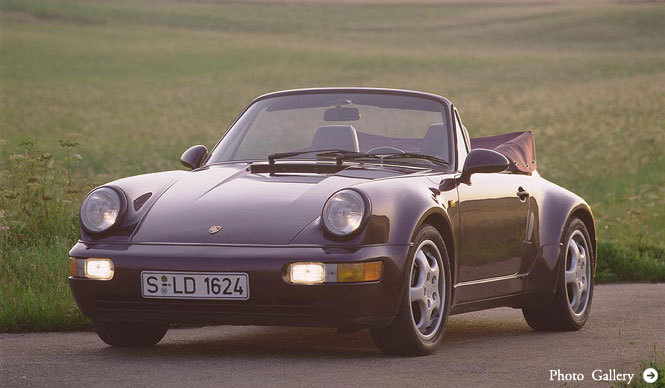
Porsche 911 Story—The Third Generation, Type 964
Porsche 911 | The Porsche 911
Porsche 911 Story──The Third Generation: 964
The Third Transformation
Continuing our "Porsche 911 Story," this third installment focuses on the third-generation 911, unveiled in 1989. Known among fans by its internal Porsche code name, "964." The 911 is always the 911, which is why such distinctions are necessary.
Text by OGAWA Fumio
A 911 That Leaves a Vivid Impression
From its debut in 1963 to the present day, the 911 has undergone three major transformations. One was the introduction of the turbo, another was the shift to water-cooled engines, and the third was the addition of a four-wheel-drive variant. This third transformation occurred with the 964.
While the styling, with its emphasized fender flares, was inherited from the preceding 930, the 964 featured bumpers color-matched to the body, giving it a distinctly different feel. The vibrant body colors, reflecting the trends of the era, also contributed to the car's striking presence.
The air-cooled flat-six engine displaced 3.6 liters. This significant increase from the 930's 3-liter engine generated considerable buzz. Maximum output also rose substantially, from 180 hp in the 930 to 250 hp.
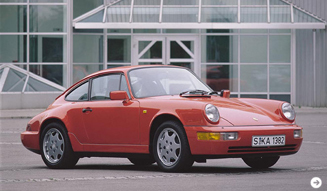
Carrera 2
Although the body dimensions were slightly more compact than the 930's, the adoption of a monocoque structure to meet significantly revised safety standards resulted in a weight increase of over 150 kg. Porsche anticipated that further tightening of safety regulations would necessitate larger car bodies and preemptively made the decision to significantly increase displacement with this model.
The Arrival of Four-Wheel Drive
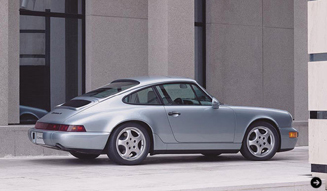
Carrera 4
The extensive revisions to the suspension also generated significant discussion upon its announcement. The unique torsion bar spring system used previously was abandoned in favor of conventional coil springs.
This provided greater flexibility in suspension design, making it easier to meet diverse market demands and develop various iterations. One such development was the full-time four-wheel-drive variant, named the Carrera 4. Its debut in 1989, as the first model released, was a testament to Porsche's bold transformation and was nothing short of sensational.
A Wealth of Model Variations
The rear-wheel-drive model, named the Carrera 2, was introduced a year later in 1990, following the Carrera 4. While the full-time 4WD system enhanced stability in adverse weather and at high speeds, the Carrera 2 was welcomed by fans who didn't require such performance and preferred the character of a lighter, traditional Porsche 911.
The 964 also saw an expansion in model variations. The Turbo arrived in 1991, eventually followed by the Turbo 3.6 in 1993, which increased displacement from 3.3 to 3.6 liters, producing 360 hp. Furthermore, the RS, a high-performance variant with simplified equipment and reduced weight, while boosting maximum output to 260 hp, remains highly popular to this day.
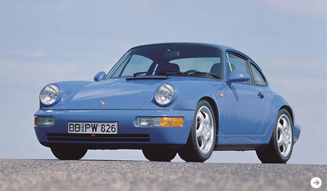
RS
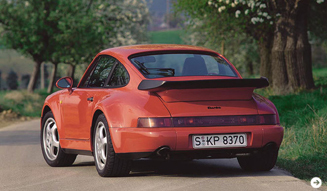
Turbo
Meanwhile, with options like the Cabriolet, Targa, and the Speedster—distinguished by its low windshield and fully open body—customers could choose a 911 that suited their preferences. This ability to cater to individual tastes is a significant reason for Porsche's enduring popularity.


