
An Interview with Annette Winkler, Head of smart at Daimler AG | smart
42nd Tokyo Motor Show 2011: VIP Interview in Japan
Annette Winkler, Head of smart, Daimler AG
The Ideal Form of Next-Generation Mobility
Smart's centerpiece at the Tokyo Motor Show booth was the "forvision," first unveiled at the Frankfurt Motor Show. While the forvision is unmistakably a Smart, it also possesses a certain flair that suggests a leap forward compared to the previous fortwo models, which maintained a consistent concept across their first and second generations.
We began by asking Annette Winkler, Head of smart at Daimler AG, who appeared in a striking suit, what defines Smart, beyond its evolution. Is it the design, the packaging, or perhaps the size?
Text by SHIMASHITA Yasuhisa
Photo by ARAKAWA Masayuki
The Essence of Smart: Redefining the City Car
"Smart is a brand that offers optimal mobility. Its radical characteristic (stance?) of redefining the city car is the very essence of Smart."
"What defines it is, first and foremost, a design and styling that is instantly recognizable. And then, compactness. A city car must be compact."
"Compact cars naturally demand high safety. For this, Smart employs its unique Tridion safety cell structure. Despite its compact size, it offers high levels of safety."
The three elements Winkler first mentioned are all closely interconnected. The reason Smart, and primarily the fortwo, has become an icon is largely due to its extremely short length, which makes it seem like a deconstructed "normal" car, and its distinctive design. However, it's undeniable that this size and design were made possible by the existence of the Tridion safety cell structure.
Without any one of these elements, the fortwo could not have come into being.
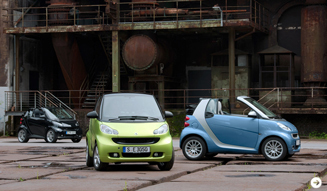
The current fortwo family
42nd Tokyo Motor Show 2011: VIP Interview in Japan
Annette Winkler, Head of smart, Daimler AG
The Ideal Form of Next-Generation Mobility (2)
What Elements Beyond Compactness Define a Smart?
"Compact and safe. That alone is not enough. Despite its small size, the interior is spacious and comfortable. This is also a very important point for Smart. We call this the 'Wao! effect.' Yes, the surprising 'Wao!'"
"For city cars, ease of repair and cost-effectiveness are also important. Minor accidents are bound to happen when driving in the city. Scratches and the like are not uncommon. By using plastic body panels, Smart makes repairs easy and low-cost. This can even help reduce insurance premiums."
"Speaking of cost, low fuel consumption and high environmental performance are also Smart characteristics. Electric mobility is the ultimate form of this. Zero emissions also contribute to improving the quality of life in urban areas."
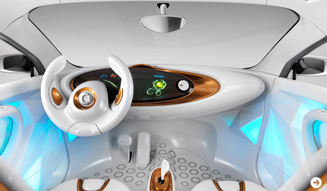
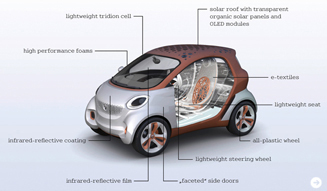
Smart was originally conceived as a brand to address the increasingly challenging traffic environment in urban areas from the vehicle's perspective. Its compact size is symbolic, but the ease of repair is indeed a crucial factor, and fuel efficiency and emissions are becoming ever more important. Moving towards electrification as the ultimate form is a natural progression.
The forvision is a model that takes new challenges in this regard, featuring a lightweight body made of carbon fiber-reinforced epoxy resin, and special insulating materials and coatings to enhance thermal insulation and improve air conditioning efficiency. These are not merely show car technologies but are intended for future mass production.
42nd Tokyo Motor Show 2011: VIP Interview in Japan
Annette Winkler, Head of smart, Daimler AG
The Ideal Form of Next-Generation Mobility (3)
Connectivity: A Key Factor for the Future of Smart
"That was a bit long (laughs). Just two more points. Individualization is indispensable. Smart allows for the addition of various features and custom tailoring to create a unique vehicle. I believe it's an attractive proposition for urban dwellers who want to express their personality."
"And finally, city cars require 'Always On' connectivity. In urban life, mobile phones are indispensable, and navigation systems are now essential for long-distance travel. In other words, constant connection to information is required. Smart will achieve this."
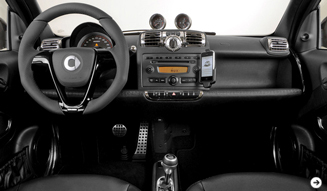
Brabus tailor-made interior. Colors for seats, steering wheel, door panels, and dashboard can be freely combined according to preference.
At this show, a fortwo coordinated with playful color schemes through the "Brabus Tailor Made" program was exhibited at the Smart booth, attracting attention. Smart possesses something that invites enjoyment as a material.
While connectivity is not yet fully realized, it is undoubtedly a key element for the brand's future, as will be discussed later.
42nd Tokyo Motor Show 2011: VIP Interview in Japan
Annette Winkler, Head of smart, Daimler AG
The Ideal Form of Next-Generation Mobility (4)
The Core of Smart's Mobility Concept, Extending Beyond Cars
"What's important is that these attributes will permeate all of Smart's products. For example, in 2012, we will launch the 'ebike' in North America and Europe, and it's the same principle. It's compact, low-emission, easy to repair, and equipped with connectivity. These are essential for anything to be called a Smart."
This ebike is an electric-assist bicycle, unveiled at the 2010 Paris Salon. It features an aluminum frame and spokes, combined with a 250W hub motor. A smartphone can be attached to record riding data or be used for navigation.
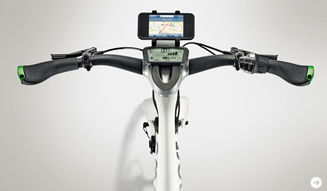
ebike
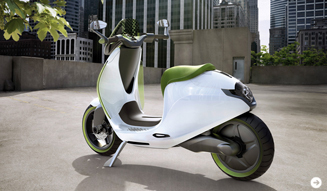
"In essence, Smart is more than just a car; it's a mobility concept itself. Imagine this: you take an ebike out of your parked Smart, transfer your smartphone from the vehicle's cradle to the ebike, and continue using its network functions. This is the core of our mobility concept."
Indeed, electric mobility and connectivity appear to be particularly key definitions for Smart's future. In addition to the ebike, Smart is also planning an e-scooter. And naturally, there will be a significant shift towards electrification for four-wheeled vehicles as well. The forvision is 100% electric. Furthermore, demonstration tests using the smart ed (electric drive) are currently underway in Japan and around the world, with a production model planned.
Through demonstration tests and other initiatives, a wealth of data must have already been accumulated. What form will the next-generation EV from Smart take?
42nd Tokyo Motor Show 2011: VIP Interview in Japan
Annette Winkler, Head of smart, Daimler AG
The Ideal Form of Next-Generation Mobility (5)
A Range Not Too Long, Considering Short-Distance Travel
"I was waiting for that question (laughs). There's so much I want to talk about. In the smart ed demonstration tests, we've received valuable feedback from users on what needs to be improved."
"As you know, EV batteries have limited output. While the forvision shows significant improvement, this cannot be denied. So, we asked the users: 'Within these limitations, what elements do you desire most? Speed? Acceleration? Range?'"
"Regarding range, the answer was 'no complaints with the current level.' The current second-generation smart ed can travel 120 km, but most users' daily driving distance is around 40 km. So, 120 km is sufficient. We will add a little more to achieve 140-150 km in the next generation. Since the smart ed doesn't use special charging plugs, it can be charged at home. Naturally, there's no need to go to places like gas stations, offering great freedom. Therefore, 140 km is more than enough."
For a full four-seater hatchback, the answer would undoubtedly be different. However, the vast majority of fortwo usage is as a short-distance commuter. Therefore, the range is not an issue at all. It truly is a vehicle suited for EV conversion.
42nd Tokyo Motor Show 2011: VIP Interview in Japan
Annette Winkler, Head of smart, Daimler AG
The Ideal Form of Next-Generation Mobility (6)
The Joy of Driving with Smart
"On the other hand, there were many requests for improved acceleration. Up to 60 km/h is fine, but beyond that, a bit more boost is desired. People want to feel a significant increase in speed even in urban areas. Customer feedback is our law (laughs), so we will enhance acceleration. With a kick-down function, you'll feel a strong push in your back as you accelerate, allowing you to experience the joy of driving."
"The top speed of the second-generation smart ed is 100 km/h, which is sufficient for urban driving. However, some users who drive on highways or suburban roads with higher speed limits expressed a desire for a slightly higher top speed. Therefore, we aim to enable speeds up to around 120 km/h to broaden the scope of driving enjoyment. Even for those who don't drive that fast, knowing the potential provides a sense of relaxation."
"In this way, we are responding to user demands in terms of power and top speed. We believe it's important to offer this at a competitive price."
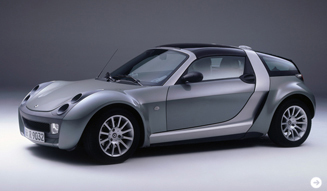
smart roadster
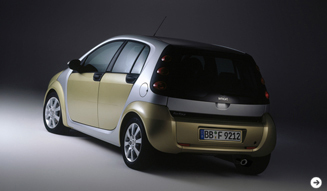
In reality, for use in Japan, the current acceleration and top speed of the smart ed are sufficient. However, having performance reserves does lead to a more relaxed driving experience, which is certainly true.
Nevertheless, emphasizing the "joy of driving" so much inevitably brings to mind the smart roadster. What kind of lineup does Smart plan to offer in the future?
"Unfortunately, we are not currently considering the Roadster. As for new lineup additions, we will introduce the 'forfour,' a four-seater model, in 2014. In the future, a motorcycle will also appear. This will be the 'forone.' Then there's the 'fortwo,' our current model. The next would be 'forthree,' but since we have the 'forfour,' could you accept that 'the larger encompasses the smaller'?"