An Interview with Porsche CEO Wolfgang Hatz: Discussing a New Model Without Compromise | Porsche
42nd Tokyo Motor Show 2011: VIP Interview in Japan
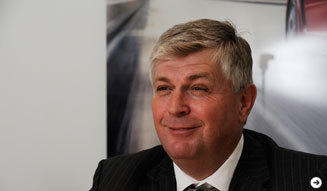
Porsche AG Board Member Wolfgang Hatz
Discussing Uncompromising New Models (1)
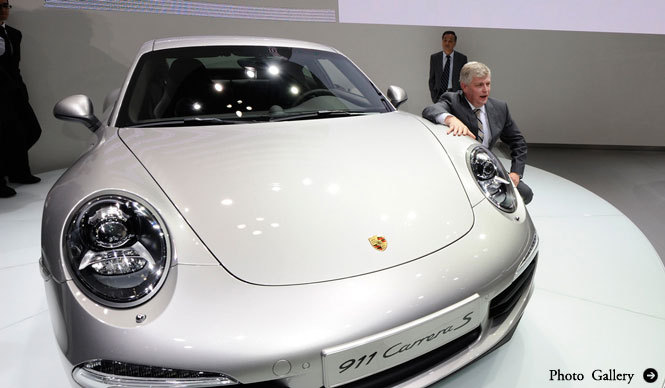
The Porsche 911, a traditional marque upholding the unique rear-engine design, has evolved into a new generation. Its world premiere took place at the IAA Frankfurt Motor Show in Germany. Naturally, the new 911 was the star of the Porsche booth at the recent Tokyo Motor Show. Attending this Japan premiere was Wolfgang Hatz, head of the Weissach R&D Center, a core part of the engineering division, and also a member of Porsche's board. He was present to unveil the new 911, along with his expectations for the Japanese market.
By Motohiro Yamazaki
Developing the New 911 with a Mindset to Renew Everything
The Porsche booth, featuring new faces like the new 911 and the Panamera GTS announced at the Los Angeles Motor Show, was constantly drawing intense attention even long before the press conference began.
Released from the fervor, Mr. Hatz appeared in the interview room prepared on the second floor of the Porsche booth, and our time to converse with him was brief. Porsche is currently a member of the Volkswagen Group, and as a board member of Porsche, he has a packed schedule. It's a situation akin to the meticulously crafted world's finest industrial product, the Porsche 911, where a single misstep could lead to total collapse.
"The development of the new 911, under the internal code name 991, began in 2006 at Weissach. At that time, I was still employed in the engineering department at Audi, but from the project's inception, we were given the freedom to create a completely new 911 while retaining the traditional rear-engine approach, thus inheriting the original concept of the 911. Yes, we challenged ourselves to develop a new model with the mindset of renewing everything about the 911."
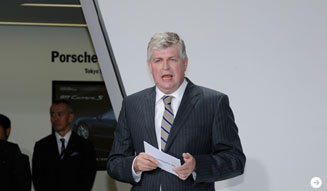
Wolfgang Hatz
The new 911, now in its seventh generation since the first model's debut in 1963, certainly incorporates various new technologies, as evidenced by those words. For instance, the horizontally opposed 6-cylinder engines, also a tradition, are now available in 3.4-liter and 3.8-liter displacements for the new model.
Notably, the entry-level model now features a 3.4-liter displacement, aligning with the global technical trend of downsizing. While the direct objectives are improved fuel efficiency and reduced CO2 emissions, Porsche has succeeded in achieving CO2 emissions of 194g/km (PDK specification) while simultaneously delivering 350 ps, surpassing the output of the 3.6-liter engine in the previous entry-level model.
42nd Tokyo Motor Show 2011: VIP Interview in Japan
Porsche AG Board Member Wolfgang Hatz
Discussing Uncompromising New Models (2)
Body Combining Aluminum and Steel in Ideal Balance
"There are many technical highlights in the new 911. Personally, I would like to draw particular attention to our new approach to lightweight construction technology. The new 911's body has also been enlarged, symbolized by a 100mm increase in wheelbase and a 56mm increase in overall length. The extension of the wheelbase was not a request from the motorsport department; it was the result of our own consideration of what the 911 would need for the future. While inheriting the traditional 911 packaging, it was the best choice to enhance its appeal as a Gran Turismo and particularly to improve stability at high speeds."
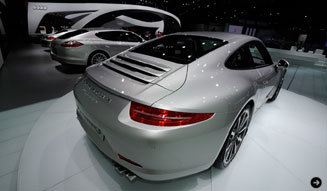
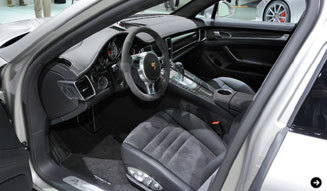
"The greatest feature of our engineering is the optimal selection and use of these materials. Since traditional welding methods cannot be used for steel and aluminum, we have also developed new manufacturing processes. Of course, steel has its advantages. For example, it cannot be denied that steel is overwhelmingly superior in terms of repairability in the event of an accident. Considering collision safety, the material steel is also indispensable. Like weight, rigidity also requires the concept of distribution – balance. In this regard, I believe we can evaluate the new 911 as having created a lightweight yet highly rigid body by using materials in an ideal combination."
42nd Tokyo Motor Show 2011: VIP Interview in Japan
Porsche AG Board Member Wolfgang Hatz
Discussing Uncompromising New Models (3)
Proof of the 911's Intrinsic Excellence
The front and rear suspensions are similar in their active introduction of aluminum materials. As mentioned earlier, the new 911's wheelbase is 2,450mm, an increase of 100mm compared to the previous generation. Furthermore, 20-inch wheels are now standard on the Carrera S, which is equipped with a 3.8-liter engine producing 400ps.
"The expansion of the wheelbase, tread, and tire size. Furthermore, the new 911 incorporates various electronic control devices, such as PTV (Porsche Torque Vectoring), which enhances cornering performance by independently braking each wheel, and PDCC (Porsche Dynamic Chassis Control), which suppresses body roll with electronically controlled variable stabilizers. The electrification of the power steering is also a noteworthy topic, but here too, I would like you to focus on the fact that each component functions precisely, and their combination idealizes the driving performance of the new 911."
"We were not strongly conscious of expanding the cabin space by extending the wheelbase. Incidentally, a more detailed explanation of the 100mm increase would be a 30mm extension towards the front and a 70mm extension towards the rear from the driver's perspective. Aerodynamics have also been further improved, which can be seen as proof of the inherently excellent silhouette of the 911, born about half a century ago."
Sales of the new 911 have already commenced in the Japanese market. The lineup naturally includes both Carrera and Carrera S models. With a 7-speed manual and a 7-speed PDK available for each, there are basically four types of variations.
Furthermore, just before the Tokyo Motor Show, Porsche already announced the addition of the Cabriolet as a new variant. It also features numerous technical highlights, such as the adoption of a lightweight top, which sandwiches a plastic panel between soft top material.
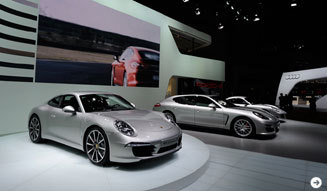
Porsche returned to the Tokyo Motor Show after a four-year absence. From Mr. Hatz's keen gaze, the head of its engineering division, one could strongly sense his satisfaction in creating the new generation 911 without any compromise, and his confidence and anticipation for the new 911 family that will surely follow. Porsche also has plans for several more new models. Will Porsche, appearing at the Tokyo Motor Show in two years, have evolved into a manufacturer asserting a unique presence far beyond our imagination?