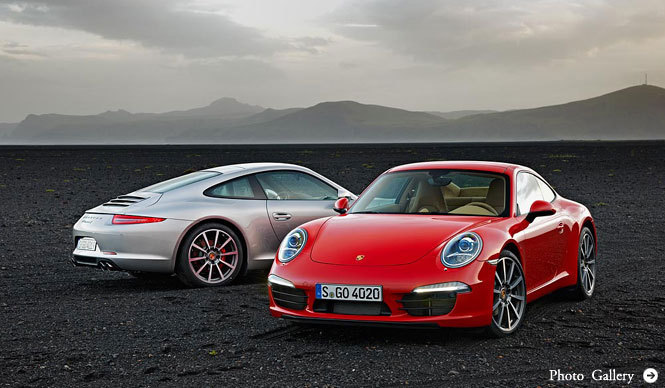
The Allure of the New 911: A Deep Dive into the Porsche
Porsche 911 | The All-New 911
A Detailed Look from Design to Environmental Performance
The Allure of the New 911 (1)
What are the characteristics of the new 911? Porsche describes it in a single phrase: 'Intelligent Performance.' It's distinguished by the use of high-level engineering technology to achieve both low fuel consumption and high performance. Here, we will introduce the full appeal of the new 911, from its design to its environmental performance.
By Fumio Ogawa
DESIGN
The hallmark of the new 911, codenamed 991, is its mechanical layout: a two-door coupe with a horizontally opposed six-cylinder engine mounted at the rear. In essence, the fundamental concept has remained unchanged since 1963.
Michael Mauer, Porsche's current Design Director, views this positively. "The 911 is the only sports car that can be identified by its proportions alone; even without any embellishments, it's immediately recognizable as a 911," he states.
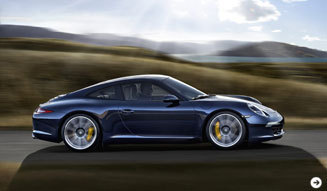
"With the tread width increased, and due to technical requirements, the wheelbase had to be extended by at least 100 millimeters. If you look at the side view, you'll notice that the front overhang has been shortened, won't you?" (Excerpt from an interview in Porsche's magazine, 'Christophorus')
Only four design directors have been responsible for the Porsche 911 throughout its history: Ferdinand Alexander Porsche, Anatole Lapine, Harm Lagaay, and Michael Mauer.

Michael Mauer
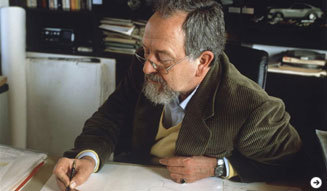
Mauer, who joined Porsche in 2004 after stints at Mercedes-Benz, Smart, and Saab, and was involved in projects like the Panamera, says there are three crucial elements in sports car design: proportion, styling, and detail.
Regarding proportions, the new 911 is 56mm longer than the previous generation 997's late model. However, its cohesive and strong visual presence indicates that elements like the roofline height have been meticulously determined. While inheriting the styling cues from the 997, the flared rear fenders, for instance, express a modern, muscular aesthetic.
And for 911 enthusiasts, details are also paramount. Take the headlights, for example. Although elliptical, the designers meticulously ensured they appear close to the traditional circular shape from certain angles. Including the design of the door mirrors, the subtle points that aficionados of the 911 focus on have been carefully addressed.
Porsche 911 | The All-New 911
A Detailed Look from Design to Environmental Performance
The Allure of the New 911 (2)
ENGINEERING
"The technological advancements in the new 911 are outstanding."
Porscheis the statement. Engineers aimed to achieve both low fuel consumption (reduced CO2 emissions) and high performance. This was accomplished through engine efficiency improvements, vehicle weight reduction, enhancements in fuel-saving technologies across all components, and the evolution of driving dynamics through computer control. In essence, the engineers' efforts can be summarized as 'Intelligent Performance' – a fitting description for a modern sports car.
Engineers, who targeted a '15 percent reduction in fuel consumption compared to the previous generation,' reportedly faced the challenge of an approximately 80kg weight increase due to stringent safety standards. The wheelbase was extended by 100mm, and the vehicle became larger. However, Porsche's engineers, believing that the best way to significantly improve fuel efficiency was through weight reduction, designed the chassis and body using lightweight metals, primarily aluminum. The result was a weight reduction of 115kg.
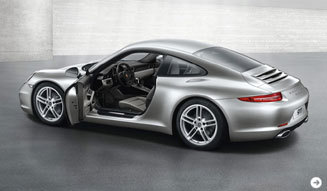
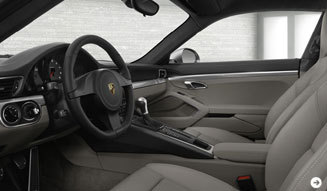
The horizontally opposed six-cylinder engine configuration has been retained, but its internals are new. Porsche particularly emphasizes its various efforts to improve fuel efficiency. In addition to a direct injection system with precise control for optimal fuel consumption, attention has been paid to thermal management. This includes technologies that enhance combustion efficiency through effective preheating, such as delaying the circulation of engine coolant during cold starts. Furthermore, an 'auto start-stop function' that shuts down the engine during idling has been adopted.
Significant changes have also been made to the transmission. One is the world's first claimed seven-speed manual transmission. By increasing the gear ratio in seventh gear for fuel economy, it significantly contributes to reducing fuel consumption at high speeds. The seven gears are distinctly separated in the gate, thoughtfully designed to allow the driver to intentionally engage this gear for economical driving.
The two-pedal dual-clutch transmission system, 'PDK,' which can be driven like an automatic, now incorporates a 'coasting mode.' This mode disengages the clutch on highways and allows the car to coast at idle speed, thereby saving fuel. While the switch from hydraulic to electric power steering has been a topic of discussion among Porsche fans, Porsche explains, "Operating a (hydraulic) power steering system requires a constantly running hydraulic pump. However, our research revealed that during straight-line driving on highways, the steering wheel is rarely moved – approximately 90% of the time." Consequently, an electric motor was adopted, which only operates when the steering system is actually being used. This is also explained as an energy-saving measure.
Porsche 911 | The All-New 911
A Detailed Look from Design to Environmental Performance
The Allure of the New 911 (2)
PERFORMANCE
The lineup of the newly announced 911 consists of two models: the '911 Carrera' and the '911 Carrera S.' The Carrera is equipped with a 3436cc flat-six unit (horizontally opposed six-cylinder engine), while the higher-performance Carrera S boasts a displacement of 3800cc.
For the Carrera, the displacement of the new power unit has been reduced from the 3.6 liters of the previous 997 model.
However, the maximum output has increased from 254kW (345ps) to 257kW (350ps), and despite the reduced displacement, the maximum torque has been maintained at 390Nm.
While the Carrera S retains its 3.8-liter displacement, its power has been boosted from 283kW (385ps) to 294kW (400ps), and its maximum torque has also increased from 420Nm to 440Nm. Porsche emphasizes, "The 0-100 km/h acceleration reaches an astonishing 4.8 seconds for the 911 Carrera and 4.5 seconds for the 911 Carrera S (with PDK)."
The appeal of a sports car lies in the driver's ability to challenge its limits through their own will. With the new 911, the performance of the engine and chassis has been enhanced, further raising that limit. Additionally, it incorporates a technology called 'PDCC (Porsche Dynamic Chassis Control),' which functions as a hydraulically controlled electronic roll stabilization system using suspension stabilizers and dampers.
By controlling the body's roll during cornering, Porsche claims it "promises a driving pleasure far exceeding that of the 997."
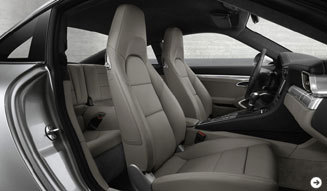
Creating a modern, high-standard sports car using the latest technology – this is precisely why the Porsche 911 is described as 'Intelligent Performance.'