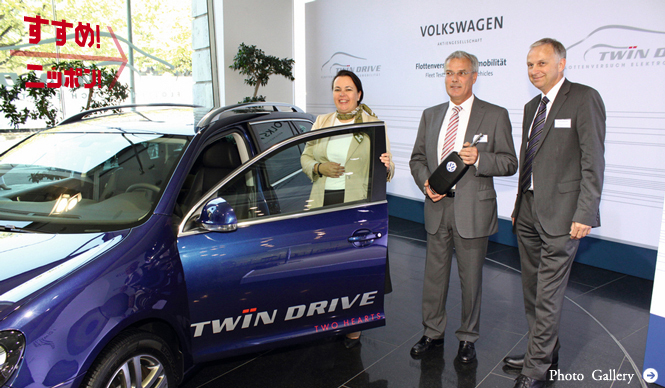
Volkswagen Golf Variant Twindrive
Volkswagen Golf Variant Twindrive |
Volkswagen Golf Variant Twindrive
Demonstration Experiment Using 20 Plug-in Hybrid Vehicles (1)
Volkswagen, along with six project partners (power company E.ON, Fraunhofer Society ISIT for battery systems and battery material development, Heidelberg Institute for energy and environmental research, German Aerospace Center for analysis and traffic scenario creation, and Westfälische Wilhelms-Universität for experimental research on battery cells) and the German Ministry for the Environment, has released an interim report on the "Demonstration Experiment for Electric Mobility," which began in July 2008.
Text by OPENERS
Germany Sets Target of 1 Million EVs by 2020
The "Joint Research on Electric Mobility" has gained further importance following Germany's shift away from nuclear power, prompted by the Great East Japan Earthquake and the accident at the nuclear power plant. The German federal government is planning to set a target of one million purely electric vehicles in Germany by 2020 and to power them with renewable energy.
This can be seen as the realization of the "1-liter car strategy" (a car that consumes only 1 liter of fuel per 100 km) established by Dr. Ferdinand Piëch.the plug-in hybrid "XL1", based on the Golf,the electric vehicle "Golf Blue e-Motion". And recently, it was announced that in the near future, including small cars,a plug-in hybrid system will be introduced across the entire lineup, demonstrating Volkswagen's high level of environmental awareness.
Deploying 20 Plug-in Hybrid "Golf Variant Twindrive" Vehicles
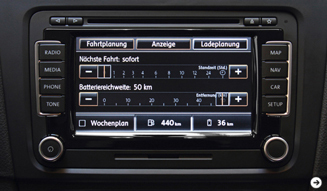
Currently, about 16 percent of Germany's electricity is generated from renewable sources, with a plan to increase this ratio to 30 percent by 2020. However, a disadvantage of natural energy is its unstable supply. Therefore, it is necessary to control electricity usage to prevent demand from exceeding supply capacity during peak times. In this demonstration experiment,the Golf Variant, a plug-in hybrid vehicle based on the Golf Variant, will be deployed in 20 units to analyze driver behavior patterns in daily use.
Volkswagen CEO Winterkorn commented as follows:
"In the medium term, plug-in hybrids hold great promise. This is because they combine the best of both electric and internal combustion engines. The electrification of mobility will continue to be a major challenge for the next century. Everyone, from automotive manufacturers and parts suppliers to energy companies, scientists, and politicians, must be involved."
Let's now turn our attention to the specifics of the Golf Variant Twindrive used in this experiment.
Volkswagen Golf Variant Twindrive |
Volkswagen Golf Variant Twindrive
Demonstration Experiment Using 20 Plug-in Hybrid Vehicles (2)
Up to 57 km of Zero-Emission Driving Possible
As mentioned earlier, the Golf Variant Twindrive is a plug-in hybrid vehicle with a port for external charging. It features an electric motor as the main powertrain, with a gasoline engine playing a supplementary role, a configuration known as a range extender.
The battery is a 13.3 kWh lithium-ion unit (a model with a smaller 11.2 kWh battery was also used in the experiment), and the electric motor alone delivers a maximum output of 65 kW (88 hp) and a maximum torque of 600 Nm. Zero-emission driving is possible up to 57 km. This is combined with an 85 kW (115 hp) 1.4-liter TSI engine, resulting in a total system output of 120 kW (163 hp). Fuel efficiency when using the engine is an impressive 48 km/l, with CO2 emissions of 49 g/km. Performance is more than adequate, with a top speed of 170 km/h and 0-100 km/h acceleration in 12 seconds. The vehicle can reach speeds of up to 120 km/h even in electric mode.
Mass Introduction of Plug-in Hybrid Vehicles Planned for 2013/2014
The Golf Variant Twindrive can automatically select its driving mode based on the driver's input, driving conditions, or battery charge level. In the electric-only mode, called E-drive, the TSI engine is stopped and disengaged from the electric motor/drivetrain by a separation clutch. If more power is needed, the TSI engine starts instantly. Additionally, when the vehicle brakes during driving, the electric motor converts the vehicle's kinetic energy into electricity and charges the battery through regenerative braking. Charging time is approximately 20 minutes with a rapid charger, or 5 hours using a household outlet.
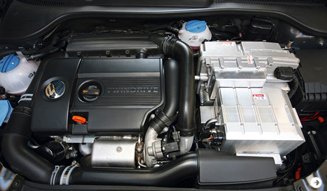
Volkswagen aims to mass-introduce plug-in hybrid vehicles to the market in 2013 and 2014. Furthermore, although not widely publicized, they are also researching the idea of using the installed lithium-ion batteries as home energy storage systems in the future. This demonstration experiment is scheduled to continue until June 2012. We eagerly anticipate future developments.