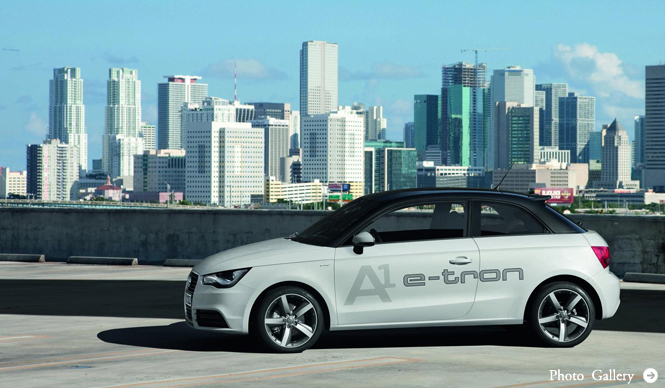
Audi A1 e-tron
Audi A1 e-tron
The Premium Compact Hybrid Model
Audi has released footage of the "A1 e-tron," a plug-in hybrid version of its premium compact "A1" aimed at younger customers, which features a rotary engine solely for power generation.
By Giraffe
A Hybrid System Boasting 52.63 km/L Fuel Economy
The A1 e-tron is primarily an EV model that runs on electric power alone. Its motor produces a maximum output of 61 ps and a peak torque of 15.3 kgm, enabling it to travel up to 50 km on zero emissions.
It also features an overboost mode, which, even then, delivers a modest 102 ps and 24.5 kgm of torque. Combined with its lightweight 1190 kg, it achieves practical figures of 0-100 km/h in 10.2 seconds and a top speed of 130 km/h. The impressive European combined fuel economy is 52.63 km/L, with CO2 emissions of 45 g/km, clearly demonstrating its environmental consideration.
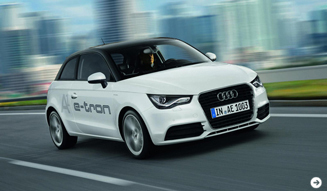
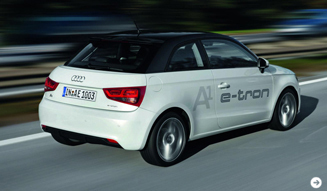
It utilizes a 12 kWh lithium-ion battery as its secondary power source, which can be charged via a socket in the front grille. Charging is possible in approximately 3 hours with a 380V power supply.
Additionally, when the battery level drops low, a rotary engine dedicated to power generation starts up. Despite its small displacement of just 254cc, it delivers a maximum output of 20 ps. This engine's kinetic energy rotates a generator, supplying power to the motor while also charging the battery. The fuel tank capacity is 12 liters, and it's said that the power generation can extend the driving range by an additional 200 km. Audi plans to introduce the A1 e-tron globally as a "mega city vehicle" intended for use in and around urban areas.
We encourage you to experience the quiet ride characteristic of a hybrid model and the unique charging methods of the e-tron model in the following video provided by Audi.
BRAND HISTORY
The Audi emblem is the "Four Rings." As you may know, each ring represents one of the automotive manufacturers: Audi, DKW (Drakenburg), Horch, and Wanderer. All were based in Saxony and were leading brands in the German automotive industry at the beginning of the 20th century. However, the four companies, hit by the global depression following World War I, formed Auto Union in 1932 to survive. DKW focused on motorcycles and small cars, Wanderer on mid-size cars, Audi on premium mid-size cars, and Horch on luxury cars.
However, following defeat in World War II, Saxony in East Germany fell under Soviet occupation, and Auto Union dissolved. Anticipating this, the new Auto Union was established in Ingolstadt, Bavaria, in West Germany. Unlike BMW and Mercedes-Benz, Auto Union faced a difficult start without existing factories, but gradually built its strength through production such as the DKW delivery van.
In late 1964, Auto Union came under the umbrella of Volkswagen and soon introduced new models bearing the Audi name. In 1969, it merged with NSU (known for developing the "Wankel engine"), based in Neckarsulm, becoming Audi NSU Auto Union. From 1985 onwards, it has continued as Audi to the present day. Technology such as Quattro, dynamic performance backed by motorsport activities, elegant design, and high-quality finishes are driving Audi's popularity.