February 27, 2015
BMW 6 Series | BMW's Own Four-Door Coupe
BMW 6 Series|BMW 6 Series
A Four-Door Coupe from BMW
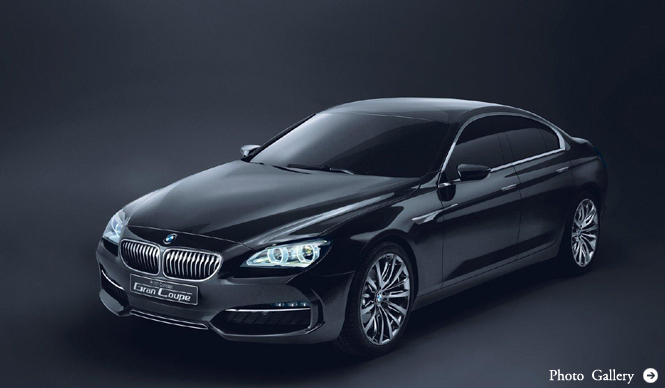
At a media event called "Design Night" held in Munich, Germany, BMW revealed that a four-door coupe will be added to the next-generation "6 Series."
Text by Giraffe
Possibility of a Hybrid Model
At the venue for the European debut of the concept car "Concept Gran Coupe," Klaus Ddrr, a member of BMW's board of management, explicitly stated that a four-door coupe would be added to the next 6 Series. It is understood that in addition to gasoline and diesel engines, a hybrid system could also be considered for the vehicle's powertrain.
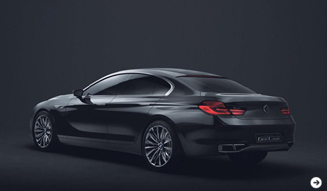
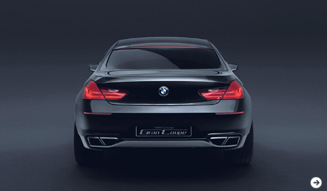
This four-door coupe, despite its large size with an approximate overall length of 5,000mm, has a height of less than 1,400mm, exuding a sporty ambiance. The styling, said to be inspired by a shark, features a sharp nose that transitions into a gently arcing roofline.
Scheduled for Release in Late 2012
While the current 6 Series is available as a two-door coupe and convertible, the addition of a four-door coupe in the next generation will undoubtedly allow it to reach a broader audience. Furthermore, Klaus Ddrr hinted at the possibility of a station wagon, which is something we will continue to watch with interest.
The next 6 Series will compete with the recently announced Audi A7 Sportback and the new Mercedes-Benz CLS, scheduled to debut at the Paris Motor Show in September. Its release is planned for the latter half of 2012.
BRAND HISTORY
With its distinctive front fascia characterized by the "kidney grille" and quad round headlights, BMW is instantly recognizable. While it consistently enjoys high popularity in the Japanese imported car market, surprisingly few people can immediately answer what its name signifies.
Bayerische Motoren Werke. Literally translated, it means "Bavarian Motor Works." Its predecessor, Rapp Motorenwerke, was an aircraft engine manufacturer founded in 1913 in Bavaria, Germany, by Karl Friedrich Rapp. By partnering with another Bavarian aircraft manufacturer, Otto-Flugzeugwerke, the business achieved success. In 1916, it was renamed Bayerische Motoren Werke GmbH. Two years later, it was reorganized into a stock company, and the propeller logo, inspired by the blue skies and white clouds of Bavaria, was registered.
BMW continued to enhance its presence through innovative technology, but due to Germany's defeat in World War I, it was forced to cease aircraft engine production. BMW then channeled its expertise into motorcycles, gaining attention in 1923 with the shaft-driven "BMW R32." However, not content with this, the company acquired Dixi, which was licensed to produce the Austin Seven. This provided a foothold in the automotive business, and in 1929, the "BMW 3/15 PS" was launched, marking the start of its history as an automobile manufacturer.
Incidentally, Otto-Flugzeugwerke, which had a close relationship with BMW, was founded by Gustav Otto, the son of Nikolaus August Otto, who established the theory of the internal combustion engine. This historical connection likely explains BMW's continued focus on internal combustion engines.