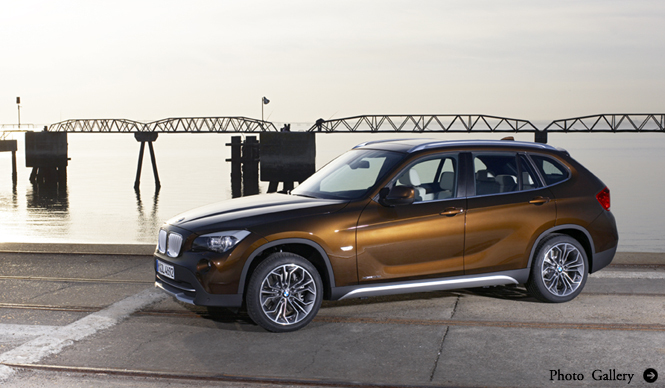
BMW X1 | The entry model of the X Series
BMW X1
The Entry Model to the X Series
BMW announced that it will begin accepting orders for the new BMW X1, its sole SAV in the premium compact segment and the entry model to its X series, at authorized BMW dealerships nationwide starting April 20.
Photo: BMW
Body Size Considered for the Japanese Market
The X models now number four with the model announced this time. The X3 and X5 established a new segment with their innovative SAV (Sports Activity Vehicle) concept, which clearly distinguished them from the rugged SUVs of the past by enhancing on-road performance. Furthermore, the X6, announced in 2008, formed a concept called the world's first Sports Activity Coupe, combining the sporty and elegant design of a coupe with the powerful presence of a BMW model.
The new X1 is born as the first SAV in the premium compact segment.
BMW describes the new X1 as the first SAV in the premium compact segment, offering the convenience for active lifestyles with its semi-command seat position providing a sense of security while driving due to its high eye point, an open and spacious interior, versatile storage functions, and a rear seat that can be arranged freely, all combined with the agile and exhilarating driving performance unique to BMW. Moreover, the new X1 was developed with sufficient consideration for the characteristics of the Japanese market, achieving a body size of 1,800mm in width and 1,540mm in height, which fits within typical mechanical parking garages.
The model lineup includes the new BMW X1 xDrive25i equipped with the intelligent all-wheel-drive system xDrive, as well as the new BMW X1 sDrive18i, a rear-wheel-drive model which is the first for a BMW X model, allowing for model selection tailored to individual needs.
Design Exuding Strength and Elegance, Concealing Functionality
The driving performance of the new X1 is characterized by its exceptional agility and versatility for various situations. This can also be inferred from its body design. A long engine hood, short overhangs, and a long wheelbase of 2,760mm create a stretched proportion. The front features a design that emphasizes presence with a powerful bumper and a kidney grille seamlessly integrated, while flared wheel arches and the press line extending over the engine hood to the kidney grille express strength. The silver underguard below the air intake signifies its membership in the X model family.
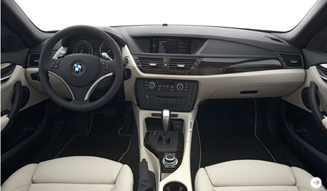
Inside, the large trim panels and dynamic lines create a sporty and youthful impression. The dashboard is divided by horizontal lines that connect to the door trims, emphasizing width and making the interior feel more spacious.
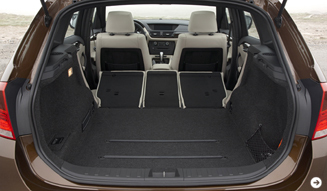
Along with the spacious interior, it offers versatility with adjustable seat layouts to suit different situations. The full-sized rear seats comfortably accommodate three adults, and the backrest angle can be adjusted. The 40:20:40 split-folding backrest can expand the cargo space to 1,350 liters when fully folded.
Achieves a Class-Leading Drag Coefficient of 0.32 in the Compact SUV Segment
The "BMW EfficientDynamics" design philosophy, which enables higher performance with less energy, is also adopted in the new X1. By incorporating numerous cutting-edge technologies such as Valvetronic, a 6-speed automatic transmission, micro hybrid (brake energy regeneration system), and lightweight construction, excellent environmental performance can be expected. Furthermore, efforts were made from the early stages of development to significantly reduce air resistance, contributing to lower fuel consumption and reduced emissions. As a result of optimizing aerodynamic characteristics, a drag coefficient (Cd value) of 0.32, among the top in the compact SUV segment, has been achieved.
The engine lineup consists of two types: a 2.0-liter inline 4-cylinder and a 3.0-liter inline 6-cylinder. The former is rear-wheel drive, a first for the X series, while the latter is the familiar all-wheel drive. Regarding pricing, the BMW X1 xDrive25i is set at 4.8 million yen, the first time an xDrive-equipped model is priced under 5 million yen, and the BMW X1 sDrive18i is priced at 3.63 million yen, significantly below 4 million yen.
BMW X1 sDrive18i
Body: Length 4,470 x Width 1,800 x Height 1,540mm
Wheelbase: 2,760mm
Vehicle Weight: 1,560kg
Engine: 2.0-liter inline 4-cylinder DOHC
Max Output: 110kW [150ps] / 6,400rpm
Max Torque: 200Nm [20.4kgm] / 3,600rpm
Drivetrain: Rear-wheel drive
Transmission: 6-speed AT
Price: 3.63 million yen
BMW X1 xDrive 25i
Body: Length 4,470 x Width 1,800 x Height 1,545mm
Wheelbase: 2,760mm
Vehicle Weight: 1,710kg
Engine: 3.0-liter inline 6-cylinder DOHC
Max Output: 160kW [218ps] / 6,100rpm
Max Torque: 280Nm [28.6kgm] / 2,500-3,500rpm
Drivetrain: All-wheel drive
Transmission: 6-speed AT
Price: 4.8 million yen
BRAND HISTORY
BMW's distinctive front mask, characterized by its "kidney grille" and four round headlights, makes it instantly recognizable. While it consistently holds high popularity in the Japanese imported car market, surprisingly few people can immediately answer what its name signifies.
Bayerische Motoren Werke. Literally translated, it means "Bavarian Engine Works." Its predecessor, Rapp Motorenwerke, was an aircraft engine manufacturer founded in Bavaria, Germany, in 1913 by Karl Friedrich Rapp. Rapp partnered with fellow Bavarian aircraft manufacturer Otto-Flugzeugwerke to achieve business success. In 1916, it was renamed Bayerische Motoren Werke GmbH. Two years later, it was reorganized into a stock corporation, and the propeller logo, inspired by the blue sky and white clouds of Bavaria, was registered.
BMW continued to enhance its presence through innovative technology, but due to Germany's defeat in World War I, it was forced to cease aircraft engine production. BMW then channeled its expertise into motorcycles, attracting attention with the shaft-driven "BMW R32" in 1923. However, not content with that, it acquired Dixi, a company that licensed production of the Austin Seven. This provided a foothold in the automotive business, and in 1929, BMW launched the "BMW 3/15 PS," marking the start of its history as an automobile manufacturer.
Incidentally, Otto-Flugzeugwerke, which had a deep relationship with BMW, was founded by Gustav Otto, the son of Nikolaus Otto, who established the theory of the internal combustion engine. This historical connection likely explains BMW's continued focus on internal combustion engines.