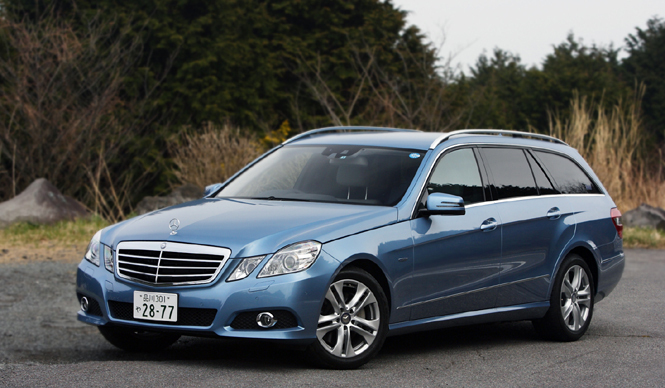
Mercedes-Benz E-Class Station Wagon
Mercedes-Benz E-Class Wagon: A Test Drive
A New Station Wagon with Deep Driving Dynamics and Functionality (1)
A full model change has been implemented.Mercedes-BenzWe test drove the Mercedes-Benz E-Class Station Wagon. The new station wagon was launched in Japan by Mercedes-Benz Japan on February 24, 2010. It features enhanced functionality, such as the "largest luggage capacity of any station wagon," while also improving fuel economy.
Text by Fumio OgawaPhotos by Masayuki Arakawa
More Space. Luggage Capacity Increased by Up to 20 Liters
The new E-Class Station Wagon, known as the S211, is characterized by "more interior space than its predecessor" (according to the Japanese subsidiary). Comparing the exterior dimensions of the new model with the previous S210, the wheelbase has been extended by 20mm to 2,875mm, and the wagon body's overall length is 4,910mm (15mm longer than the predecessor), with a width of 1,855mm (35mm wider). The overall height remains the same at 1,500mm (for the Avantgarde). This results in an increase in luggage capacity of 15 to 20 liters.
The lineup is as follows:
E250CGI BlueEFFICIENCY Station Wagon (¥6.69 million)
E300 Station Wagon (¥7.65 million)
E350 BlueTEC Station Wagon Avantgarde (¥8.33 million)
E350 4MATIC Station Wagon Avantgarde (¥9.30 million)
E550 Station Wagon Avantgarde (¥11.15 million)
E63 AMG Station Wagon (¥15.30 million)
The engine lineup is thus broad. Notably, the S211 model features a high-efficiency, low-consumption "BlueEFFICIENCY" system with a 1.8-liter four-cylinder engine equipped with a turbocharger, following the sedan's introduction. Furthermore, the "BlueTEC" model, equipped with a clean diesel engine that successfully removes nitrogen compounds and particulate matter using urea, is also noteworthy.
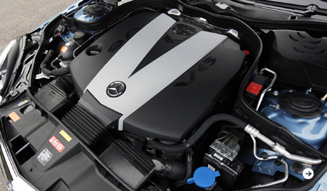
Let's start with the clean diesel, which is generating significant buzz. The engine is a 3-liter V6 that produces 211 horsepower, equipped with a direct fuel injection system and a turbocharger with a variable nozzle turbine. This is combined with the "BlueTEC" system.
"BlueTEC" is a system developed to purify diesel exhaust gases. Its main feature is the effective removal of the two major harmful components in diesel exhaust: nitrogen compounds known as NOx and particulate matter (PM). While increasing engine combustion efficiency can reduce PM, NOx, which burns at relatively low temperatures, remains. Therefore, "BlueTEC" employs a mechanism that injects urea in the final stage of the exhaust system to neutralize NOx, breaking it down into nitrogen and water.
Mercedes-Benz E-Class Wagon: A Test Drive
A New Station Wagon with Deep Driving Dynamics and Functionality (2)
"BlueTEC" Decomposes Harmful Substances Using Urea
The urea water solution, known as "AdBlue," is stored in a 24-liter tank located under the trunk floor. Approximately 1 liter is consumed for every 1,000 km driven. Therefore, in most cases, replenishment is carried out at the service center during vehicle inspections. A similar system is used in heavy-duty commercial vehicles from Mitsubishi Fuso Truck and Bus Corporation, part of Daimler Truck. However, in passenger cars, it is expected to be adopted in diesel models from various German manufacturers, including the Audi Q7 diesel scheduled for introduction in Japan this year.
Compared to the previous diesel model, the E320CDI, the NOx emissions are reduced by 69% and PM by 21%. Driving the E350 BlueTEC Station Wagon Avantgarde, equipped with the cleaner BlueTEC diesel engine, the engine's feel is indeed excellent. As expected from its characteristic of producing maximum torque at 1600rpm, it accelerates powerfully from just above idling, and the acceleration becomes intense as it enters the turbo range.
It is fundamentally the same as the previous S210 E320CDI, but the level of refinement is clearly higher, with smoother and more comfortable acceleration and power delivery. Even those unfamiliar with diesel engines will likely not feel any sluggishness. In fact, with a substantial torque of 55.1 kgm available from 1,600 rpm, the low-speed acceleration is superior to gasoline engines. Furthermore, at 100 km/h cruising speed, the engine speed is less than 2,000 rpm, making it remarkably quiet. This is also a virtue of the diesel engine.
Because the diesel model's urea tank is located in the trunk, the space for the spare tire is lost. Therefore, the Japanese specification is equipped with Goodyear run-flat tires. Although the exact mileage is not specified, run-flat tires allow for driving distances of about 50-100 km even with a puncture.
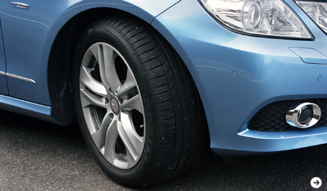
These run-flat tires are a subject of debate, with some critics harshly stating that they compromise the directness of handling and sacrifice steering accuracy in corners. Indeed, compared to regular tires, the response around the neutral position is vague, and there is some initial discomfort.
However, once you start driving, it's surprisingly not bothersome. In fact, the relaxed feel, compared to tires with quicker response around the neutral position, is rather pleasant. Unlike the Lexus SC430, which came standard with run-flat tires and couldn't overcome its unnatural feel during its 10-year model life, the E350 BlueTEC Station Wagon Avantgarde demonstrates a good match between its ride comfort, handling setup, and tire characteristics.
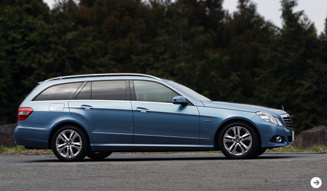
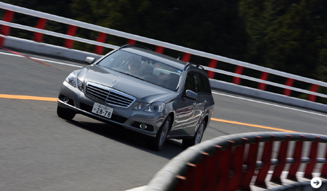
The styling has become more sporty. With character lines on the side of the body, the presence of the rear wheels is emphasized, similar to the current W211 (sedan). This successfully conveys an image of a station wagon that also offers driving enjoyment.
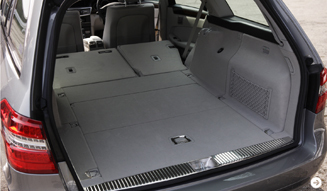
The luggage compartment expands by folding down the split-folding second-row seats. It boasts the largest load capacity among station wagons. This is a testament to Mercedes' long tradition in building wagons. Furthermore, thanks to the wheelbase extended by 20mm compared to the predecessor, the interior space feels more expansive. Both front and rear passengers have ample legroom, shoulder room, and headroom, making for a comfortable ride.
Mercedes-Benz E-Class Wagon: A Test Drive
A New Station Wagon with Deep Driving Dynamics and Functionality (3)
1.8-Liter Four-Cylinder + Turbocharger BlueEFFICIENCY
Another noteworthy model is the E250CGI BlueEFFICIENCY Station Wagon (¥6.69 million), equipped with a 1.8-liter four-cylinder engine and a turbocharger. This model achieves high efficiency while suppressing fuel consumption. CGI stands for Charged Gasoline Injection.
Its efficiency, with high power output of 204 ps and fuel economy exceeding 11 km/liter in the 10-15 mode, has already been proven in the sedan. The setup, which generates a maximum torque of 31.6 kgm at 2,000 rpm, should be sufficient even for a wagon weighing approximately 1.8 tons... However, in reality, there is a noticeable difference in acceleration above and below approximately 2,000 rpm, where the turbo's effect becomes apparent.
Starting off feels a bit heavy, and to quickly merge into traffic, you inevitably have to press the accelerator pedal further. While this might not be a major issue in consistent traffic conditions like in Europe, it can feel a bit jerky in urban Japan until you get used to it. Perhaps due to the car's weight, which is about 100kg more than the lighter sedan I drove previously, this was not an issue then.
With its standard radial tires, the E250CGI BlueEFFICIENCY feels sporty, especially after driving the BlueTEC with run-flat tires. In fact, the response to steering input is significantly improved. On winding roads, it demonstrates surprisingly sporty handling for a station wagon. Even with slight steering input near the center, the car immediately reacts and changes direction. This aspect truly conveys the feeling of a new generation Mercedes.

Mercedes-Benz E350
BlueTEC Station Wagon Avantgarde
Body: Length 4900 x Width 1855 x Height 1500mm
Wheelbase: 2,875mm
Vehicle Weight: 1,820kg
Engine: 3.0L V6 DOHC (Diesel) + Intercooled Turbocharger
Max Output: 155kW [211ps] / 3400rpm
Max Torque: 540Nm [55.1kgm] / 1600-2400rpm
Drivetrain: Rear-wheel drive
Transmission: 7-speed automatic
Price: ¥8.33 million
Mercedes-Benz E250
CGI BlueEFFICIENCY Station Wagon
Body: Length 4900 x Width 1855 x Height 1515mm
Wheelbase: 2,875mm
Vehicle Weight: 1,770kg
Engine: 1.8L Inline 4-cylinder DOHC + Intercooled Turbocharger
Max Output: 150kW [204ps] / 5500rpm
Max Torque: 310Nm [31.6kgm] / 2000-4300rpm
Drivetrain: Rear-wheel drive
Transmission: 7-speed automatic
Price: ¥6.69 million
MERCEDES CALL
0120-190-610