March 5, 2015
BMW 3 Series Coupe & Convertible | Embodiment of "EfficientDynamics"
BMW 3 Series Coupe & Convertible
Embodying "EfficientDynamics"
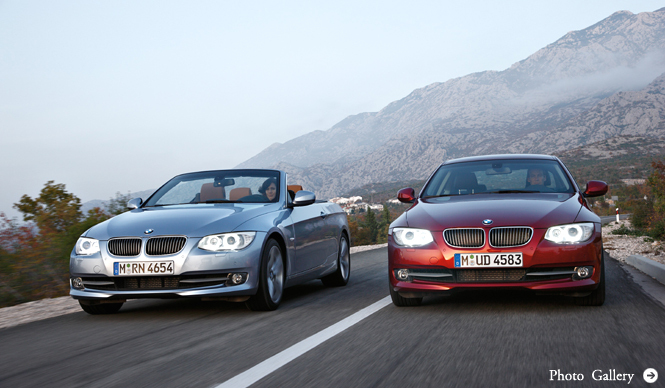
BMW has announced the 2010 models of the "Coupe" and "Convertible" (Japanese name: Cabriolet) versions of the 3 Series for the European market.
Text by Giraffe
Wider Kidney Grille
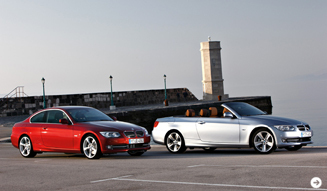
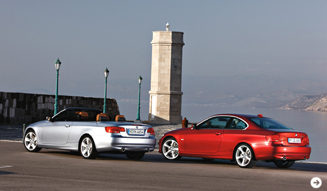
The changes are mainly to the exterior, including a wider kidney grille, newly designed headlamps, and revised designs for the front and rear bumpers, door mirrors, and tail lamps.
The overhangs have been extended by 29mm at the front and 3mm at the rear, giving it a sportier impression. The adoption of optional LED daytime running lights is also a notable topic for this new model.
A significant feature is the new engine lineup, which further refines BMW's "EfficientDynamics" philosophy of "more performance with less energy."
The direct-injection 3.0-liter inline-6 engine in the top-grade "335i" has been changed from a twin-turbo to a twin-scroll single-turbo, producing a maximum output of 306 ps at 5800 rpm and a maximum torque of 40.8 kgm between 1200 and 5000 rpm. The maximum torque is generated 100 rpm lower than the previous engine, achieving 0-100 km/h in 5.5 seconds for the Coupe and 5.8 seconds for the Convertible. The top speed for both is 250 km/h (with limiter).
Despite this, the European combined fuel economy is 11.9 km/l, and CO2 emissions are 196 g/km, an improvement of about 8 percent in environmental performance compared to the previous model, showcasing the capabilities of the new engine.
Two Diesel Variants
The "318i" has been newly set as the entry-level model. Its 2.0-liter inline-4 engine produces a maximum output of 143 ps at 6000 rpm and a maximum torque of 19.4 kgm at 4250 rpm, with 0-100 km/h acceleration in 9.1 seconds for the Coupe and 10.3 seconds for the Convertible. The top speed for both is 210 km/h. It achieves European combined fuel economy of 15.87 km/l and CO2 emissions of 146 g/km.
For diesel engines, new units are also installed in both the "325d" and "320d" models. The "325d" features a new 3.0-liter inline-6 diesel engine equipped with a variable geometry turbocharger and the latest common-rail injection system. This unit delivers a maximum output of 204 ps at 3750 rpm and a maximum torque of 43.8 kgm at 1750 rpm. Performance figures include 0-100 km/h acceleration in 6.9 seconds (Coupe) and 7.5 seconds (Convertible), with top speeds of 244 km/h (Coupe) and 238 km/h (Convertible). Environmental performance is also notable, with European combined fuel economy of 17.54 km/l and CO2 emissions of 151 g/km.
Meanwhile, the newly designed 2.0-liter inline-4 turbo diesel engine in the "320d" produces a maximum output of 184 ps at 4000 rpm and a maximum torque of 38.7 kgm at 1900 rpm. These figures represent an increase of 7 ps in maximum output and 3 kgm in maximum torque compared to the previous model. This results in 0-100 km/h acceleration of 7.5 seconds (Coupe) and 8.3 seconds (Convertible), with top speeds of 237 km/h (Coupe) and 228 km/h (Convertible). It achieves an impressive European combined fuel economy of 21.28 km/l and CO2 emissions of 125 g/km.
A total of nine engines (five gasoline, four diesel) are available for the 2010 European 3 Series Coupe and Convertible models.
The Coupe models are also available with the 4WD "xDrive" system. The 6-speed manual transmission variants of the 335i and 320d are equipped with a dry-sump lubrication system, also featured in the new 5 Series.
We await its introduction to Japan.
BRAND HISTORY
BMW is instantly recognizable by its front fascia, characterized by the "kidney grille" and quad round headlights. While consistently popular in the Japanese imported car market, surprisingly few people can immediately explain what its name signifies.
Bayerische Motoren Werke. Literally translated, it means "Bavarian Engine Works." Its predecessor, Rapp Motorenwerke, was an aircraft engine manufacturer founded in 1913 in Bavaria, Germany, by Karl Friedrich Rapp. It partnered with fellow Bavarian aircraft manufacturer Otto-Flugzeugwerke to achieve business success. In 1916, it was renamed Bayerische Motoren Werke GmbH. Two years later, it reorganized as a stock company and registered its propeller logo, inspired by the blue skies and white clouds of Bavaria.
BMW continued to enhance its presence through innovative technology, but the defeat in World War I forced it to cease aircraft engine production. BMW then channeled its expertise into motorcycles, unveiling the shaft-driven "BMW R32" in 1923, which garnered significant attention. However, not content with this, it acquired Dixi, which was licensed to produce the Austin Seven. This provided a foothold in the automotive business, and in 1929, BMW launched the "BMW 3/15 PS," marking the start of its history as an automobile manufacturer.
Incidentally, Otto-Flugzeugwerke, which had a close relationship with BMW, was founded by Gustav Otto, the son of Nikolaus August Otto, who established the theory of the internal combustion engine. This historical connection likely explains BMW's continued focus on internal combustion engines.