March 17, 2015
PORSCHE BOXSTER SPYDER (Part 2) | The Ultimate Lifestyle Car
PORSCHE BOXSTER SPYDER | Porsche Boxster Spyder (Part 2)
The Ultimate Lifestyle Car
The long-rumored high-performance version of the Boxster has debuted as the "Boxster Spyder." In the latter half, Porsche fanatic Hisayasu Shimashita delves into its driving appeal.
Text by Hisayasu ShimashitaPhotos by Porsche Japan
Power Unit Transplanted from the Cayman S
The heart of the Boxster Spyder, its 3.4-liter direct-injection flat-six, produces a maximum output of 320 ps and peak torque of 370 Nm, an increase of 10 ps and 10 Nm over the Boxster S. In fact, this is the exact unit from the Cayman S. When we asked the development team in the past, they said the Boxster, as an open-top sports car, prioritized low-to-mid-range usability over maximum output. However, it was judged that a high-revving, high-output characteristic was more fitting for the pure sports car that is the Boxster Spyder. Even so, its lack of weakness in the practical range is, needless to say, thanks to the car's light weight.
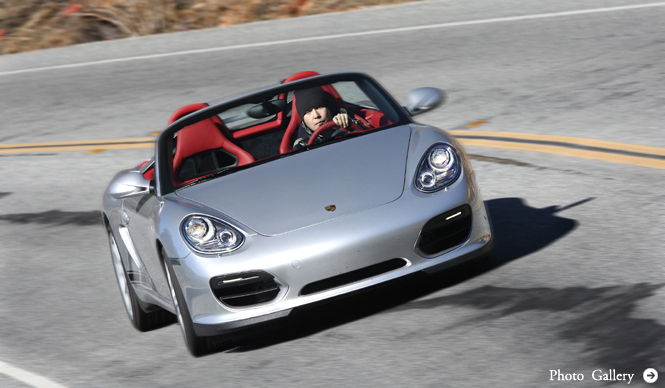
Press the accelerator, and the car immediately surges forward; lift off, and it decelerates smoothly. Turn the steering wheel, and the nose darts left or right. The response to every input is clearly tighter than the Boxster S, making my heart race with the sense of unity with the car. The lightness, which can be felt even when simply navigating an intersection, is a joy.
The PASM adaptive damping system is omitted. The suspension, set to a firmer setting, along with the lowered ride height and particularly the weight reduction in the upper body, has lowered the center of gravity by 25mm, significantly contributing to the lightness of its movements. On the other hand, the ride comfort is correspondingly firm. The public roads near Carmel, California, where I test drove it, were far from smooth, but thanks to the solid rigidity of the body, I didn't find it uncomfortable at all. The body hasn't been specifically reinforced, but the weight reduction has effectively increased its rigidity.
With that in mind, cornering is bound to be exhilarating. Turn-in is exceptionally sharp. With barely any perceptible roll, the nose cuts into the corner as if moving in parallel. Once it starts turning, it changes direction cleanly, like a spinning top at the center of which you are positioned, true to its mid-engine layout. Then, as you see the exit, you apply the accelerator. The mechanical LSD, an option on the Boxster S, is standard here, providing outstanding traction to powerfully propel the car forward.
In any case, every movement is devoid of waste, and it excels in balance. Its footwork, to use a cliché, is like that of a finely trained athlete.
The Ultimate Porsche for a Satisfying Sweat
When pushed hard like this, the engine feel is also exhilarating. As the revs climb, the response sharpens noticeably from around 4000 rpm, and if you keep your foot down, you're rewarded with a final surge of acceleration just before the redline. The sound, which changes with increasing revs, also reaches your ears more directly. At this point, you can't help but keep accelerating.
Consequently, I spent the entire day driving around with insatiable enthusiasm. In the sense of being able to work up a satisfying sweat on public roads, I can confidently say this is the ultimate Porsche.
Logically speaking, the practicality and everyday usability that are strengths of the Boxster are certainly sacrificed in exchange for this performance. While the top can be removed by one person, it takes over five minutes. Sudden rain would be troublesome, and it's understandable if a passenger loses patience. In the first place, it would be difficult to endure a Japanese summer without air conditioning.
However, if you are drawn to its form, it would be a shame to give up over such minor inconveniences. The key is to change your perspective and approach it with the leisure to even enjoy the process of removing the top. Always checking the weekend weather forecast, and when it's time to drive, slowly removing the top in the garage before heading out in style. Such moments, interspersed with the hustle and bustle of daily life, will be filled with an unparalleled sense of fulfillment.
Stoic and Spartan. The Boxster Spyder is certainly such a car in terms of hardware, but when you think about it that way, it might just be the ultimate lifestyle car after all.
Porsche Japan
http://www.porsche.com/japan/
BRAND HISTORY
PORSCHE is a sports car brand representing Germany, earning overwhelming support from skilled drivers worldwide. Its origins trace back to 1931. Ferdinand Porsche, a genius who distinguished himself as an automotive engineer from his twenties, gained experience as technical director at Daimler before establishing his own "Porsche Design Office" in Stuttgart, Germany. From then on, he was entrusted with developing various cars for automobile manufacturers. Among his most famous works is the "Volkswagen Beetle," which greatly contributed to motorization as Germany's "people's car."
The first car to bear his name as a manufacturer was the "356," which appeared in 1948. Since then, Porsche has released sports cars such as the "911," "924," and "928," while also focusing on motorsports. For example, they have achieved 16 victories in the 24 Hours of Le Mans, arguably the world's most grueling race, and contributed to three series championships as an engine supplier in Formula 1, accumulating a brilliant track record. It goes without saying that their technological prowess and commitment to driving continue to live on in their products today.
Currently, their lineup, including the "911" which continues to be highly acclaimed as a top-tier sports car even 45 years after its debut, the open-top sports car "Boxster," the coupe version of the Boxster, the "Cayman," and the premium sports SUV "Cayenne," all boast immense popularity.