March 5, 2015
PORSCHE 911 turbo (Part 2): The Pinnacle of the Latest Turbo
PORSCHE 911 Turbo | The Porsche 911 Turbo (Part 2)
What is the Pinnacle Reached by the Latest Turbo?
Since its debut in 1974, the 911 Turbo has reigned as Porsche's flagship model. Its latest iteration has now been unveiled.
Text by Satoshi WatanabePhotos by Porsche Japan
Ultimate Comfort for a Pure Sports Car
What stands out most during our test drive of the new 911 Turbo on public roads is its comfort. The refinement in terms of noise and vibration is nothing short of dramatic compared to the previous model. At sensible speeds, its ride quality is on par with a standard Carrera, offering no discernible compromise. The 911's ride is now so sophisticated it approaches that of a sports sedan, making its suitability as a daily driver reach a level that is arguably ultimate for a pure sports car.
The seamless handling is also aided by the flawless tuning of the PDK, which delivers minimal shock during gear changes. Fuel economy, encompassing a mix of city and highway driving typical for daily use, hovered around 6-12 km/l. These figures serve as a testament to its excellent CO2 emissions.
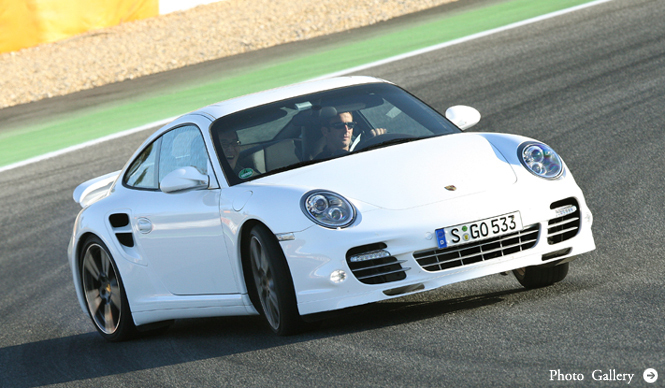
Moving to the circuit, the first thing that impresses is its resilience. Even after repeated full-throttle laps in temperatures nearing 30 degrees Celsius, neither the engine nor the brakes show any signs of fading. It's a testament to Porsche's engineering that a car with the thermal demands and high speeds of the Turbo can maintain such consistent performance. This is truly a Porsche product.
Without exaggeration, the power of the new 911 Turbo is enough to make one's blood run cold. Its world-class acceleration seems to carve through the gaps between corners, leaving the driver no time to catch their breath. Yet, upon regaining composure, one notices that this immense power builds linearly and smoothly from very low RPMs. This surge continues with unwavering linearity and composure right up to the 7000rpm redline, without any excessive drama.
The Driving Character Unique to the 911
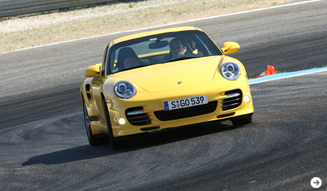
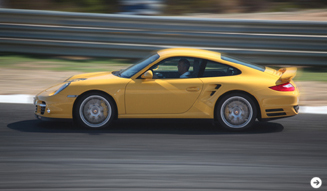
Throughout the drive, the handling exhibited a consistent, mild understeer. Even at larger steering angles, there were few instances where the characteristic AWD tendency to resist turning was felt. The refinement of the drivetrain in this regard has reached a point of near perfection. Furthermore, in high-speed corners, particularly those taken at around 180 km/h, the typical 911 tendency for the heavy tail to swing outwards is effectively suppressed. Instead, the car adheres precisely to the intended line with a natural, impressive rotation. This is supported by the PTV and active engine mounts, which physically stabilize the car's behavior without the driver consciously perceiving their intervention.
Faced with this immense speed and formidable cornering force, the desire to constantly operate the clutch and shift gears with one hand and foot simply doesn't arise. In reality, a PDK would undoubtedly achieve faster lap times. As the example of the GT-R demonstrates, two-pedal automatics are increasingly becoming the optimal choice in this ultimate class.
However, even with the PDK, the new Turbo retains the distinctive 911 driving character, allowing for precise weight transfer on corner entry and exhilarating acceleration out of bends. The new 911 Turbo, equipped with its new engine and PDK, has reached a state where it has meticulously removed all obstacles, filtering out only the elements that hinder the ultimate performance of the 911—a car special and loved precisely for its uniqueness. If one seeks to master speed through analog-style driving, the GT3 is the choice. While both are 911s, they occupy remarkably distinct and highly refined positions in the lineup.
Porsche Japan
http://www.porsche.com/japan/
BRAND HISTORY
Porsche stands as Germany's premier sports car brand, earning overwhelming support from discerning enthusiasts worldwide. Its origins trace back to 1931. Ferdinand Porsche, a prodigy who distinguished himself as an automotive engineer from his twenties, gained experience as technical director at Daimler before establishing his own "Porsche Design Office" in Stuttgart, Germany. From there, he undertook development projects for various car manufacturers. Among his most famous works is the "Volkswagen Beetle," which significantly contributed to motorization as Germany's "people's car."
The first car to bear his name as a manufacturer was the "356," introduced in 1948. Since then, Porsche has released sports cars such as the "911," "924," and "928," while also focusing on motorsport. For instance, they have achieved 16 victories in the 24 Hours of Le Mans, arguably the world's most grueling race, and contributed to three Formula 1 driver's championships as an engine supplier. It goes without saying that their technological prowess and dedication to driving performance continue to live on in their products today.
Currently, the "911," which continues to be highly acclaimed as a top-tier sports car even 45 years after its debut, alongside the open-top sports car "Boxster," its coupe counterpart the "Cayman," and the premium sports SUV "Cayenne," all boast immense popularity.