Audi R8 5.2 FSI quattro (Conclusion) | A Challenge to Car Enthusiasts
Audi R8 5.2 FSI quattro | Audi R8 5.2 FSI quattro (Part 2)
A Challenge to Car Enthusiasts
AudiThe R8, a mid-engined supercar from Audi. This high-performance model, named after the R8 Le Mans 24 Hours endurance race winner, now features a 5.2-liter V10 engine. Automotive writer Satoshi Watanabe tested its true capabilities at Fuji Speedway.
By Satoshi WatanabePhotos by Nobuhiro Takahashi
Exceeding 260 km/h on Full Acceleration from the Final Corner
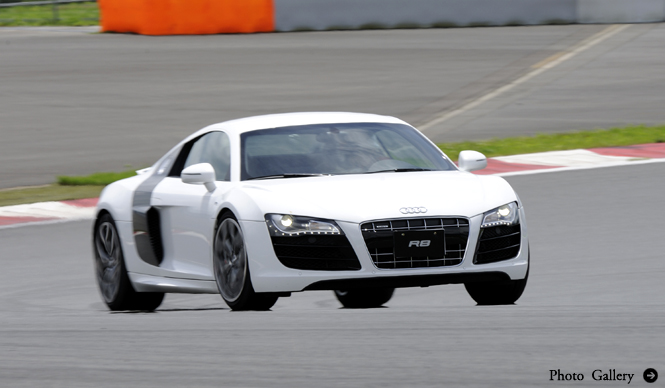
The startup sound, clearly different from the V8 model, is likely due to intentional sound tuning rather than engine characteristics. As I began driving, captivated by the exhaust's suddenly ferocious impression, I noticed the V10 model, from around 2000 rpm, powerfully propelling the light body with a tenacious torque that felt a class above the V8. Then, when the way ahead was clear and I floored the accelerator, the V10 unit raised its distinctive, slightly low and muffled sound, delivering acceleration that was literally like a startled rabbit. After all, it has 525 horsepower. Ordinary cars wouldn't manage this. The tires would spin, dissipating the propulsion. But in the R8's case, the excellent traction from its rear-biased mid-ship layout, combined with Audi's signature quattro system, firmly grips the road and transmits power effectively.
The intervention of electronic devices at this point is minimal, and crucially, the tire size is the same as the V8 model... which reveals the car's inherent nature. Its chassis possesses the foundation of an exceptionally pure sports car.
At Fuji Speedway, the test venue, it marked speeds exceeding 260 km/h on full acceleration from the final corner. These figures suggest its performance is approaching that of the GT-R. It is firmly in the realm of world-class super sports cars.
And from there, full braking brings the speed down dramatically with deceleration G-forces that feel like hitting a wall, thanks to the optional carbon-ceramic brake system. However, even without relying on this expensive option, the standard brake system provides sufficient stopping power and exquisite feel, as confirmed during public road testing. And here too, the light weight of the car likely plays a significant role.
A Drivability Unlike Any Other Car
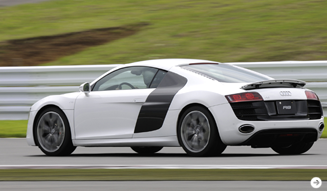
However, perhaps more than its performance or braking capabilities, the difference between the V8 and V10 models becomes clearly apparent in the cornering feel. While the initial turn-in response is not vastly different, during the cornering phase, the slightly larger mass at the rear does become noticeable. As power is applied gently, the inherent understeer tendency of all-wheel drive is well suppressed, but the rear's breakaway point feels somewhat sensitive.
In this regard, the V8 model is revolutionarily neutral and offers high freedom with a gentle transition to unstable behavior. The increase in rear-end load due to the V10 engine is only about 30 kg, but its impact on limit driving is not insignificant. However, this is purely in the circuit domain, and personally, I believe it's a trait that could be mitigated by simply adjusting the tire size.
If exotic supercar ownership and absolute speed are the priorities, then the V10. If viewed as a pure driving machine, then the V8 with a manual transmission. Ultimately, for me, the R8 variations are segmented in this way. Regardless, what impresses me every time I drive this car is its utterly unique drivability, achieved through extreme precision. It's easy to use the term 'digital-like,' but in reality, it's not quite that simple.
If the traditional affection for supercars lies in appreciating their beautiful form, the emotional roar of the engine, and the pleasure of cleanly navigating corners while being tested at precarious speeds, then the R8 diverges from that. It relentlessly pursues a high level of resolution in faithfully reproducing the driver's intentions, to the point where it fosters an analog sense of affection in the driver. In this respect, it is no exaggeration to say that the GT-R and R8 share the same directionality. In any case, this is a cutting-edge supercar that serves as a kind of challenge to car enthusiasts who tend to be bound by conventional values.
Audi Communication Center
0120-598-106
BRAND HISTORY
You may know that the Audi emblem, the 'Four Rings,' represents four automotive manufacturers: Audi, DKW, Horch, and Wanderer. All were headquartered in Saxony and were leading brands in the German automotive industry at the beginning of the 20th century. However, the four companies, hit by the Great Depression after World War I, formed Auto Union in 1932 to survive. DKW focused on motorcycles and small cars, Wanderer on mid-size cars, Audi on premium mid-size cars, and Horch on luxury cars.
However, following Germany's defeat in World War II, Saxony in East Germany fell under Soviet occupation, and Auto Union ceased to exist. Anticipating this, the new Auto Union was established in Ingolstadt, Bavaria, in West Germany. Unlike BMW and Mercedes-Benz, Auto Union faced a difficult start without existing factories, but gradually gained strength through the production of vehicles like the DKW delivery van.
In late 1964, Auto Union came under the umbrella of Volkswagen and soon introduced new models bearing the Audi name. In 1969, it merged with NSU (known for developing the Wankel engine), headquartered in Neckarsulm, becoming Audi NSU Auto Union. From 1985 onwards, it has continued as Audi to the present day. Technologies like quattro, dynamic performance backed by motorsport activities, elegant design, and high-quality finishes are driving Audi's popularity.