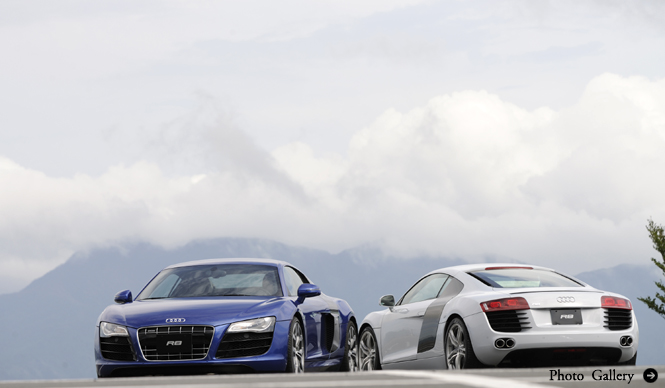
Audi R8 5.2 FSI quattro (Part 1) | A True Athlete with an Air of Intellect
Audi R8 5.2 FSI quattro | Audi R8 5.2 FSI quattro (Part 1)
An Athlete of Pure Intellect
AudiThe R8, a mid-engined supercar from Audi, takes its name from the Le Mans 24 Hours-winning race car. Now, a higher-performance model equipped with a 5.2-liter V10 has been added. What is the true value of this German supercar that directly challenges its Italian rivals?
By Toshihumi WatanabePhotos by Nobuhiro Takahashi
R8 and GT-R
“This might be something of an event.”
I recall saying this to an Audi staff member while gripping the wheel of the Audi R8 for the first time in the mountains of Las Vegas in 2007.
The precision of the moving parts, evident from the moment it began to roll; the intense structural rigidity felt through every sense the more you drove; the surprisingly spacious cabin with Audi's signature interior quality; and an exceptionally comfortable ride that defied expectations...
Even setting aside the crucial performance and dynamic capabilities for a sports car, the R8 possessed a static quality that surpassed its Italian supercar rivals. Moreover, this was wrapped in a design language entirely different from the Italian idiom. An athlete of pure intellect, exuding avant-garde fashion with effortless sophistication. It perfectly embodies one of today's heroic archetypes.
Interestingly, in that same year of 2007, another car evoked the exact same sentiment. Driven in the vicinity of Germany's Nürburgring during Golden Week, it was what Nissan called a “new high-performance car.” Cloaked in camouflage that hinted at aerodynamic enhancements, this car surged forward on the autobahn with ferocious acceleration, exhibiting an uncanny stability that increased with speed, effortlessly inviting me to speeds near 300 km/h. Later, experiencing its extraordinary dynamic prowess on the circuit, I became convinced it would deliver a powerful blow to those in the over-300 km/h club who would have readily paid over 20 million yen for such performance. Needless to say, it was the GT-R.
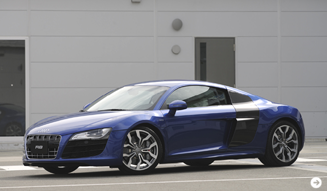
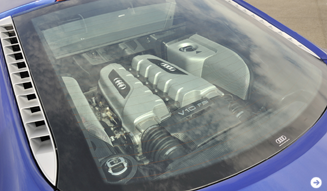
Top Speed: 316 km/h, 0-100 km/h Acceleration: 3.9 seconds
Yes, the GT-R and the R8. In a sense, it is no exaggeration to say that the former brought a revolution in cost performance, and the latter in quality, to the supercar market, which could be described as conservative and exclusive. By presenting unprecedented value, this segment, which had been akin to vested interests, has consequently undergone a seismic shift. Observing the details and specifications of the recently announced Ferrari 458 Italia and Porsche 911 Turbo, car enthusiasts will recognize that they are clearly designed with these challenges in mind.
Even so, the R8 was not without its weaknesses. A particularly notable point was its performance. The data from the 4.2-liter V8 unit producing 420 ps indicated a top speed of 301 km/h and 0-100 km/h acceleration in 4.6 seconds. These figures comfortably surpassed the Porsche 911 Carrera 4S, which Audi had targeted as a rival from the outset. However, compared to the pure sports model of the 911, the GT3, the mid-engined Ferrari F430, or its close relative, the Lamborghini LP560-4, the R8's specifications were slightly inferior. While it was undoubtedly fast, users in this market, with their insatiable desire for the world's best specifications and the thrill they bring, perceived the R8 as somewhat lacking. This gap is precisely what the 5.2-liter V10-powered model, now arriving, aims to fill.
With a maximum output of 525 ps, a top speed of 316 km/h, and 0-100 km/h acceleration in 3.9 seconds, its specifications now surpass or match those of the aforementioned rivals. Externally, the differences from the V8 model are subtle: gloss-finished grilles, a small V10 emblem on the front fenders, oval exhaust tips, and slightly larger air intakes on the distinctive side blades. This understated refinement is characteristic of Audi.
Audi Communication Center
0120-598-106
BRAND HISTORY
Audi's emblem is the 'Four Rings.' As you may know, each ring represents one of the automotive manufacturers: Audi, DKW (Derrick Vay), Horch, and Wanderer. All were based in Saxony and were pioneers of the German automotive industry at the beginning of the 20th century. However, the four companies, hit by the Great Depression after World War I, formed Auto Union in 1932 to survive. DKW focused on motorcycles and small cars, Wanderer on mid-sized cars, Audi on premium mid-sized cars, and Horch on luxury cars.
However, following Germany's defeat in World War II, Saxony in East Germany fell under Soviet occupation, and Auto Union ceased to exist. Anticipating this, the new Auto Union was established in Ingolstadt, Bavaria, in West Germany. Unlike BMW and Mercedes-Benz, Auto Union faced a difficult start without existing factories, but gradually gained strength through the production of vehicles like the DKW delivery van.
Auto Union, acquired by Volkswagen at the end of 1964, soon introduced new models bearing the Audi name. In 1969, it merged with NSU (known for its development of the Wankel engine), based in Neckarsulm, becoming Audi NSU Auto Union. From 1985 onwards, it has continued as Audi to the present day. Technologies such as quattro, dynamic performance backed by motorsport activities, elegant design, and high-quality finishes are driving Audi's popularity.