LEXUS HS250h (Part 2): A Luxury Sedan Symbolizing a New Era
LEXUS HS250h | Lexus HS250h (Part 2)
A Luxury Sedan Symbolizing a New Era
Hybrid cars are gaining attention not only in Japan but also in Europe and the US. The HS250h, Lexus's first dedicated hybrid model, has made its long-awaited debut. We took it for a spin to ascertain its true value.
Text by Fumio OgawaPhotos by Masayuki Arakawa
A Unique Ride: Neither Soft Nor Hard
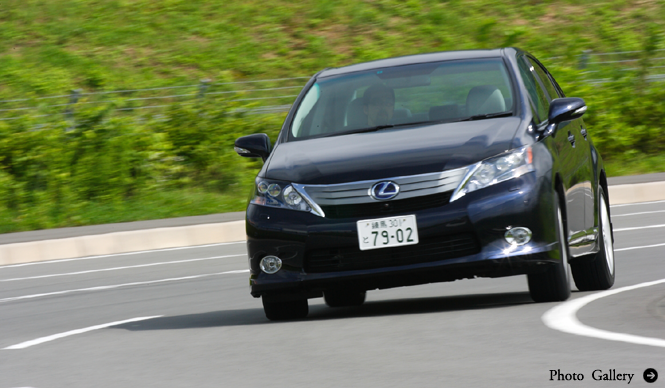
Like the Toyota Prius, the Lexus HS250h offers a normal driving mode, plus an "ECO mode" to suppress engine revs, a "Power mode" for brisk acceleration, and an "EV mode" for electric-only propulsion. The EV mode alone allows for driving at certain speeds as long as the battery charge remains above a certain level. This is also reminiscent of the Prius, but it's interesting how it offers a quiet, torquey, and distinct driving sensation.
In terms of quietness, the cabin acoustics of the HS250h are particularly noteworthy. Wind noise, sound penetrating from the engine bay, and noise from the road and wheel wells are all suppressed to a very low level. A slight coarseness in the engine sound during acceleration is audible, but it's rather surprising that this slight engine noise stands out precisely because the overall noise level has been so successfully reduced (though it is still a quiet sound).
Those who believe front-wheel drive doesn't align with the image of a "luxury car" are likely a minority now, especially with the rise of Audi. The Lexus development team apparently had such concerns initially, but as Chief Engineer Hiroyuki Koba states, "We focused on meeting the benchmarks for completion at Lexus's standards, regardless of the drive system." Consequently, there are absolutely no moments that feel out of place. The weight distribution, with about 60 percent of the load on the front, did not seem to affect the handling.
Meanwhile, the ride comfort during steady-state cruising is flat. There's no sense of body flex or suspension jarring. By meticulously calculating spot weld locations in areas like door openings and the floor, and by increasing the rigidity of various body parts, such as the junction of the suspension tower and cowl, the body's rigidity is enhanced. Simultaneously, features like rebound springs in the shock absorbers have been employed. The result of this meticulous tuning is a car with a unique ride quality that is neither soft nor hard. The word "supple" feels most appropriate.
From the Standard Grade at ¥3.95 Million to the Version L at ¥5.35 Million
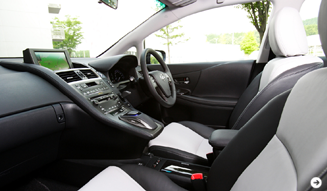
The interior boasts a high level of craftsmanship, satisfying even those LS or GS owners who might need a more compact model for various reasons and are considering switching. It also features the "Remote Touch," which operates like a computer mouse for precise control of the navigation system and other functions, adopted from the Lexus RX. This enhances the driver's sense of being in command, creating a strong "cockpit" feel.
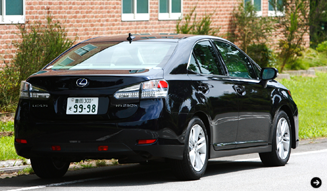
The range of available body colors and interior leather colors is extensive. The quality, with skilled artisans handling everything from painting to stitching, sets Lexus apart from other brands.
There are four grades. Starting with the standard grade (¥3.95 million), which has slightly simplified comfort features, there's the "Version S" (¥4.15 million) with shock absorbers tuned to be about 10% sportier for those seeking a more dynamic drive. The "Version I" (¥4.53 million), aimed at those desiring luxury with features like leather seats, is the volume seller. Finally, the "Version L" (¥5.35 million) comes standard with numerous safety features, including pre-collision mitigation, a driver fatigue warning system, a lane-keeping assist, a wide front view monitor to check obstacles ahead and to the sides, and ten airbags. While the Version S certainly has a sportier feel, the standard grade did not feel lacking in any way. It's best to choose according to your preference.
As Chief Engineer Koba puts it, "Consumers today want eco-friendly cars even in the luxury segment. We developed this car to satisfy that desire." Indeed, from its fuel efficiency and quality to its driving performance, the HS250h truly symbolizes a new era of luxury sedans.

LEXUS HS250h
Body | Length 4700 x Width 1785 x Height 1505mm Wheelbase 2700mm
Engine | 2.4L Inline-4
Max Output | 110kW [150ps] / 6000rpm
Max Torque | 187Nm [19.1kgm] / 4400rpm
Electric Motor | AC Synchronous Motor
Max Output | 105kW [143ps]
Max Torque | 270Nm [27.5kgm]
Drive System | FWD
Transmission | Electronically Controlled Continuously Variable Transmission
Battery | Nickel-Metal Hydride
Price | From ¥3.95 million
Lexus Information Desk 0800-500-5577
http://lexus.jp
BRAND HISTORY
Toyota launched its luxury car brand LEXUS in the American market in 1989. The aim was to offer a new value proposition distinct from American and German luxury cars, leveraging Toyota's advanced technology, superior quality, and exceptional customer service.
When the "LS400" (domestic name: Celsior) and "ES250" (domestic name: Camry) were introduced to the American market in September of that year, the LS400 quickly won the Best Import Car award in February 1990. Lexus's reputation continued to grow, and with an expanding lineup, it solidified its position as a luxury car brand.
Following its success in America, Lexus expanded into Europe in 2004 and announced its business development in Japan in May of the same year. In August 2005, it launched its luxury car business in its home country. Initially, the lineup lacked a flagship model like the "LS," consisting of the "GS" (successor to Toyota's Aristo), "SC" (successor to the Soarer), and "IS" (successor to the Altezza). However, the long-awaited new LS arrived in September 2006, followed by its hybrid version, the "LS600h/LS600hL," in May 2007, meeting the expectations of luxury sedan buyers.
Meanwhile, Lexus has been focusing on building a sporty image, announcing the "IS F" sports model in October 2007 and entering the developing "LF-A" sports coupe in the Nürburgring 24 Hours race in May 2008. Further growth in popularity is anticipated.