March 5, 2015
BMW X1: The Entry-Level X Series Model Officially Unveiled
BMW X1
Entry Model of the X Series Officially Unveiled
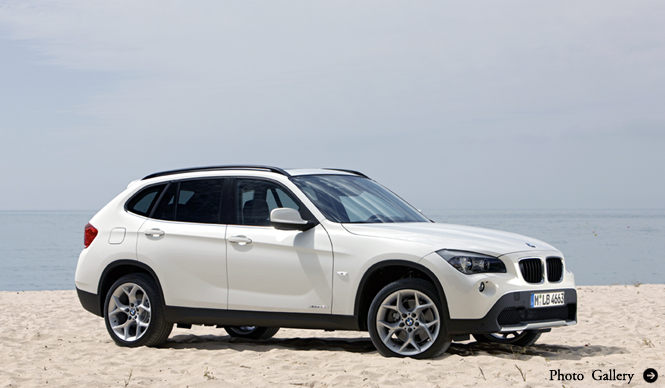
BMW has officially announced the launch of its new SUV model, the X1. This model is categorized within the SAV (Sports Activity Vehicle) series, alongside the X3 and X5. The announcement provides an overview and photographs of the vehicle.
By Giraffe
A Body Slightly Smaller Than the X3
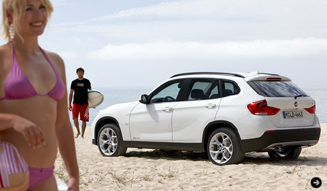
The X1 series arrives as a new variation of the BMW 1 Series, characterized by a design that is both sporty and elegant. Above all, it's a premium compact with a look that is unmistakably BMW at first glance.
The body dimensions are 4454mm in length, 1798mm in width, and 1545mm in height, with a wheelbase of 2760mm. Compared to the 1 Series hatchback (4240mm length, 1750mm width, 1415mm height), these dimensions are considerably larger. (Compared to the X3, it is 110mm shorter in length, 60mm narrower, and 140mm lower, with a wheelbase that is 35mm shorter.)
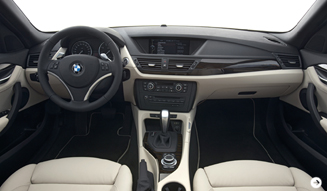
However, this size allows for a cabin space where three adults can comfortably sit in the rear. The luggage capacity is 420 liters, and by folding the 40/20/40 split-folding rear seats, it can expand to a generous 1350 liters.
The primary engine offered is diesel, with diesel engines featured in 5 out of the 6 models. There are two basic units: one gasoline and one diesel. The diesel engine, however, will be available in different output variants tailored to each model.
The model variations include 'xDrive28i', 'xDrive23d', 'xDrive20d', and 'xDrive18d'. Additionally, two-wheel-drive (FR) versions, 'sDrive20d' and 'sDrive18d', using the same engines, will also be offered. Naturally, both gasoline and diesel engines meet Euro 5 emission standards.
Official Debut at the Frankfurt Motor Show in September
The 3.0-liter inline-six gasoline engine (258 ps/6600 rpm, 31.6 kgm/2600-3000 rpm) powers the 'xDrive28i'. Paired with a six-speed automatic transmission, it achieves 0-100 km/h in 6.8 seconds and a top speed of 205 km/h.
The diesel engine is a single type: a direct-injection 2.0-liter inline-four turbo. It features the latest common-rail fuel injection and an aluminum crankcase, with output characteristics adjusted for each respective model.
The 'xDrive23d', the only twin-turbo model, boasts a maximum output of 204 ps and a peak torque of 40.8 kgm.
The single-turbo 'xDrive20d' and 'sDrive20d' deliver a maximum output of 177 ps and a peak torque of 35.7 kgm. The 'xDrive18d' and 'sDrive18d' record a maximum output of 143 ps and a peak torque of 24.1 kgm. The 'xDrive23d' comes exclusively with a six-speed automatic transmission, while other models are primarily equipped with a six-speed manual (a six-speed automatic is optional for the 'xDrive20d').
Furthermore, this new X1 model incorporates BMW's 'EfficientDynamics' low-fuel-consumption concept, featuring regenerative braking, an auto start-stop function, and a gearshift point indicator (on manual transmission models).
The X1 was officially unveiled at the Frankfurt Motor Show in September 2009 and is scheduled for release in Europe by the end of the year.
BRAND HISTORY
BMW's signature front-end design, with its "kidney grille" and quad round headlights, makes it instantly recognizable. While consistently popular in the Japanese imported car market, surprisingly few people might know the meaning behind its name.
Bayerische Motoren Werke. Literally translated, it means "Bavarian Engine Works." Its predecessor, Rapp Motorenwerke, was an aircraft engine manufacturer founded in Bavaria, Germany, in 1913 by Karl Friedrich Rapp. Rapp partnered with fellow Bavarian aircraft manufacturer Otto Flugmaschinenbau to achieve business success. In 1916, it was renamed Bayerische Motoren Werke GmbH. Two years later, it reorganized as a stock corporation and registered its propeller logo, inspired by the blue skies and white clouds of Bavaria.
BMW continued to enhance its presence through innovative technology, but following Germany's defeat in World War I, it was forced to cease aircraft engine production. BMW then channeled its expertise into motorcycles, gaining attention in 1923 with the shaft-driven "BMW R32." Not content with this, the company acquired Dixi, which held a license to produce the Austin Seven. This acquisition provided a foothold in the automotive business, and in 1929, BMW launched the "BMW 3/15 PS," marking the start of its history as an automobile manufacturer.
Incidentally, Otto Flugmaschinenbau, a company with deep ties to BMW, was founded by Gustav Otto, the son of Nikolaus August Otto, who established the theory of the internal combustion engine. This historical connection likely explains BMW's continued focus on internal combustion engines.