BMW X1 | The entry model of the X Series
BMW X1 | The Entry Model of the X Series
The Entry Model of the X Series
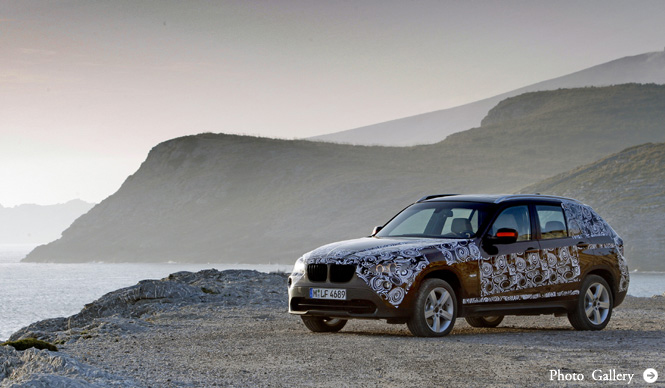
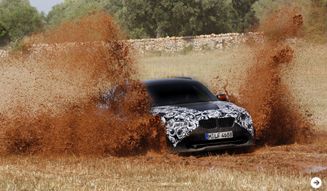
BMW has released teaser photos of its new model, the "X1."
By Giraffe
Design Motifs Shared with the X3, X5, and X6
These photos reveal a large kidney grille, common to the X3, X5, and X6, along with the ring-shaped positioning lights found in the latest BMWs and LED stop lamps. Like the X3 and X5, the front and rear overhangs are cut short, and the vehicle features large fender arches and a slightly elongated bonnet.
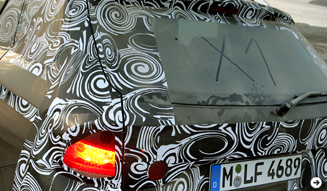
The body dimensions are 4457mm in length, 1789mm in width, and 1535mm in height. This is 130mm shorter, 65mm narrower, and 140mm lower than the X3. However, judging by the photos, the most striking feature is its low ride height. While undoubtedly belonging to BMW's SAV (Sports Activity Vehicle) lineup, its low stance contributes to a remarkably light and sporty impression. The rear tailgate, designed with a slight rake, is another characteristic of the "X1," lending it a stylish appearance.
Official Debut Scheduled for the Frankfurt Motor Show
Details such as the engine have not yet been disclosed, but rumors suggest the adoption of a 2.0-liter inline-4 gasoline engine (170ps) or a 2.0-liter inline-4 diesel engine (177ps), similar to those found in the "1" and "3" series. It is also rumored that the top-tier model will feature BMW's traditional 3.0-liter straight-six engine (231ps). Naturally, "xDrive" will be employed as the drivetrain.
The "X1" is officially set to be unveiled at the Frankfurt Motor Show in September. Sales are expected to begin in Europe by the end of the year.
BRAND HISTORY
BMW is instantly recognizable by its signature front fascia, characterized by the "kidney grille" and quad round headlights. It consistently holds a high level of popularity in the Japanese import car market, yet surprisingly few people can immediately explain the meaning behind its name.
Bayerische Motoren Werke. A direct translation is "Bavarian Engine Works." Its predecessor, Rapp Motorenwerke, was an aircraft engine manufacturer founded in Bavaria in 1913 by Karl Friedrich Rapp. He partnered with fellow Bavarian aircraft maker Otto Flugmaschinenbau to achieve business success. In 1916, it was renamed Bayerische Motoren Werke GmbH. Two years later, it was reorganized into a stock corporation, and the propeller logo, inspired by the blue skies and white clouds of Bavaria, was registered.
BMW continued to enhance its presence through innovative technology. However, following Germany's defeat in World War I, BMW was forced to cease aircraft engine production. The company then channeled its expertise into motorcycles, gaining attention in 1923 with the shaft-driven "BMW R32." Not content with this, BMW acquired Dixi, which was licensed to produce the Austin Seven. This acquisition provided a foothold in the automotive business, and in 1929, the "BMW 3/15 PS" was launched, marking the start of its history as an automobile manufacturer.
Incidentally, Otto Flugmaschinenbau, a company with deep ties to BMW, was founded by Gustav Otto, the son of Nikolaus August Otto, who established the theory of the internal combustion engine. This historical connection likely explains BMW's continued focus on internal combustion engines.