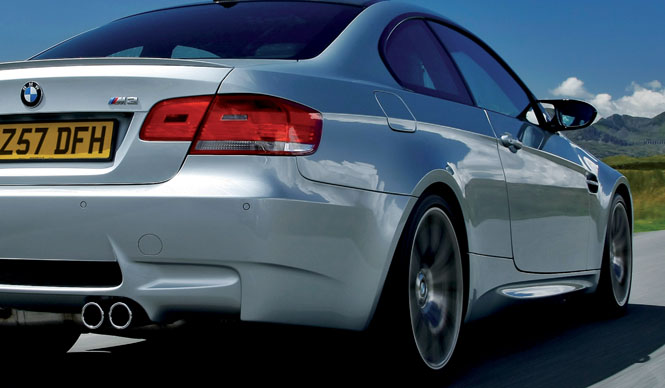
April 13, 2015
BMW M3 M DCT Drivelogic | Part 24 (Conclusion) | Is There No Hope for Manual Transmissions?
Part 24: BMW M3 M DCT Drivelogic (Part 2)
Is There Any Hope Left for Manual Transmissions?
Faced with a dual-clutch, two-pedal gearbox that uses a machine instead of a human left foot to operate the clutch, even Yasushi Shitano, the self-proclaimed chairman of the "Manual Preservation Society," thought, "There's no hope left."
By Yasushi ShitanoPhoto byBMW
The shift robot is faster
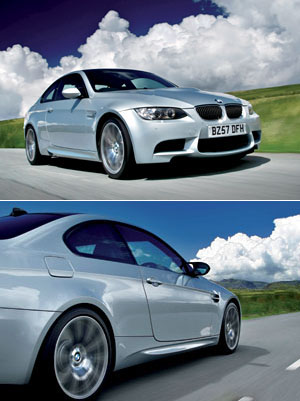
The new "M DCT Drivelogic" gearbox, newly available for the "BMW M3," is even better than expected.
Its shifting smoothness, in particular, surpasses that of pioneering models like Volkswagen's "DSG," Nissan's "GT-R" "Dual Clutch Transmission," and Mitsubishi's "Lancer Evolution X" "Twin Clutch SST." It masterfully avoids any clunky, mechanical feel.
These twin-clutch, two-pedal gearboxes are marketed for their superior sporty performance compared to manual transmissions (MT), but in the Japanese market, comfort is paramount. In other words, how close are they to the effortless ease of a conventional torque-converter automatic (AT)?
In this regard, the M DCT isLexusandMercedes-Benz's E-Class AT, not quite as smooth, but not far off.
On the other hand, its performance as a sports gearbox slightly surpasses the previous "SMG." This is clearly demonstrated by the acceleration data: the M DCT version completes the 0-100 km/h sprint in 4.8 seconds, 0.2 seconds faster than the 6-speed manual. This means the shift robot in the M DCT is quicker than even a skilled test driver's gear changes.
It even surpassed in fun-to-drive
I'm such a manual enthusiast that I'd happily run for chairman of the preservation society, but I believe the M3 is best experienced with the M DCT.
The 4-liter V8 engine in the fourth-generation M3 is a high-revving unit, reaching up to 8400 rpm, yet it also delivers the substantial torque characteristic of a big V8 from low revs. It smoothly accelerates from below 30 km/h in top gear, and overtaking on the highway can be done without downshifting. With an engine like this, a manual transmission actually has limited utility.
In this respect, the M DCT makes sporty driving more accessible. When set to the sportier side of its 11 drive modes, even in the fully automatic AUTO mode, the kickdown and engine response become sharper. With shifts this fast and smooth, you'll find yourself wanting to downshift unnecessarily in manual mode.
The M DCT offers more opportunities for sporty driving and teaches its enjoyment even to lazy drivers who might have bought it thinking, "Finally, the M3 has a torque converter."
When the "Volkswagen Golf GTI" was equipped with DSG, I honestly thought, even as a manual lover, that there was no hope left for MT. This was because DSG surpassed MT not only in shifting performance but also in fun-to-drive.
Furthermore, when I heard it even slightly outperformed MT in fuel economy, I felt that the clutch pedal might be nothing more than a misstep for the left foot. Single-clutch systems, exemplified by Alfa Romeo's "Selespeed" and including SMG, all felt like "better than AT, but not quite MT." However, since the "DSG era," my perspective has completely changed.
Twin-clutch transmissions have fundamentally changed the world of two-pedal gearboxes.
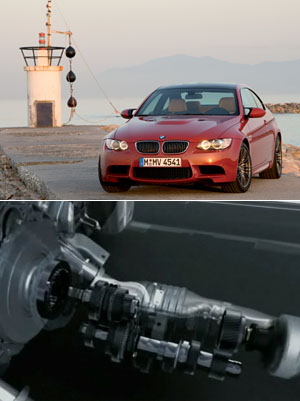
The M DCT Drivelogic divides its 7 gears into two
(1st, 3rd, 5th, 7th gears and 2nd, 4th, 6th gears),
each with its own clutch.
While one is engaged, the other is
kept on standby, allowing for instantaneous gear changes
and smooth acceleration and deceleration.
Of course, all control is automated, but
manual-style operation is also possible.
Vehicle Overview: BMW M3
A high-performance car based on BMW's flagship "3 Series," developed by BMW M, which specializes in high-performance models. Among the M models, which include the "M5" (based on the 5 Series), "M6" (based on the 6 Series), and "Z4 M" (based on the Z4), it boasts high popularity and is active on circuits worldwide.
The current generation is available in three types: sedan, coupe, and convertible (open-top), with the sedan and coupe being introduced in Japan. While the sedan and coupe share many engines and components as siblings, the coupe, with its longer history, can be considered the image setter for the M3.
The 4-liter V8 engine produces a formidable output of 420 ps and 40.8 kgm of maximum torque, which is handled by either a conventional 6-speed manual transmission (MT) or the 7-speed dual-clutch transmission "M DCT Drivelogic" introduced here. It's rear-wheel drive (FR), and naturally adheres to BMW's ideal of a near 50:50 front-to-rear weight distribution.
The 0-100 km/h acceleration is a mere 4.8 seconds with the M DCT, 0.2 seconds faster than the manual version. While manual gears traditionally offered superior acceleration, it's no exaggeration to say that the sophistication of automatic transmissions has now surpassed that of manuals.
The 4.6m long, 1.8m wide body appears imposing with its flared fenders and aluminum hood. The coupe, in particular, benefits from weight reduction, with a lightweight and expensive carbon-fiber roof.
Prices are 9.73 million yen (MT) and 10.20 million yen (M DCT) for the 4-door sedan, and 10.03 million yen (MT) and 10.50 million yen (M DCT) for the 2-door coupe. Whether to insist on manual shifting with a clutch pedal operated by the left foot, or to savor the smooth performance delivered by the machine. The 470,000 yen difference between the gearboxes offers a different perspective depending on the driver's values.