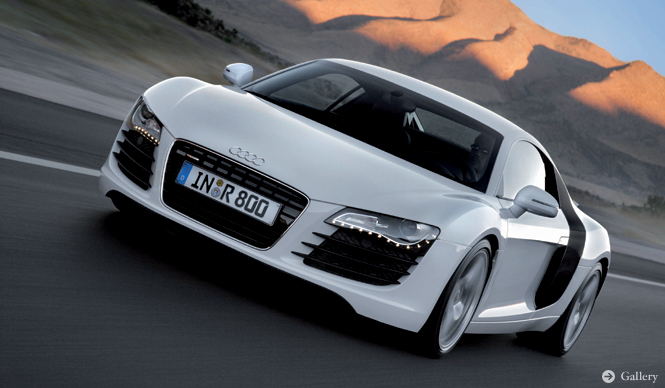
Audi R8 | The Sports Car Inheriting the Legacy of Racing Cars
Audi R8
Audi R8
A Sports Car Inheriting the Legacy of a Racing Car
For a long time,Audihas poured its efforts into motorsport. For example, in the Auto Union era, it made its name known with the Grand Prix car known as the "Type C," and in the 1980s, it dominated the WRC (World Rally Championship) with its proud "quattro" all-wheel-drive system. Motorsport has been an ideal field for showcasing the company's technological prowess. More recently, you may be aware that they have been sending machines to the 24 Hours of Le Mans, known as the world's most grueling endurance race, achieving a remarkable record of 8 wins in 10 starts.
The "Audi R8" achieved the first five of these victories, and it's a recent memory that a private team from Japan achieved an overall win in 2004. The model that inherits the name of such a legendary racing car is Audi's new sports car, the "R8," which debuted at the 2006 Paris Salon.
The R8 inherits features from the racing car R8, such as its mid-engine layout, high-revving V8 direct-injection gasoline engine, and sequential gearbox. At the same time, it incorporates the quattro permanent all-wheel-drive system, which is not permitted in Le Mans racing cars. Its lightweight yet highly rigid body is realized through Audi's proud aluminum spaceframe structure, "ASF."
While boasting high performance as a sports car, it also features excellent practicality and a high-quality finish, which is the very essence of Audi's car manufacturing. The R8 is a model that symbolizes the current Audi.
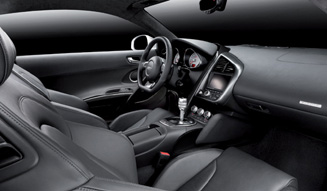
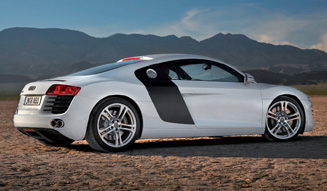

Audi R8
Body | Length 4435 x Width 1905 x Height 1250mm
Engine | 4.2-liter V8
Max Output | 309kW [420ps] / 7800rpm
Max Torque | 430Nm [43.8kgm] / 4500-6000rpm
Drivetrain | 4WD
Transmission | R tronic (6-speed sequential gearbox)
Price | 16.7 million yen
(As of July 2008)
BRAND HISTORY
Audi's emblem is the "Four Rings." You may know that each ring represents one of the car manufacturers: Audi, DKW (Dampf-Kraft-Wagen), Horch, and Wanderer. All were based in Saxony and were leading brands in the German automotive industry at the beginning of the 20th century. However, facing the fallout from the Great Depression after World War I, the four companies, in a bid for survival, formed Auto Union in 1932. DKW specialized in motorcycles and small cars, Wanderer in mid-size cars, Audi in premium mid-size cars, and Horch in luxury cars.
However, due to the defeat in World War II, Saxony in East Germany fell under Russian occupation, and Auto Union ceased to exist. Anticipating this, the new Auto Union was established in Ingolstadt, Bavaria, in West Germany. Unlike BMW and Mercedes-Benz, Auto Union faced a difficult start without existing factories, but it gradually gained strength through the production of vehicles like the DKW delivery van.
In late 1964, Auto Union came under the umbrella of Volkswagen and soon introduced new models bearing the Audi name. In 1969, it merged with NSU (known for its development of the "Wankel engine"), based in Neckarsulm, becoming Audi NSU Auto Union. From 1985 onwards, it has continued as Audi to the present day. Technologies like quattro, dynamic performance backed by motorsport activities, elegant design, and a high-quality finish are driving Audi's popularity.