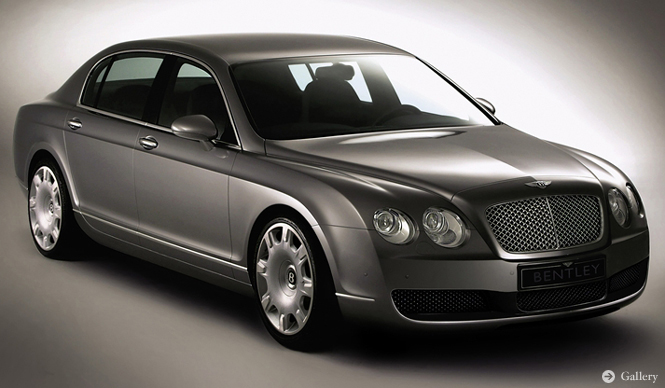
BENTLEY CONTINENTAL FLYING SPUR | Both a Saloon and a Driver's Car
BENTLEY CONTINENTAL FLYING SPUR
BENTLEY CONTINENTAL FLYING SPUR
A saloon that is also a driver's car
Once upon a timeBentleyhad a saloon named 'Flying Spur'. Born in 1957 based on the sportiest coupe of the time, the Flying Spur was lauded for inheriting the qualities of a Gran Turismo while offering high comfort and an elegantly crafted cabin.
Half a century later, in 2005, the name Flying Spur was revived. Two years after the debut of the Continental GT, this 'Continental Flying Spur' was created, just as before, from the latest Gran Turismo, as a high-performance saloon.
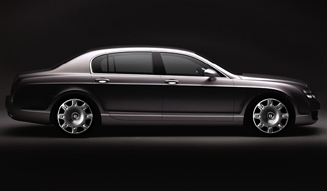
While its sharp front mask and short front overhang suggest a strong connection to the Continental GT, the 320mm extended wheelbase ensures a style befitting a luxury saloon and provides ample rear-seat space.
However, it would be premature to view the Continental Flying Spur as leaning too heavily towards chauffeured driving. This is evident from its performance, which rivals the Continental GT. The W12 twin-turbo engine nestled under the bonnet delivers power that meets the driver's expectations at all times, and the normally comfortable air suspension offers sporty handling that belies the car's size when needed.
The philosophy of crafting a car that is both a saloon and a driver's car is truly Bentley's tradition.

BENTLEY CONTINENTAL FLYING SPUR
Body | Overall length 5310 x Overall width 1930 x Overall height 1480mm
Engine | 6.0-liter W12 twin-turbo
Maximum output | 411kW [560ps] / 6100rpm
Maximum torque | 650Nm [66.3kgm] / 1600rpm
Drivetrain | 4WD
Transmission | 6-speed automatic
Price | 22.3 million yen
(As of May 26, 2008)
BRAND HISTORY
'I want to build a car that offers the best speed and value in its class.' These are the words of Walter Owen Bentley, the founder of BENTLEY MOTORS, affectionately known as 'W.O.'
Although W.O. had gained experience as an engineer from a young age, his initial work was with steam locomotives rather than automobiles. While participating in motorcycle races during his free time, his interest turned towards engines, and after retiring, he began developing racing engines in earnest after World War I.
In the 1920s, he participated in races both in Britain and abroad. Notably, in the 24 Hours of Le Mans, the 'Bentley Boys' achieved five victories between 1924 and 1930, establishing the marque's reputation. However, the financial situation was dire, and in 1931, the company was acquired by Rolls-Royce, barely managing to preserve its name.
Rolls-Royce's control continued for the next 67 years, but a turning point arrived in 1998. Volkswagen acquired the Bentley name and the Crewe factory in the UK. This allowed Bentley to forge its own path, separate from Rolls-Royce, and through the introduction of new models such as the 'Continental GT', 'Continental Flying Spur', and 'Continental GTC', it successfully re-established itself in the luxury car market. Furthermore, in 2003, Bentley secured its sixth victory at the 24 Hours of Le Mans, its first in 73 years.