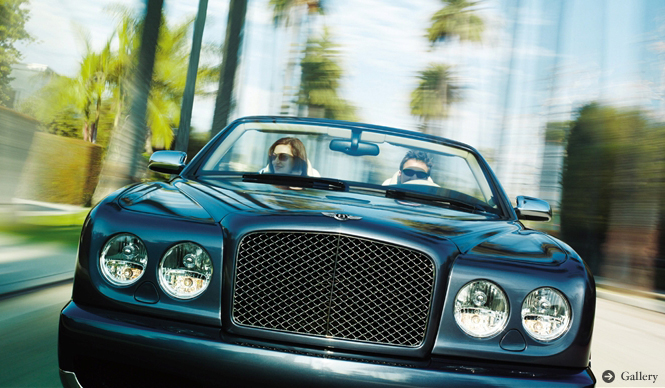
BENTLEY AZURE | A Traditional Name Revived
BENTLEY AZURE
BENTLEY AZURE
A Storied Name Returns
In January 2005,Bentleyunveiled a concept car at the Los Angeles Auto Show. Based on the "Arnage," it was a four-seater open-top model with a soft top, named the "Arnage Drophead Coupe."
Fans who witnessed its elegant presence called for its commercialization, and in response, the production version, the "Azure," was presented at the Frankfurt Motor Show the same year. Bentley had an open model of the same name from 1955 to 2002, and after a hiatus of about three years, the storied name was revived.
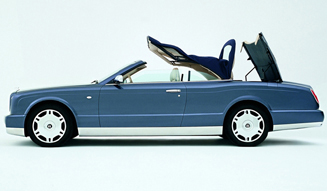
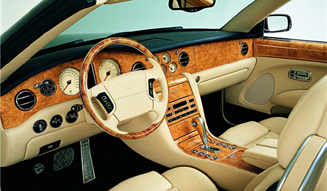
While it inherited the front mask, platform, and engine from the four-door Arnage, the rear section, which forms a two-door body, and the interior feature unique designs. The soft top is made of a three-layer fabric and can be opened or closed in about 30 seconds with the flick of a switch.
The engine is the same 6.75-liter V8 twin-turbo found in the "Arnage R/RL," with identical specifications of 457 ps and 89.2 kgm of maximum torque.
To minimize the reduction in body rigidity and increase in weight due to the open-top design, the Azure incorporates efforts such as reinforcing the underfloor with carbon fiber. This most luxurious of Bentleys breathes with the luster of tradition and the latest technology.

BENTLEY AZURE
Body | Length 5430 x Width 1930 x Height 1495mm
Engine | 6.75-liter V8 twin-turbo
Max Output | 336kW [457ps] / 4000rpm
Max Torque | 875Nm [89.2kgm] / 1800rpm
Drivetrain | FR
Transmission | 6-speed automatic
Price | ¥40,000,000
(As of May 26, 2008)
BRAND HISTORY
"I want to build a car that is the fastest and most valuable in its class." These are the words of Walter Owen Bentley, the founder of BENTLEY MOTORS, affectionately known as “W.O.”
Although W.O. gained experience as an engineer from a young age, his initial work was with steam locomotives, not automobiles. While participating in motorcycle races during his spare time, his interest turned to engines, and after retiring, he began developing racing engines in earnest after World War I.
In the 1920s, he participated in races both in Britain and abroad. Notably, the "Bentley Boys" achieved five victories in the 24 Hours of Le Mans between 1924 and 1930, establishing the marque's reputation. However, the company's financial situation was precarious, and in 1931, it was acquired by Rolls-Royce, barely managing to preserve its name.
Rolls-Royce's control continued for the next 67 years, but a turning point arrived in 1998. Volkswagen acquired the Bentley name and the Crewe factory in the UK. This allowed Bentley to forge its own path, separate from Rolls-Royce. Beginning with the "Continental GT," the introduction of new models such as the "Continental Flying Spur" and "Continental GTC" marked a triumphant return to the luxury car market. Furthermore, in 2003, Bentley secured its sixth Le Mans victory, the first in 73 years.