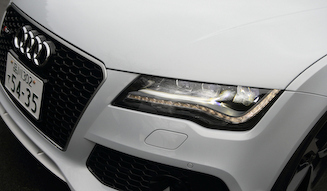
Test Drive the Audi RS7 Sportback | Audi
Audi RS7 Sportback
The Multi-Purpose Sports Car
Test Drive: Audi RS7 Sportback
Based on the "A7 Sportback," which combines a flowing roofline with the convenience of four doors, the "RS7 Sportback" is crowned with the RS designation, signifying ultimate sports performance. It features a 4-liter V8 twin-turbo engine producing 560ps and Audi's renowned "quattro" all-wheel-drive system. Tatsuya Otani, who test-drove this car that harmoniously blends an elegant four-door coupe with high driving dynamics, delves into the RS7 Sportback from its origins.
Text by OTANI TatsuyaPhotographs by ARAKAWA Masayuki
Audi Focuses on Sports Models
In recent years, Audi has been particularly focused on expanding its sports series, including RS and S models. In the post-war era, Audi (or rather, what was then called Auto Union) initially focused on compact cars closely tied to people's daily lives. However, it gradually expanded its lineup to include more premium vehicles. Furthermore, as many of you know, the launch of the Audi "Quattro" in 1980 established its reputation as a sporty brand.
The lineage of Audi's sports models, which began in this way, gradually contributed to enhancing the sporty image of the Audi brand as a whole. Therefore, it is no exaggeration to say that the sporty image of Audi was originally created by the Quattro, and this is why Audi cherishes the Quattro.
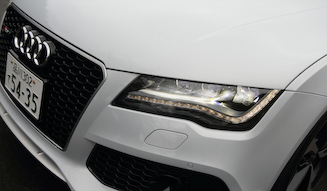
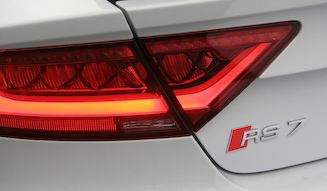
Moreover, recently, all three major German premium automakers have been enthusiastically promoting their highly profitable sports models. In this context, Audi cannot afford to fall behind. Fortunately, Audi has two distinct sports lines, the RS models and S models, both equipped with Quattro as standard. Furthermore, both RS and S models possess unique characteristics that leverage the strengths of Quattro. It is only natural for an automotive manufacturer's strategy to enrich such a lineup and promote them more aggressively.
Meanwhile, the planning and development of Audi's RS models are handled by quattro GmbH, a division within Audi that attracts particularly passionate enthusiasts. Although it is positioned as a subsidiary of Audi, by entrusting the RS models to this compact organization, they may be aiming to create more distinctive, or perhaps more accurately, "edgier" products.
Audi RS7 Sportback
The Multi-Purpose Sports Car
Test Drive: Audi RS7 Sportback (2)
Revisiting the Origins of the RS7 Sportback
One of the missions assigned to quattro GmbH is to "expand the market for RS models."
To explain in more detail, Audi's main sales regions are broadly Europe, North America, and Asia, centered around China. While sedan models are highly popular in China, sports models have not yet gained widespread recognition. If Audi can establish its sporty image here, RS and S models are expected to sell exceptionally well... This must have been the thinking of some executive. Consequently, after much deliberation by the staff at quattro GmbH and Audi headquarters, the "RS7 Sportback" was born.
However, the most popular models in China are undoubtedly four-door sedans with separate trunks. Therefore, the RS7 Sportback, a five-door sports coupe, might seem difficult to sell. Conversely, if the RS7 Sportback succeeds, other RS models will become easier to sell, and Audi's sporty image will accelerate significantly.
Whether such a strategy was indeed in place is purely speculative, but it is a fact that Audi aimed to penetrate the Chinese market with RS models through the RS7 Sportback. Viewed from this perspective, it is interesting to see another facet of the RS7 Sportback emerge.
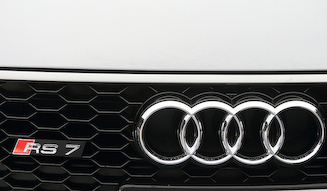
Audi RS7 Sportback
The Multi-Purpose Sports Car
Test Drive: Audi RS7 Sportback (3)
All-Around High Performance
While this introduction has been quite lengthy, the origins of the RS7 Sportback are relatively straightforward. It is equipped with a V8 4.0-liter twin-turbo engine (maximum output: 560ps, maximum torque: 700Nm) and an 8-speed torque converter automatic transmission. The suspension features a front double-wishbone and rear trapezoidal link setup. While the DRC (Dynamic Ride Control) sports suspension is an optional extra in Germany, it has been deliberately chosen as standard equipment for the Japanese specification (European specifications come with a softer air suspension as standard).
One might imagine a Spartan ride that requires endurance in daily driving, but in reality, it is remarkably supple and comfortable. With this, complaints from family members on long drives would likely be minimal.
However, this is by no means a "soft suspension."Experiencing Alpine crossings at an overseas test drive eventThe chassis maintains a stable posture even when entering corners at speeds far exceeding everyday limits, allowing for precise control. It can be evaluated as a chassis that can be manipulated exactly as the driver intends.
The only perceived weakness is a slight moment of understeer felt at turn-in. Conversely, as you accelerate towards the exit of a corner, the handling is so agile that it creates the illusion that the rear is sliding out before the front.
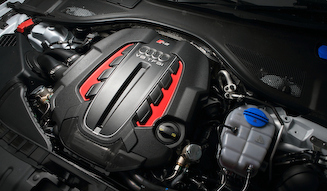
The engine is simply powerful. Thanks to a relatively high compression ratio of 9.3, its responsiveness is excellent, delivering ample torque even in low to mid-speed ranges, such as in city traffic. On the other hand, it incorporates a cylinder deactivation system and achieves a remarkable fuel economy of 10.4 km/l in the JC08 mode for its class, demonstrating consideration for environmental performance.
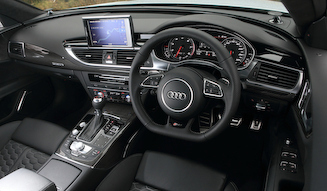
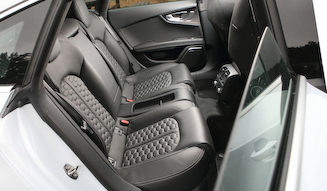
Furthermore, the coupe-like body encloses a living space comparable to a four-seater sedan of the same class, and the luggage compartment is as spacious as a wagon. Moreover, the quattro system ensures solid traction and stability regardless of road conditions.
"Could this succeed even in the challenging Chinese market?" The Audi RS7 Sportback is a multi-purpose sports car that inspires such expectations.

Audi RS 7 Sportback
Body Dimensions: Length 5,010 x Width 1,910 x Height 1,425 mm
Wheelbase: 2,915 mm
Tread (Front/Rear): 1,635 / 1,625 mm
Weight: 2,070 kg
Engine: 3,993 cc V8 Twin-Scroll Twin-Turbo
Maximum Output: 412 kW (560ps) / 5,700-6,600 rpm
Maximum Torque: 700 Nm / 1,750-5,500 rpm
Transmission: 8-speed Automatic (Tiptronic)
Drivetrain: 4WD
Tires: 275/30R21
Trunk Capacity: 535 liters
0-100 km/h Acceleration: 3.9 seconds
Fuel Economy (JC08 Mode): 10.4 km/l
CO2 Emissions: 223 g/km
Price: 16,150,000 yen
Audi Communication Center
 0120-598-106