Test Drive the All-New Third-Generation MINI | MINI
MINI Cooper
MINI Cooper S
Change That Feels Like No Change
Test Drive the All-New MINI, Now in its Third Generation
We took the new "MINI" for its first drive in Puerto Rico, which made its world premiere at last autumn's Tokyo Motor Show. The models tested were the "Cooper," equipped with a newly developed 1.5-liter 3-cylinder engine, and the "Cooper S" with a 2-liter 4-cylinder. Tatsuya Kushima reports on this highly anticipated new model, now in its third generation.MINIWe took the new "MINI" for its first drive in Puerto Rico, which made its world premiere at last autumn's Tokyo Motor Show. The models tested were the "Cooper," equipped with a newly developed 1.5-liter 3-cylinder engine, and the "Cooper S" with a 2-liter 4-cylinder. Tatsuya Kushima reports on this highly anticipated new model, now in its third generation.
Text by KUSHIMA Tatsuya
Expectations for the New Model
It's well-known that MINI has a large following in Japan, dating back to the classic MINI era. There's even a tale that in the late 90s, about half of the production volume at the time was consumed in this country. I recall a column in the British car magazine "CAR" about it back then. It was something like, "Wonderland, MINI-loving Japan!"
I myself have owned a "Clubman" and a "Crossover". I've also driven a classic MINI at classic car events. I'm a MINI fan, like many others. Based on those experiences, I have high expectations for the new model. If I had to put it into words, it would be "change that feels like no change."
Driving the new model, now in its third generation, I felt that this had been achieved. I'm sure theBMWdevelopment team must have agonized over it. How much should they change, and how? However, this was largely predictable.
When I saw the design study "MINI Vision" unveiled in Munich last July, I thought, "What's changed?" Looking back, that might have been a form of market research. They were likely gauging reactions to not changing too much by observing the media's expressions.
So, does this mean there's no change at all? Not quite. While the car's internals have evolved, their communication with the market has clearly shifted. Previously, BMW considered MINI borderless and downplayed its nationality. Even if they advertised "Made in Britain!", they'd be met with "But it's made by BMW, isn't it?"
However, this time they've prominently emphasized the fact that "MINI was born in Britain." Furthermore, they explicitly state, "The technology is from BMW!" There's no particular explanation for this intention, but it's been about 10 years since the BMW MINI. It feels like we're entering a new era...
Now, let's turn our attention to the new MINI's internals.
MINI Cooper
MINI Cooper S
Change That Feels Like No Change
Test Drive the All-New MINI, Now in its Third Generation (2)
Not a Single Part is the Same
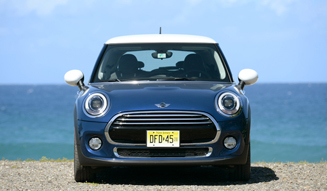
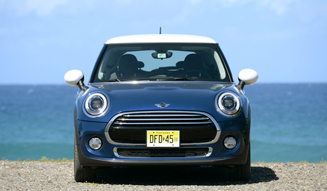
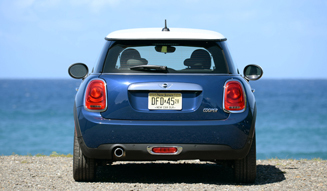
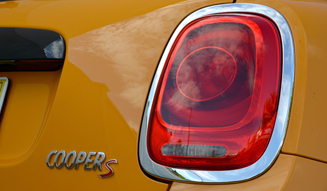
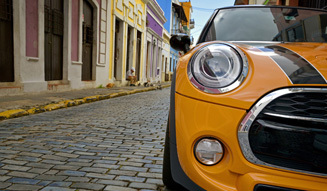
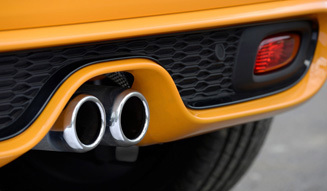
As you can see from the photos, the visual changes are minimal. The taillights are larger, and the headlights are more angled, but the overall impression remains the same. One might even think it's a minor change and wouldn't complain. Yet, according to the designers, details like the hexagonal grille at the front being much closer to the classic MINI era have been meticulously incorporated.
Nevertheless, the internals are completely all-new. The floor panel, suspension, and powertrain have all been revamped. The development team even boasts that not a single part is the same. In other words, a substantial investment has been made.
However, there was another reason for this. Rumors suggest that the chassis frame is shared with the BMW "Active Tourer" which was announced as a concept car last year and officially unveiled as a production model at this year's Geneva Motor Show. The Active Tourer is BMW's first front-wheel-drive car, with rivals like the Mercedes-Benz "B-Class". If this chassis is to be used not only for the MINI but also for the BMW brand, the investment will be recouped quickly. Considering this, it's safe to say that the new MINI represents a significant financial undertaking.
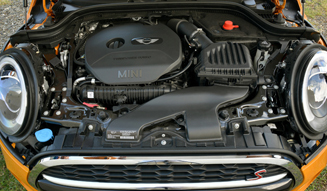
Sitting atop this newly developed chassis is, once again, a new engine. These are the units already announced at the Tokyo Motor Show. Specifically, the MINI "One" will feature a 1.2-liter 3-cylinder, the "Cooper" a 1.5-liter 3-cylinder, and the "Cooper S" a 2-liter 4-cylinder.
All are direct-injection with turbochargers and equipped with Double VANOS for variable camshaft timing. Except for the One, they also feature variable valve timing, a BMW patent.
The maximum outputs are 102ps, 135ps, and 192ps, respectively, showing a definite increase in power despite the reduced cylinder count. Truly impressive. Incidentally, the diesel engines, not available in Japan, will be the MINI "One D" and "Cooper D," both with 1.5-liter displacement. Both models will be offered with a 6-speed manual or a 6-speed automatic transmission. The former is from Getrag, and the latter from Aisin AW.
MINI Cooper
MINI Cooper S
Change That Feels Like No Change
Test Drive the All-New MINI, Now in its Third Generation (3)
Strong Torque from Low Speeds
The stage chosen for test driving these MINIs was Puerto Rico in Central America, the home of Bacardi rum. Why was the international media test drive held there? During the presentation, the head of development explained, "There are many roads with poor pavement here, so you can fully experience the refined ride quality of the new MINI." I see, so they seem quite confident in the new model's performance, not just its powertrain but also its suspension.
Both the Cooper and Cooper S were available for test drives. The Cooper was equipped with a manual transmission, and the Cooper S with an automatic. The steering wheel was on the left. As the currency is the US dollar, Puerto Rico holds a quasi-autonomous status within the United States, and traffic laws adhere accordingly.
MINI Cooper
MINI Cooper S
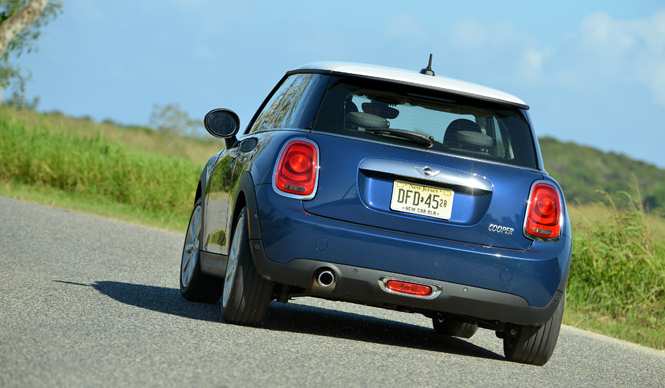
The driving experience still delivers that signature go-kart feeling. The acceleration that pulls eagerly from the front and the quick steering response are exactly that. Furthermore, the increased body rigidity enhances the sense of unity. While not quite reaching the level of the current "John Cooper Works," the feeling of solidity is strong.
The revving of the 3-cylinder unit is hardly noticeable. The development team repeatedly emphasized its superior balance compared to the 4-cylinder, and indeed, the noise is minimal. In fact, the number of balancer shafts is two for the 4-cylinder and one for the 3-cylinder.
The Cooper delivers strong torque from low speeds. With the increased engine power, the amount of throttle input required is noticeably less. The Cooper S, in particular, feels almost like overkill. The sudden acceleration when you stomp on the gas pedal is on another level compared to before.
MINI Cooper
MINI Cooper
MINI Cooper S
Change That Feels Like No Change
Test Drive the All-New MINI, Now in its Third Generation (4)
Variable Dampers on a MINI? Surprising!
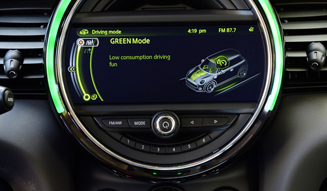
A notable new feature in the new MINI is the "MINI Driving Modes." In each mode – Sport, Mid, and Green – the throttle response, steering feel, gear shift timing (for AT only), and damper stiffness can be adjusted. Variable dampers on a MINI? Surprising!
Sport mode is appropriately firm. However, Mid and Green modes feel the same. Green mode actively engages the idling stop to improve fuel economy.
MINI Cooper
MINI Cooper
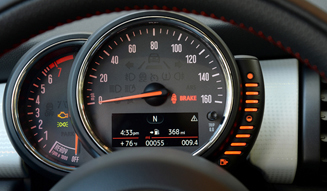
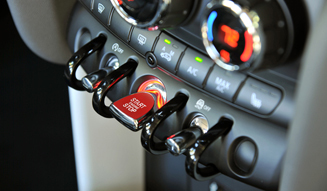
Shifting focus to the interior, while retaining the traditional center-meter layout, it clearly conveys a sense of modernity. The design of the various gauges has changed, and it now features keyless push-button start. Seat upholstery options include fabric, a fabric and leather combination, and full leather. The rear seats are split-folding 60:40 and can be reclined.
So, when will this new MINI arrive in Japan? When asked,sales are expected to begin in April.It's a shame it won't make it by March 2nd, but the surprisingly early sales launch is nothing but good news for MINI enthusiasts.

MINI Cooper
Body Dimensions | Length 3,821 x Width 1,727 x Height 1,414 mm
Wheelbase | 2,495 mm
Tread Front/Rear | 1,501 / 1,501 mm
Minimum Ground Clearance | 124 mm
Weight | (6MT) 1,085 kg (6AT) 1,115 kg
Engine | 1,499cc Inline 3-cylinder Direct Injection DOHC Turbocharged
Bore x Stroke | 82 x 94.6 mm
Compression Ratio | 11.0
Maximum Output | 100 kW (136 ps) / 4,500-6,000 rpm
Maximum Torque | 220 Nm / 1,250-4,000 rpm
(Overboost) | 230 Nm / 1,250-4,000 rpm
Transmission | 6-speed Manual / 6-speed Automatic
Drivetrain | FF
Front Suspension | MacPherson Single Joint Suspension Strut Axle
Rear Suspension | Multi-link Axle
Brakes Front/Rear | Ventilated Disc / Disc
Tires Front/Rear | 175/65R15 84H
0-100 km/h Acceleration | (6MT) 7.9 sec (6AT) 7.8 sec
Maximum Speed | 210 km/h
Fuel Consumption |
(6MT) 4.5-4.6 L/100km (approx. 22.2-21.7 km/L)
(6AT) 4.7-4.8 L/100km (approx. 21.3-20.8 km/L)
CO2 Emissions | (6MT) 105-107 g/km (6AT) 109-112 g/km
Trunk Capacity | 211 Liters
MINI Cooper S
Body Dimensions | Length 3,850 x Width 1,727 x Height 1,414 mm
Wheelbase | 2,495 mm
Tread Front/Rear | 1,485 / 1,485 mm
Minimum Ground Clearance | 124 mm
Weight | (6MT) 1,160 kg (6AT) 1,175 kg
Engine | 1,998cc Inline 4-cylinder Direct Injection DOHC Turbocharged
Bore x Stroke | 82 x 94.6 mm
Compression Ratio | 11.0
Maximum Output | 141 kW (192 ps) / 4,700-6,000 rpm
Maximum Torque | 280 Nm / 1,250-4,750 rpm
(Overboost) | 300 Nm / 1,250-4,750 rpm
Transmission | 6-speed Manual / 6-speed Automatic
Drivetrain | FF
Front Suspension | MacPherson Single Joint Suspension Strut Axle
Rear Suspension | Multi-link Axle
Brakes Front/Rear | Ventilated Disc / Disc
Tires Front/Rear | 195/55R16 87W
0-100 km/h Acceleration | (6MT) 6.8 sec (6AT) 6.7 sec
Maximum Speed | (6MT) 235 km/h (6AT) 233 km/h
Fuel Consumption |
(6MT) 5.7-5.8 L/100km (approx. 17.5-17.2 km/L)
(6AT) 5.2-5.4 L/100km (approx. 19.2-18.5 km/L)
CO2 Emissions | (6MT) 133-136 g/km (6AT) 122-125 g/km
Trunk Capacity | 211 Liters