Test drive the Audi A3 Sedan: Audi's serious contender
Audi A3 Sedan 1.8 TFSI quattro
Audi A3 Sedan 1.4 TFSI Cylinder On Demand
Audi's technology condensed into a compact body
Test drive of Audi's serious "A3 Sedan"
AudiThe "A3" family has a newsedan model. As the name suggests, it is based on the compact hatch "A3 Sportback", but most of its exterior parts are designed exclusively for the sedan, making it a truly serious model. Audi's highly anticipated new model for the Japanese market in 2014 was test-driven by Tatsuya Otani in Hokkaido during winter.A3 Sportback. As the name suggests, it is based on the compact hatch "A3 Sportback", but most of its exterior parts are designed exclusively for the sedan, making it a truly serious model. Audi's highly anticipated new model for the Japanese market in 2014 was test-driven by Tatsuya Otani in Hokkaido during winter.
Text by OTANI TatsuyaPhotographs by ARAKAWA Masayuki
A beautiful sedan
To be blunt, I don't recall encountering many sedans with beautiful styling that are based on C-segment hatchbacks. Since they are designed as hatchbacks in the first place, it's natural for the overall balance to be disrupted when a trunk is forcibly added. Ideally, sedans should be designed as sedans from the outset, just as hatchbacks are designed as hatchbacks.
So, what about the styling of the Audi A3 Sedan?
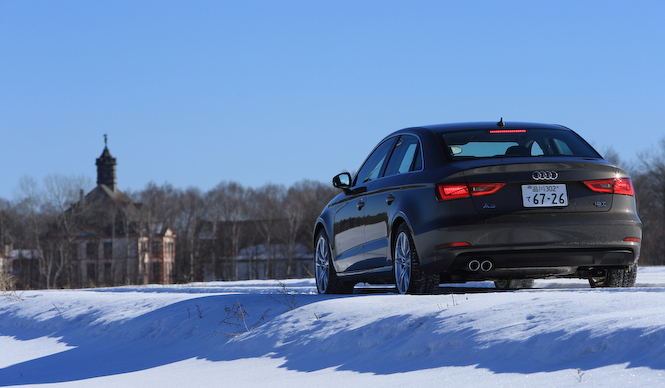
Compared to larger sedans, the trunk is understandably shorter. However, the overall proportions of the car are elegant and well-balanced. We learned that all exterior parts except for the door handles, Singleframe grille, door mirrors, and headlights were newly designed for the A3 Sedan. In other words, the stylish exterior design of the A3 Sedan is the result of Audi's earnest commitment to not sparing effort or cost, even for its derivative models.
Comparing the exterior dimensions with the hatchback version, the "A3 Sportback", the overall length is extended by 140mm to 4,465mm. As expected, the width is increased by 10mm to 1,795mm, and surprisingly, the height is reduced by 45mm to 1,390mm.
It's clear that the A3 Sedan's elegant proportions, reminiscent of a five-door coupe, are born from these wide and low dimensions. However, this also brings subtle changes to the cabin space. Simply put, the vertical dimension is smaller than in the Sportback.
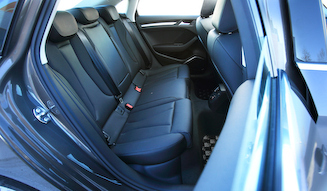
For example, when I, at 172cm tall, sit in the rear seat of the A3 Sedan, there is about half a fist's worth of space above my head. In the A3 Sportback, this increases to about a full fist.
I don't intend to conclude that "hatchbacks are better than sedans" simply because of this. Generally, in the C-segment, whether it's a hatchback or a sedan, about half a fist of rear headroom is standard. The A3 hatchback manages to achieve this much space only through clever interior design of the headliner. Moreover, one of its rivals, which debuted before the A3 Sedan, has such limited rear headroom that my head hits the ceiling when I sit upright in the rear seat. Compared to that, the A3 Sedan's interior space is much more generous and perfectly adequate.
Audi A3 Sedan 1.8 TFSI quattro
Audi A3 Sedan 1.4 TFSI Cylinder On Demand
Audi's technology condensed into a compact body
Test drive of Audi's serious "A3 Sedan" (2)
Handling that inspires driver confidence
Meanwhile, the interior design is largely shared with the A3 Sportback. It exudes a sense of high precision and meticulous craftsmanship, characteristic ofAudi. While the Volkswagen Golf, a sibling model to the A3, also boasts high quality, the A3's design is so much more refined and lustrous in comparison that the Golf can seem somewhat utilitarian and plain. The sense of premium is more than sufficient.Golf. While the Volkswagen Golf, a sibling model to the A3, also boasts high quality, the A3's design is so much more refined and lustrous in comparison that the Golf can seem somewhat utilitarian and plain. The sense of premium is more than sufficient.
Driving the A3, Audi's unique tuning is strongly felt. Like its sibling model, the Golf, it offers a comfortable ride. However, unlike the Golf, which feels firmly planted to the road, the A3 has a distinctly lighter and more agile feel. This might suggest a bouncy ride, but that's not the case at all. The A3's suspension gracefully absorbs road imperfections, maintaining a consistently flat posture for the body. This is a remarkably fresh sensation.
The handling is similar. Unlike the Golf's stability-focused nature, which requires a deliberate effort to change direction, the A3 navigates corners with nimble agility. To be clear, the A3 consistently demonstrates excellent road holding, allowing the driver to steer with confidence. In essence, it provides a strong sense of security.
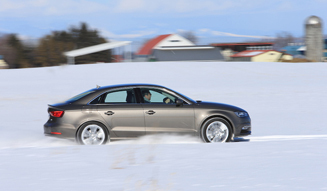
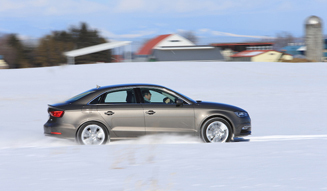
Speaking of security, this test drive took place in Hokkaido during mid-winter. At the Tokachi Speedway, a special course covered in snow was prepared, and even here, the A3 provided an astonishing sense of security.
The test car was the A3 Sedan "1.8 TFSI quattro". While it's well-known that Audi's quattro system enhances stability on paved roads, I was curious to see how it would perform on snow.
I recall driving an Audi "Q3" at a studless tire test event last year (its rear-wheel torque transfer mechanism is the same electronically controlled hydraulic multi-plate clutch as the A3). However, the test course this time, with its tight low-speed corners and quick S-curves, seemed much more challenging.Q3 (its rear-wheel torque transfer mechanism is the same electronically controlled hydraulic multi-plate clutch as the A3). However, the test course this time, with its tight low-speed corners and quick S-curves, seemed much more challenging. Let's get started.
Audi A3 Sedan 1.8 TFSI quattro
Audi A3 Sedan 1.4 TFSI Cylinder On Demand
Audi's technology condensed into a compact body
Test drive of Audi's serious "A3 Sedan" (3)
Quattro's unique behavior on snow
First, a sudden start from a standstill. Even attempting a full-throttle acceleration with shifts at the rev limiter, the A3 Sedan strongly tends to go straight, requiring almost no steering correction.
Next, entering a medium-speed S-curve. It took a moment for the turn-in to initiate in the first corner, but once I could generate yaw (a type of rotational force that makes the car try to spin like a top during cornering; the change in the car's direction at corner entry is largely due to this 'yaw' force), the turn-in for the next corner began surprisingly easily, utilizing the rebound of that yaw. Then, by gradually pressing the throttle pedal, the rear wheels push the car forward, allowing for a powerful drift.
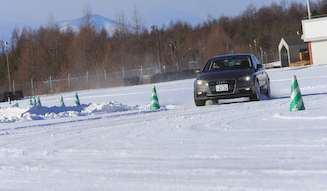
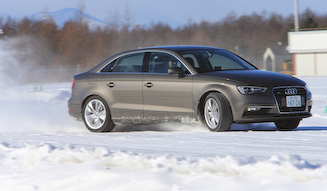
What's surprising here is that even with full counter-steer – that is, turning the steering wheel in the opposite direction of the turn – as long as the throttle pedal is firmly pressed, the A3 never spins and can navigate the corner at high speed.
Many 4WD systems are too stability-oriented, making it difficult to maintain such large drift angles. This is usually the privilege of rear-wheel-drive cars, but then they tend to spin due to instability, and moreover, the rear wheels alone cannot apply sufficient driving force to the snowy road to maintain such speed. In other words, this kind of driving is unique to 4WD – or rather,Audi's quattro. Honestly, enjoying snow driving this much was a first for me in my life.
(Editorial Note: The test drive was conducted on a test course. Please do not attempt this on public roads.)
Audi A3 Sedan 1.8 TFSI quattro
Audi A3 Sedan 1.4 TFSI Cylinder On Demand
Audi's technology condensed into a compact body
Test drive of Audi's serious "A3 Sedan" (4)
The A3's compelling charm isn't limited to quattro
So, does the front-wheel-drive A3, which doesn't have quattro, lack appeal? I can confidently answer no to this question.
Certainly, when comparing performance on snow-covered roads, front-wheel drive cannot compete with quattro. However, front-wheel drive has advantages such as higher straight-line stability at high speeds compared to rear-wheel drive. The benefits of front-wheel drive are not limited to its packaging advantages when building compact cars.
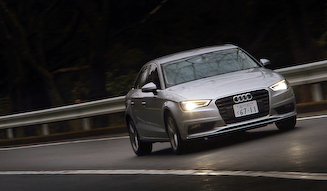
Furthermore, the aforementioned ride comfort is exactly the same in the A3 Sedan "1.4 TFSI cod" that I test-drove later. Additionally, the fact that the engine noise does not become unduly loud even at full throttle, and that road noise is kept low even during high-speed driving, is excellent to the point that no amount of praise would be too much. In the same C-segment, it can be said to be unrivaled.
While these are merits common to both the 1.8 TFSI quattro and the 1.4 TFSI cod, the 1.4 TFSI cod surpasses the 1.8 TFSI quattro in fuel economy, no matter how you look at it.
Audi A3 Sedan 1.4 TFSI cod
This is based on the onboard computer readings, so it may not be entirely accurate, but the fuel economy of the 1.8 TFSI quattro at 100 km/h is around 14-16 km/l, whereas the 1.4 TFSI cod easily achieves 18 km/l, and with a little effort, it seems possible to reach around 22 km/l.
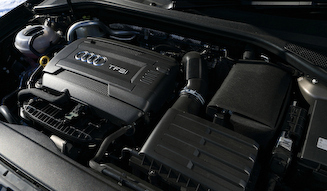
By the way, "cod" at the end of the model name stands for "cylinder on demand," meaning it is equipped with a cylinder-deactivation engine that can switch between four and two cylinders depending on the situation. This 1.4-liter engine itself is a latest specification with an aluminum block. It's natural for it to have good fuel economy.
What's more, the transition from four to two cylinders, or from two to four cylinders, is completely imperceptible in terms of sound and vibration, which is a welcome feature. Actually, when I test-drove the Volkswagen "Polo BlueGT" in the Netherlands, which was the first car to feature this engine, I noticed a subtle change in vibration, but I was relieved to find that it has been completely eliminated in the A3.Polo BlueGTin the Netherlands, which was the first car to feature this engine, I noticed a subtle change in vibration, but I was relieved to find that it has been completely eliminated in the A3. However, I barely felt any change in the "Golf 7" with the same engine, so this improvement might apply to the entire Volkswagen Group, not just Audi.Golf 7with the same engine, I barely felt any change, so this improvement might apply to the entire Volkswagen Group, not just Audi.
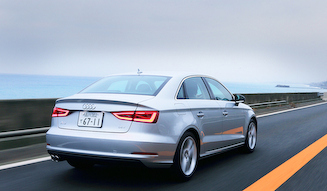
Audi A3 Sedan 1.4 TFSI cod
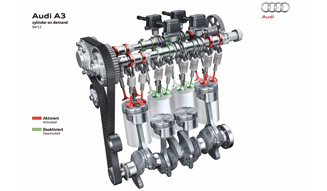
Audi A3 Sedan 1.4 TFSI cod
The advantages of the 1.4 TFSI cod are not limited to fuel economy. Although its displacement is 400cc smaller, it delivers a maximum torque of 250 Nm, nearly matching the 1.8 TFSI quattro's 280 Nm. Furthermore, its weight is 130 kg lighter, and the gearing is set lower overall, resulting in a more spirited performance than the 1.8 TFSI quattro, especially at lower speeds.
Moreover, the 1.4 TFSI cod is priced nearly 500,000 yen cheaper than the 1.8 TFSI quattro at 3.64 million yen. While the 4.1 million yen for the 1.8 TFSI quattro is also quite a bargain for a quattro model, choosing between the 1.4 TFSI cod and the 1.8 TFSI quattro presents a significant dilemma. (Although I haven't test-driven it yet, the 1.4 TFSI without cod is priced even more attractively at 3.25 million yen!) Will you choose quattro, or the excellent fuel economy and lively performance? It might be worthwhile to ponder this dilemma as if you were Hamlet.
Audi A3 Sedan 1.8 TFSI quattro
Body size | Length 4,465 × Width 1,795 × Height 1,390 mm
Wheelbase | 2,635 mm
Tread Front/Rear | 1,550 / 1,520 mm
Minimum ground clearance | 130 mm
Minimum turning radius | 5.1 meters
Trunk capacity (VDA value) | 390 liters
Weight | 1,470 kg
Engine | 1,798cc Inline 4-cylinder DOHC Turbo
Compression ratio | 9.6 : 1
Bore x Stroke | 82.5 × 84.1 mm
Maximum output | 132 kW (180 ps) / 4,500-6,200 rpm
Maximum torque | 280 Nm (28.6kgm) / 1,350-4,500 rpm
Transmission | 6-speed automatic (S tronic)
Drivetrain | 4WD
Suspension Front | MacPherson strut
Suspension Rear | 4-link
Tires | 225/45R17
Brakes Front/Rear | Ventilated disc / Disc
Fuel economy (JC08 mode) | 14.8 km/ℓ
Price | 4.1 million yen
Audi A3 Sedan 1.4 TFSI Cylinder On Demand
Body size | Length 4,465 × Width 1,795 × Height 1,390 mm
Wheelbase | 2,635 mm
Tread Front/Rear | 1,550 / 1,520 mm
Minimum ground clearance | 130 mm
Minimum turning radius | 5.1 meters
Trunk capacity (VDA value) | 425 liters
Weight | 1,340 kg
Engine | 1,394cc Inline 4-cylinder DOHC Turbo
Compression ratio | 10.0 : 1
Bore x Stroke | 74.5 × 80.0 mm
Maximum output | 103 kW (140 ps) / 4,500-6,000 rpm
Maximum torque | 250 Nm (25.5kgm) / 1,500-3,500 rpm
Transmission | 7-speed automatic (S tronic)
Drivetrain | FF
Suspension Front | MacPherson strut
Suspension Rear | 4-link
Tires | 225/45R17
Brakes Front/Rear | Ventilated disc / Disc
Fuel economy (JC08 mode) | 20.0 km/ℓ
Price | 3.64 million yen
Audi Communication Center
0120-598106 (9:00-19:00, open year-round)