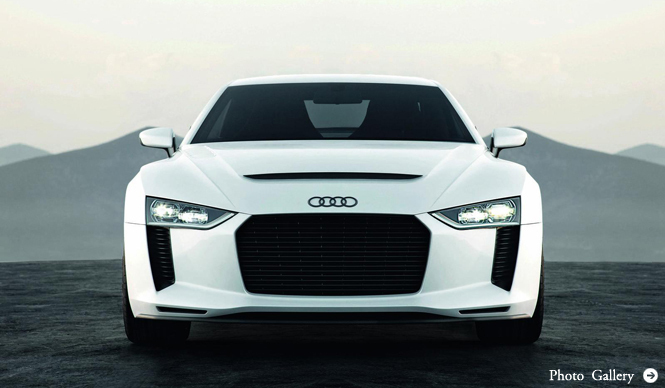
AUDI Quattro Concept | Audi Quattro Concept Announced
AUDI QUATTRO CONCEPT
A Concept Model Recalling 30 Years of History
AudiAudi announced the "Quattro Concept," a special model celebrating 30 years of the Quattro, at the Paris Motor Show. It features the engine from the "TT RS" and a chassis based on the "RS5" but made more compact.
Text by Giraffe
Inheriting a Lightweight, Compact 2.5-Liter Inline-5
The full-time AWD "Quattro," a symbol of Audi technology that emerged in the 1980s and continues to play a vital role in the driving performance of Audi cars today, celebrates its 30th anniversary since its debut. The "Quattro Concept" announced on this occasion is a special model developed to commemorate this milestone, featuring the "TT RS" engine mounted on a chassis based on the "RS5."
The body dimensions are 4,280mm in length, 1,860mm in width, and 1,330mm in height, with a wheelbase of 2,600mm. Compared to the base RS5, the wheelbase is 150mm shorter and the height is 40mm lower.
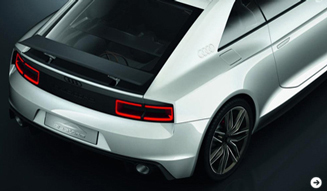
The engine is the lightweight, compact 2.5-liter inline-5 gasoline turbo from the "TT RS," but its maximum output has been increased by 68ps to 408ps compared to the conventional TT RS. Maximum torque is also up by 3kgm to 48.9kgm. Combined with the Quattro system and a 6-speed manual transmission, it achieves an impressive 0-100 km/h acceleration time of 3.9 seconds.
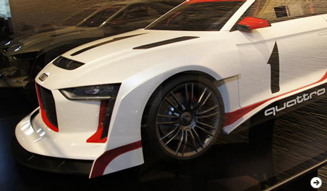
Also on display was a rally machine, reminiscent of the Quattro S1 that competed in the WRC (World Rally Championship) in the 1980s, colored in a base of white with red and black accents.
With its large front spoiler, rear wing, polycarbonate side windows, and 20-inch alloy wheels, the car possesses a presence that suggests it could immediately enter motorsport competition.
BRAND HISTORY
Audi's emblem is the "Four Rings." As you may know, each ring represents one of the automotive manufacturers: Audi, DKW (de:ka:ve:), Horch, and Wanderer. All were based in Saxony and were leading brands in the German automotive industry at the beginning of the 20th century. However, the four companies, hit by the Great Depression after World War I, formed the Auto Union in 1932 to survive. DKW specialized in motorcycles and small cars, Wanderer in mid-size cars, Audi in premium mid-size cars, and Horch in luxury cars.
However, due to Germany's defeat in World War II, Saxony in East Germany fell under Soviet occupation, and Auto Union ceased to exist. Anticipating this, the new Auto Union was established in Ingolstadt, Bavaria, in West Germany. Unlike BMW and Mercedes-Benz, Auto Union faced a difficult start with no existing factories, but gradually built its strength through the production of vehicles like the DKW delivery van.
In late 1964, Auto Union came under the umbrella of Volkswagen and soon introduced new models bearing the Audi name. In 1969, it merged with NSU (known for its development of the Wankel engine), based in Neckarsulm, becoming Audi NSU Auto Union. From 1985 onwards, it has continued as Audi to the present day. Technology such as Quattro, dynamic performance backed by motorsport activities, elegant design, and high-quality finishes are driving Audi's popularity.