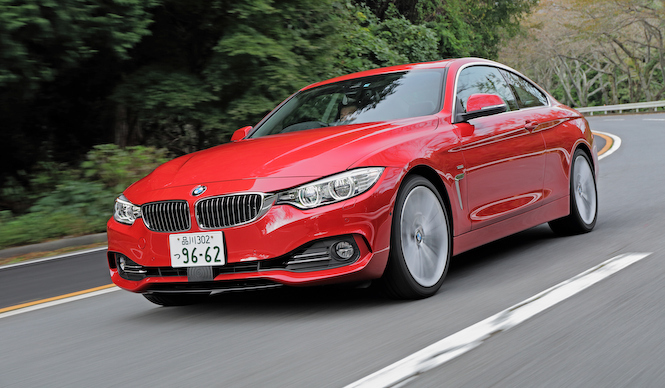
Test Drive the BMW 4 Series Coupé, Now in Japan
BMW 4 Series Coupe
Seeking What Sedans and Wagons Lack
Test Drive of the "4 Series Coupe" Upon its Arrival in Japan
"4 Series Coupe" succeeded the "3 Series Coupe," and its concept car debuted inDetroit Motor Show2013. Its production model was unveiled at theFrankfurt Motor Show, and it arrived in Japan by the end of the same month. This sleek coupe, given an even number to signify its departure from the existing basic lineup, was test-driven by Yasuhiko Kawamura.
Text by KAWAMURA Yasuhiko
Photographs by HANAMURA Hidenori
Different Name from the 3 Series, But Close Kin
"From "3 Series Coupe" to "4 Series"—This latest BMW coupe, with its name change suggesting a stronger sense of independence and aspiration for a higher class, has arrived in Japan less than half a year after its debut in its home market.
When we think of the former "3 Series", the impression was strongly that of a "compact model supporting the BMW lineup from the bottom." However, tracing its lineage, this "4 Series," which is a derivative, can no longer be described as "compact" in any way.
Its body silhouette, starting with the long front hood that is the source of its "BMW-ness," feels more elongated and flowing, despite sharing the same 2,810mm wheelbase as the sedan.
Furthermore, while adopting a fastback-style roofline, the point at which it begins to descend is set relatively far back, giving the impression of a surprisingly spacious interior for a coupe, which is another characteristic of this model's unique exterior design.
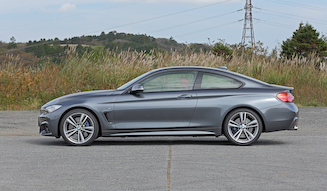
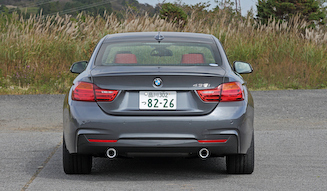
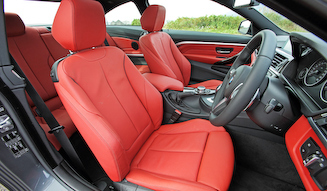
In reality, the rear seats of the 4 Series are a "space where adults can spend long periods without significant discomfort." At the same time, the trunk space, while not particularly tall, offers considerable depth, and the rear seatbacks fold down in a 60:40 split. These features contribute to the model's excellent utility for a two-door coupe, making it a significant characteristic of its packaging.
On the other hand, the view from the front seats is "not significantly different" from that of the "3 Series Sedan" or "Touring." The layout of the center panel, with its motif of a landscape tablet device mounted on the dashboard, the split audio and climate control systems arranged in two vertical rows, and the center console with its visually distinct placement of the "iDrive" control dial and the shift-by-wire selector, all adopt the exact same "grammar" as the 3 Series.
Yes, it is clear that this model's strong blood ties with the 3 Series remain unchanged, even with its new name.
BMW 4 Series Coupe
Seeking What Sedans and Wagons Lack
Test Drive of the "4 Series Coupe" Upon its Arrival in Japan (2)
A Coupe Suitable for Daily Use
Indeed, this model is 25mm wider than the sedan/touring, and to ensure ease of entry/exit for rear passengers, the B-pillar is positioned further back, requiring longer doors. This means that door opening in tight spaces is somewhat compromised.
On the other hand, to compensate for the reduced ease of buckling the seatbelt from the front seats, an electric belt feeder extending forward from the B-pillar during entry and exit is standard, a thoughtful consideration that should not be overlooked.
In other words, along with the aforementioned high utility, this coupe's design allows it to be treated as a "two-door sedan." As a result, for users who do not frequently use the rear seats, it is entirely possible to use this single vehicle for all their daily needs.
Two Engine Options Combined with Four Trim Lines
In Japan, the 4 Series is offered with a choice of two turbocharged direct-injection engines – a 2.0-liter four-cylinder or a 3.0-liter six-cylinder – paired with an 8-speed automatic transmission, each available in four trim levels.
The test drive included two models: the former, the "428i Luxury," and the latter, the "435i M Sport."
The 428i was equipped with optional items totaling over 750,000 yen, including LED headlights, a glass sunroof, and Active Cruise Control. The 435i also had these features, plus an "Adaptive M Suspension" consisting of electronically controlled variable dampers and upgraded "M Sport Brakes," with options totaling over 850,000 yen.
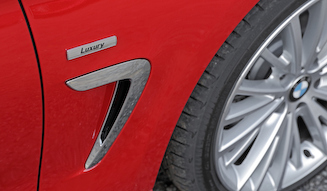
Due to time constraints, we started with the "435i M Sport," which had its "suspension also enhanced with optional items." In retrospect, this seems to have been like "eating the more delicious dish first."
BMW 4 Series Coupe
Seeking What Sedans and Wagons Lack
Test Drive of the "4 Series Coupe" Upon its Arrival in Japan (3)
The 435i M Sport: A Perfect Harmony of Engine, Chassis, and Transmission
With its twin-scroll turbocharger, this model delivers a substantial torque boost from very low RPMs, making its power performance completely mask the vehicle's weight of over 1.6 tons. Not only is the power delivery seamless across all rev ranges, but the smooth rotation characteristic of an inline-six engine and the satisfyingly powerful and engaging sound further enhance the driving experience. It's truly a masterpiece that makes you want to exclaim, "Perfectly executed!"
Furthermore, the transmission complements the engine's ability to rev powerfully and precisely to its 7,000rpm redline, with a tight, direct-drive feel that links engine speed and vehicle acceleration seamlessly. It achieves both quick shifts and direct torque transfer while maintaining the smooth operation distinct from a dual-clutch transmission at low speeds, making it equally flawless.
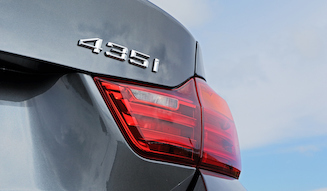
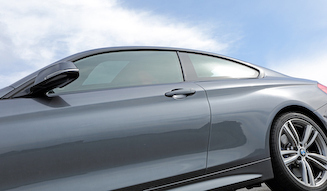
In essence, it's no exaggeration to say that the driving appeal of the 435i lies primarily in its powertrain.
So, is the appeal of this model solely concentrated in its powertrain? Not at all. The chassis tuning is equally impressive, rivaling the powertrain's excellence.
Its handling feel isn't necessarily "agile" in the strictest sense. The steering response from the neutral position has a slightly gentle resistance. For those who prioritize crisp, immediate feedback, it might be perceived as "lacking a bit of excitement."
However, in reality, the steering response is consistently predictable, and the balance between handling and stability maintains a "neutral feel even when pushed hard through corners." While there are moments where sensitivity to road imperfections is noticeable, possibly due to the run-flat tires, the ride quality is fundamentally very supple. Overall, the exceptional balance in every aspect is a key characteristic of this model's driving impression.
BMW 4 Series Coupe
Seeking What Sedans and Wagons Lack
Test Drive of the "4 Series Coupe" Upon its Arrival in Japan (4)
The 428i Luxury: An Exemplary Balance
Switching from the 435i M Sport to the 428i Luxury, the first thing I noticed was that the "brake feel seemed a bit soft."
As mentioned earlier, it was later revealed that the brakes on the 435i M Sport I drove were equipped with optional upgraded components. Therefore, my conclusion is that if you choose the "M Sport grade, the "M Sport Brakes" are an option you should definitely select."
After all, the price is only 100,000 yen, meaning the additional cost is "negligible" compared to the base price of the 4 Series.
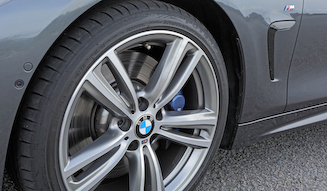
The 428i's engine also produces 350 Nm of torque at a mere 1,200 rpm, ensuring ample acceleration for daily driving. However, compared to the 435i, it felt somewhat "lacking," not due to a difference in absolute acceleration, but rather because of a clear distinction in rotational feel and sound.
The suspension tuning also impresses with its excellent balance. In fact, the effect of "minus two cylinders" is apparent, with the front axle load being 50kg lighter than the 435i M Sport. However, the inability to fully appreciate the benefits of this "weight reduction" in terms of handling or comfort is likely related to the fact that the 435i M Sport I drove was equipped with optional electronically controlled dampers.
By comparison, the conclusion is that, in this regard as well, the "435i M Sport is more fitting to the 4 Series' intended purpose."
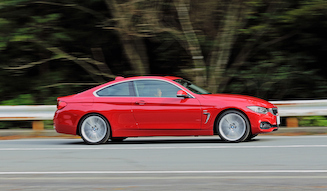
If You're Getting a Coupe—
Given that there is already an excellent "role model" in the 3 Series Sedan, the reason for creating a coupe model that sacrifices practicality and adds cost is, naturally, to meet the demands of users who desire a more beautiful body and a more enriching driving experience that cannot be achieved with sedans or station wagons.
Therefore, between the two models tested, I would strongly recommend the "435i M Sport," which more vividly embodies the intended purpose of the coupe as a model.—Ultimately, I find myself wanting to conclude with such a statement.

BMW 428i Coupe Luxury
Body Dimensions | Length 4,640 x Width 1,825 x Height 1,375 mm
Wheelbase | 2,810 mm
Tread Front/Rear | 1,545 / 1,575 mm
Weight | 1,570 kg
Ground Clearance | 130 mm
Engine | 1,997 cc Inline 4-Cylinder Direct Injection DOHC Turbo
Max Power | 180 kW (245 ps) / 5,000 rpm
Max Torque | 350 Nm (35.7 kgm) / 1,250-4,800 rpm
Transmission | 8-Speed Automatic
Drivetrain | FR
Tires Front/Rear | 225/40R19 / 255/35R19
Fuel Economy (JC08 Mode) | 15.2 km/ℓ
Trunk Capacity | 445 Liters
0-100km/h Acceleration | 5.8 Seconds
Price | 6.46 million yen (428i 6.04 million yen / 428i Sport 6.24 million yen / 428i M Sport 6.44 million yen)
BMW 435i Coupe M Sport
Body Dimensions | Length 4,670 x Width 1,825 x Height 1,375 mm
Wheelbase | 2,810 mm
Tread Front/Rear | 1,545 / 1,575 mm
Weight | 1,620 kg
Ground Clearance | 130 mm
Engine | 2,979 cc Inline 6-Cylinder Direct Injection DOHC Turbo
Max Power | 225 kW (306 ps) / 5,800 rpm
Max Torque | 400 Nm (40.8 kgm) / 1,200-5,000 rpm
Transmission | 8-Speed Automatic
Drivetrain | FR
Tires Front/Rear | 225/45R19 / 255/35R19
Fuel Economy (JC08 Mode) | 12.7 km/ℓ
Trunk Capacity | 445 Liters
0-100km/h Acceleration | 5.1 Seconds
Price | 7.74 million yen (435i 7.38 million yen / 435i Sport 7.54 million yen / 435i Luxury 7.58 million yen)