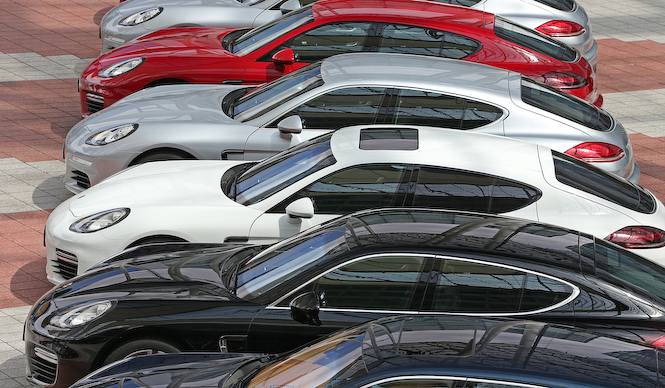
First Major Update: A Drive in the Porsche Panamera
Porsche Panamera S
Porsche Panamera Turbo Executive
Porsche Panamera S E-Hybrid
First Major Update
Test Drive: Porsche Panamera
First released in 2009,Porscheits first full four-seater, four-door sedan, thePanamera,received its first major revision this year,debuting in Shanghai.The "Panamera S" and "4S" models, which were powered by a 4.8-liter naturally aspirated V8 engine, have undergone significant downsizing to a 3.0-liter V6 twin-turbo. In terms of displacement alone, this is smaller than the 3.6-liter naturally aspirated V6 engine found in the standard "Panamera" and "4" models. Furthermore, while the hybrid model retains the same engine, its electric components have been substantially enhanced. This time, Yasuhiko Kawamura, who was in charge of the report from the car'sworkshop,takes the wheel.
Text by KAWAMURA Yasuhiko
Porsche's Dream Leading to the Panamera
A sports car for four, with ample room—This packaging design was, in fact, a long-cherished dream for Porsche.
It's an anecdote known to those in the know that the four-door model "989," based on the "928," was canceled despite completing prototypes due to "insufficient development funds."
Moreover, over half a century ago, when the first generation "911" was still under development as the "901," a notchback design with a more horizontal and longer roof was envisioned to enhance rear-seat comfort. This can be confirmed by the "T7" model, which is now exhibited at the Porsche Museum. Additionally, there's a past instance of a one-off four-door wagon based on the 928, separate from the aforementioned 989, being produced.
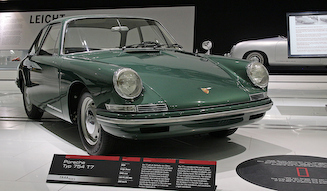
The T7 designed by F.A. Porsche (1956) was the prototype for the 911, but featured a notchback design like a sedan.
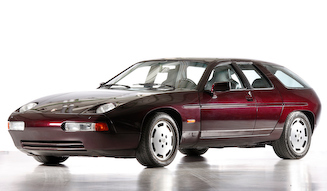
A four-door station wagon based on the 928, released in 1991. The exterior of the model called the 989 was much closer to the 911 than this.
Thus, while known as a "sports car manufacturer," Porsche has also been a brand that has long sought opportunities to enter the full four-seater category.
With this background, and spurred by the success of the "Cayenne,"Porsche finally introduced the all-new "Panamera" model in 2009. What we introduce here is the latest version, which has undergone its first significant refinement since its debut.
Porsche Panamera S
Porsche Panamera Turbo Executive
Porsche Panamera S E-Hybrid
First Major Update
Test Drive: Porsche Panamera (2)
Focus on Hardware
The "main highlights" of the Panamera's minor model change are primarily focused on the following three points.
First, the introduction of the "Executive" long-wheelbase version, with a 15cm extended wheelbase, targeting the Chinese market, where "now the most Panameras are sold (!)."
Second, the release of new models equipped with a newly developed 3.0-liter V6 twin-turbo engine, replacing the previous 4.8-liter naturally aspirated 8-cylinder engine.
Third, a significant refinement of the hybrid model's system, which includes replacing the conventional nickel-metal hydride drive battery with a lithium-ion type, increasing its capacity by more than five times, doubling the motor output, and enabling external charging for the first time.
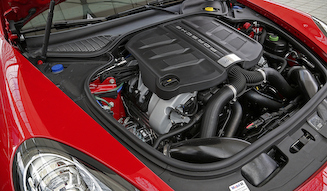
Porsche Panamera S
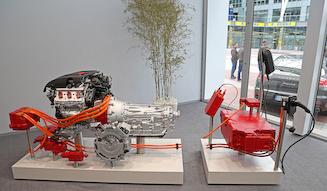
Porsche Panamera S E-Hybrid
Of course, there are also numerous visual changes, such as design modifications centered around the lighting and the adoption of a newly shaped tailgate.
However, considering the aforementioned hardware refinements, the first impression of this Panamera minor change is that it "emphasizes evolution of the 'core' in true Porsche fashion."
Porsche Panamera S
Porsche Panamera Turbo Executive
Porsche Panamera S E-Hybrid
First Major Update
Test Drive: Porsche Panamera (3)
How Has the Panamera S Changed with the Downsized Engine?
The first car I drove at the international press event held in the suburbs of Munich, Germany, was the "S" grade, equipped with the aforementioned 6-cylinder engine, newly developed from an 8-cylinder unit.
While the displacement is reduced by more than 1.8 liters compared to the previous 8-cylinder unit, the maximum output and torque figures of 420ps and 520Nm represent an increase of "20ps and 20Nm" respectively over the previous model. Furthermore, the fact that the maximum torque is available from 1,750rpm, a full 1,750rpm lower than the 8-cylinder unit, is also noteworthy.
Indeed, the power delivered by this engine to the new S grade was more than sufficient, offering a rich driving experience.
Certainly, one can understand the sentiment of those who miss the "lost V8 sound." However, there is no doubt that the sound produced by this engine is also highly appealing and among the sportiest of the many V6 units available.
Additionally, what left a positive impression was the overall improvement in ride quality, making it more refined. The suspension felt as if "each joint had become smoother," providing a strong "sense of unity between driver and car" and making the car feel more compact than it is—truly a "Porschecharacteristic feel."
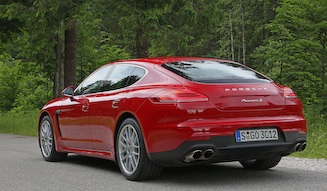
This test car was optionally equipped with the active stabilizer "PDCC" paired with the torque vectoring system "PTV Plus," and 20-inch wheels, a 2-inch increase over the standard size.
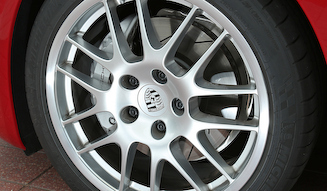
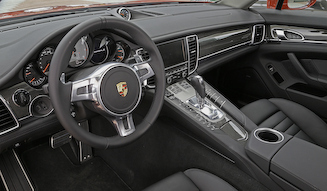
Despite these options, the road noise was surprisingly low, and the suspension movement didn't feel excessively heavy, showcasing its demeanor as a "luxury sedan."
Incidentally, the excellent performance, including steering precision, was likely also contributed to by the superb finish of the Michelin "Pilot Super Sport" tires fitted to the car.
Porsche Panamera S
Porsche Panamera Turbo Executive
Porsche Panamera S E-Hybrid
First Major Update
Test Drive: Porsche Panamera (4)
The Difference of the Long Wheelbase
Switching from the S grade to the "Turbo Executive" grade, which features the aforementioned long-wheelbase body, the driving impression admittedly decreased slightly.
The legroom in the rear seats is, as expected, vastly more spacious than in the standard version. While I personally don't find the extended appearance particularly beautiful, considering it was developed due to strong demand from the Chinese market after the original model's debut, it can be perceived as "well-executed."
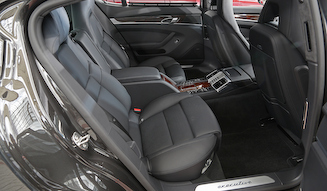
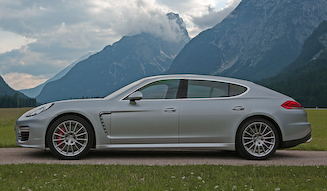
On the other hand, although engineers claim "no change in rigidity values," there is an undeniable impression of a slight decrease in overall "sense of rigidity." The time it takes for micro-vibrations in the body to dissipate feels longer than in the standard body. Frankly, this version feels somewhat "looser" than the standard body.
However, the sheer power of the V8 twin-turbo, producing up to 520ps, "completely overcomes" the 100kg increase in weight compared to the standard body model.
As evidenced by the first-class sports car level 0-100km/h acceleration time of 4.1 seconds, the acceleration felt during full throttle is "so powerful that it might make passengers in the rear seats feel a bit queasy."
The "297" (!) displayed on the speedometer while catching up to the car ahead on an open autobahn also demonstrates its high-speed capability.
Admittedly, the acceleration noticeably slows beyond around "270," but the catalog's top speed of 305km/h is undoubtedly accurate.
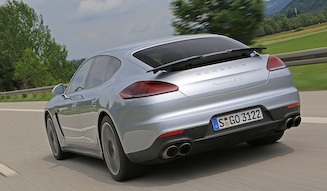
Perhaps due to the effectiveness of the spoiler, which spreads its "wings" widely below the rear window, the stability at such ultra-high speeds is impressively high, a testament to "Porsche's craftsmanship."
Porsche Panamera S
Porsche Panamera Turbo Executive
Porsche Panamera S E-Hybrid
First Major Update
Test Drive: Porsche Panamera (5)
Finally, Taking the Wheel of the Hybrid
In Japan, the hybrid version is often perceived as a "golden sign" for its eco-friendliness. However, forPorsche,it goes beyond simply promoting environmental performance.
Indeed, the new model, renamed from the previous "S Hybrid" to "S E-Hybrid," has achieved remarkable success by both significantly reducing CO2 emissions under the European measuring standard "NEDC" from 159g/km to 71g/km, and shortening the 0-100km/h acceleration time from 6.0 seconds to 5.5 seconds—truly succeeding in "chasing two rabbits."
As mentioned earlier, with the motor output more than doubled, practical acceleration from a standstill is possible even in situations like congested city traffic without starting the engine.
Furthermore, with sufficient battery charge, cruising at speeds exceeding 100km/h in "EV mode" is easily achievable. The maximum speed in EV mode is 135km/h; the engine starts at this point because "structurally, 150km/h is possible, but efficiency decreases at that speed."
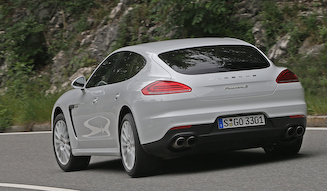
As with the previous model, the 3.0-liter V6 unit with a mechanical supercharger, supplied by within the group'sAudi,delivers additional power, significantly boosting performance. The engine starts and stops automatically, and the smoothness is such that "you wouldn't notice it unless you were watching the tachometer needle move."
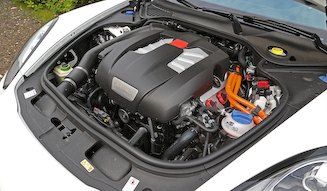
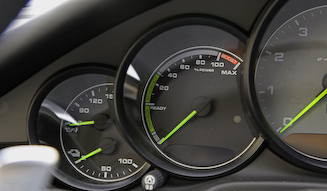
Thus, with a single touch of the accelerator, this model can dramatically alter its driving character, transforming from a surprisingly "eco-friendly car" to a "super saloon" befitting the Porsche name, much like "Dr. Jekyll and Mr. Hyde."
On the autobahn, a light press of the accelerator pedal instantly propels you into speeds exceeding 200km/h. This model, therefore, possesses a character entirely different from "Japanese hybrids."
Porsche Panamera S
Porsche Panamera Turbo Executive
Porsche Panamera S E-Hybrid
First Major Update
Test Drive: Porsche Panamera (6)
Rapid Charging While Driving
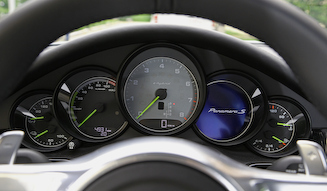
What was interesting was the provision of not only an "E-Power Mode" that expands the electric motor's operating range via a switch on the center console, but also an "E-Charge Mode" that actively recharges the battery using the engine's surplus power.
If you anticipate needing to drive in EV mode in the city after highway cruising, this mode allows you to "revive" EV driving even after the 36km EV range (NEDC) has been depleted.
In fact, when tested in this mode on a suburban road at 80-100km/h, the battery indicator, which had shown zero, recovered to half capacity in just about 15 minutes.
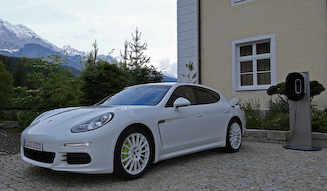
The plug-in mechanism on this model does not support rapid charging.
However, this is compensated by the aforementioned function enabling "rapid charging while driving." Instead of blindly extending the EV range, it is based onPorsche'sphilosophy: "It is optimal to balance high performance and weight by utilizing the engine's efficiency in scenes where it can be used effectively, such as high-speed cruising."
Porsche's Weakness
Interestingly, this S E-Hybrid model uniquely features "InnoDrive," which optimizes the hybrid system for fuel efficiency by anticipating route information up to several kilometers ahead, including gradients, corner radii, speed limits, and intersections, when a destination is set in the navigation system. It also offers "Car Connect," which allows for pre-conditioning of the climate control before starting and checking battery charge status or setting charging timers from a smartphone.
Unfortunately, these features will not be available on the Japanese specification models. Along with the fact that the "PCM" information system, available on all Porsche models for several years, is still not offered on any model, the lack of advanced telematics systems compared to rival manufacturers is becoming a significant weakness for Japanese specification Porsche cars.
Despite these "blind spots," the new Panamera series, led by the hybrid model's significantly enhanced performance and environmental credentials, truly embodies the slogan "Intelligent Performance" with its improved driving dynamics and fuel efficiency, strengthening its character as a "Porsche four-door."

Porsche Panamera S
Body Dimensions | Length 5,015 x Width 1,931 x Height 1,418 mm
Wheelbase | 2,920 mm
Tread Front/Rear | 1,658 / 1,662 mm
Trunk Capacity | 445-1,263 Liters
Weight | 1,810 kg
Engine | 2,997 cc 90-degree V6 Direct Injection DOHC Twin-Turbo
Compression Ratio | 9.8:1
Bore x Stroke | 96.0 x 69.0 mm
Max Output | 309kW (420ps) / 6,000 rpm
Max Torque | 520Nm / 1,750-5,000 rpm
Transmission | 7-speed Automatic (PDK)
Drivetrain | FR
Tires Front/Rear | 245/50R18 / 275/45R18
0-100km/h Acceleration | 5.1 seconds
Top Speed | 287 km/h
Fuel Economy (NEDC) | 8.7 ℓ/100km
CO2 Emissions | 204 g/km
Porsche Panamera Turbo Executive
Body Dimensions | Length 5,165 x Width 1,931 x Height 1,425 mm
Wheelbase | 3,070 mm
Tread Front/Rear | 1,656 / 1,646 mm
Trunk Capacity | 432-1,250 Liters
Weight | 2,070 kg
Engine | 4,806 cc 90-degree V8 Direct Injection DOHC Twin-Turbo
Compression Ratio | 10.5:1
Bore x Stroke | 96.0 x 83.0 mm
Max Output | 382kW (520ps) / 6,000 rpm
Max Torque | 700Nm / 2,250-4,500 rpm
Transmission | 7-speed Automatic (PDK)
Drivetrain | FR
Tires Front/Rear | 255/45R19 / 285/40R19
0-100km/h Acceleration | 4.2 seconds
Top Speed | 305 km/h
Fuel Economy (NEDC) | 10.3 ℓ/100km
CO2 Emissions | 242 g/km
Porsche Panamera S E-Hybrid
Body Dimensions | Length 5,015 x Width 1,931 x Height 1,418 mm
Wheelbase | 2,920 mm
Tread Front/Rear | 1,658 / 1,662 mm
Trunk Capacity | 335-1,153 Liters
Weight | 2,095 kg
Engine | 2,995 cc 90-degree V6 Direct Injection DOHC Supercharger
Compression Ratio | 10.5:1
Bore x Stroke | 84.5 x 89.0 mm
Max Output | 245kW (333ps) / 5,500-6,500 rpm
Max Torque | 440Nm / 3,000-5,250 rpm
Motor Max Output | 70kW (95ps) / 2,200-2,600 rpm
Motor Max Torque | 310Nm / 0-1,700rpm
Transmission | 8-speed Automatic (Tiptronic S)
Drivetrain | FR
Tires Front/Rear | 245/50R18 / 275/45R18
0-100km/h Acceleration | 5.5 seconds
Top Speed | 270 km/h (135 km/h on electric motor alone)
Fuel Economy (NEDC) | 3.1 ℓ/100km
CO2 Emissions | 7.1 g/km