December 25, 2014
The Days Leading Up to the Birth of the LaFerrari | Ferrari
Ferrari LaFerrari | Ferrari LaFerrari
The Days Leading to the Birth of LaFerrari
The development project for "LaFerrari," which adopted numerous technologies derived from F1. How did Ferrari's engineering team transplant the hybrid system into a road model? Motohiro Yamazaki interviewed Ferrari CEO Amedeo Felisa.
Text by YAMAZAKI Motohiro
Offsetting a 1kg Weight Increase with a 1ps Power Boost
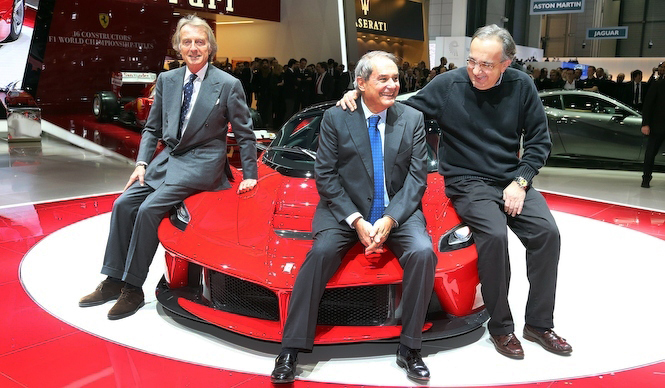
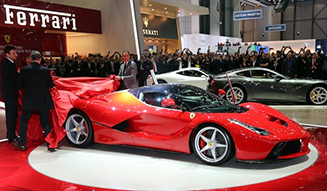
LaFerrari, Ferrari's first special limited-production road model for VIP customers in approximately 10 years, was unveiled at this year's Geneva Motor Show in March.Geneva ShowWorld Premiere
In April, it was also presented at the Shanghai Motor Show 2013, held in China, a market where Ferrari's presence is growing year by year.Auto ShanghaiAnd in late May, a Japan Premiere event was held in Tokyo.Japan Premiere EventThe production of LaFerrari is announced at 499 units, but according to Ferrari, all units had customers assigned by the time of the Geneva Show. This is similar to the situation with previous special models.
At the Geneva Motor Show, we had the opportunity for a brief interview with Ferrari CEO Amedeo Felisa. Mr. Felisa, who has a career as an engineer, having led the engineering team for V12 models, was naturally in a position to directly oversee the LaFerrari development project.
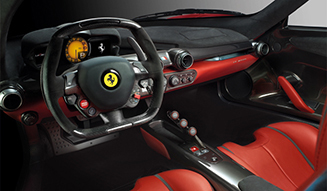
──Two years after the hybrid test car was first unveiled, LaFerrari has finally been born.
"At the 2010 Geneva Motor Show, we unveiled the hybrid test car based on the V12 two-seater 599GTB Fiorano, the "Vettura Laboratorio HY-KERS". The days leading up to the birth of LaFerrari were truly challenging for us.
The biggest challenge was how to achieve a high level of balance between Ferrari's traditional performance and the environmental performance demanded by the market.
"As one criterion for evaluating this, we first considered offsetting a 1kg weight increase from hybridization with a 1ps power increase. If this target could not be met, there would be no point in adopting HY-KERS."
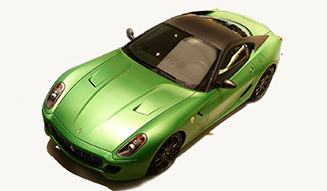
The hybrid test car "Vettura Laboratorio HY-KERS" based on the 599GTB Fiorano, unveiled at the 2010 Geneva Motor Show.
Ferrari LaFerrari | Ferrari LaFerrari
The Days Leading to the Birth of LaFerrari (2)
Produce One Less Than the Number Required
──What was the most difficult aspect for the engineering team during the development of LaFerrari?
"The LaFerrari engineering team faced various challenges in how to optimally position heavy components between the wheelbases. For example, the lithium-ion battery cells manufactured by Scuderia Ferrari, the Ferrari F1 team, weigh a total of about 60kg, and they are designed to be stored in a dedicated box-shaped space located in the rear of the carbon monocoque floor.
While HY-KERS is a very simple hybrid system, it offers significant advantages in terms of both weight and size. Including thermal management for the batteries, the LaFerrari engineering team did a truly remarkable job.
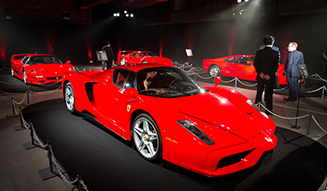
The Japan Premiere event in late May also featured an exhibition of past special models. In the foreground is the Enzo Ferrari. From the back left are the "F50," "F40," and "288GTO."
The production of LaFerrari is 499 units, but this reflects the will of the founder, Enzo Ferrari, to produce one less than the number required by the market.
The previous model, "Enzo," had a production plan of 399 units, and the "F50" had a plan of 349 units. The figure of 499 units for this model symbolizes how much the Ferrari market itself has grown in the interim."
──Will Ferrari's hybrid model lineup expand further?
"I cannot comment at this stage on whether Ferrari has plans to introduce hybrid models with similar or even more advanced technological solutions to the market in the future. It was only possible to attempt such innovative techniques precisely because LaFerrari is a limited-edition model. To adopt these for regular production models, we believe further step-by-step consideration is necessary.
However, if you ask whether Ferrari is planning for EVs beyond hybrids, the answer is definitively 'no.' Whether it's a V12 or a V8, I don't believe customers would respond positively to a Ferrari without the captivating sound of its engine."

Amedeo Felisa
Born in Milan in 1946. Studied mechanical engineering at the Polytechnic University of Milan. Joined Alfa Romeo in 1972. After working in the development department, he became head of the product development department in 1987. He joined Ferrari in 1990. In June 2004, he was appointed Deputy General Manager, concurrently serving as Head of the Gran Turismo Division. After becoming General Manager in 2006, he has served as CEO since 2008.