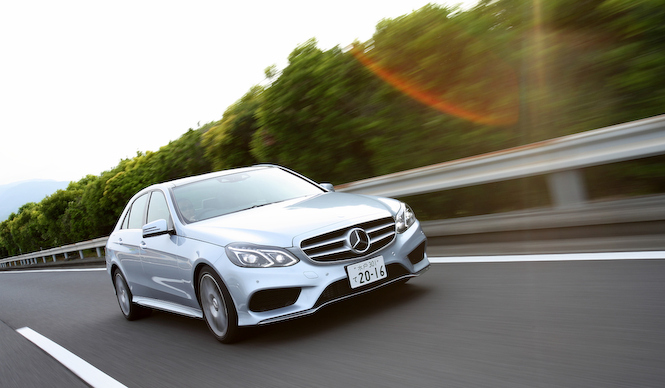
First Drive of the Mercedes-Benz E-Class in Japan
Mercedes-Benz E-Class
Test Drive: Mercedes-Benz E-Class
The E-Class has undergone a minor model change. However, as OPENERS readers are likely aware, the extent of these changes—encompassing exterior, engine, and safety equipment—is so comprehensive that it borders on a full model change, affecting approximately 2,000 components. This time, we tested the E-Class in Japan. We drove three models—the "E 250," "E 350 BlueTec," and "E 400 Hybrid"—equipped with cutting-edge safety features and the highly efficient engines that have garnered attention, accompanied by Tatsuya Otani.
Text by OTANI TatsuyaPhotographs by ARAKAWA Masayuki
Autonomous Driving!
The minor model change has resulted inMercedes-BenzThe prospect of autonomous driving in the new E-Class is likely to surprise many.
To be precise, it's not full autonomous driving, but rather technology that brings us "just a step away from autonomous driving." Yet, upon experiencing it firsthand, one can't help but feel a sense of awe, thinking, "The era has truly arrived."
This feature is called "Distronic Plus (with Steering Assist)."
By combining two radar sensors operating at different frequencies with a newly adopted stereo camera in the new E-Class, the system detects vehicles ahead and automatically controls the throttle, brakes, and even steering to match.
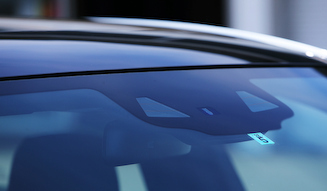
The newly adopted stereo camera
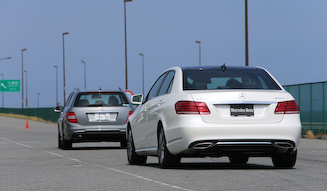
The adaptive cruise control, which automatically adjusts speed to match the vehicle ahead using radar, is available from various manufacturers, not just Mercedes-Benz. What's new in the E-Class is the integration of steering control into this system.
The adaptive cruise control, which automatically adjusts speed to match the vehicle ahead using radar, is available from various manufacturers, not just Mercedes-Benz. What's new in the E-Class is the integration of steering control into this system.
Experiencing it firsthand, you'll be impressed by its smooth operation.
The steering, throttle, and braking inputs are virtually indistinguishable from those of a careful human driver.
However, if you remove your hands from the steering wheel for an extended period, Distronic Plus will flash a warning light, gently prompting you to "Please hold the steering wheel." If this prompt is ignored, the system will eventually deactivate.
It's as if the car is saying, "I'll assist you if you intend to drive, but I won't if you don't."

"If it can do this much, why not just make it fully autonomous instead of adding such complicated safety features...?"
You might be thinking.
One reason for not doing so is that autonomous driving is not legally permitted. However, I believe Mercedes has implemented this system with the driver's feelings in mind.
Mercedes-Benz E-Class
Test Drive: Mercedes-Benz E-Class (2)
A Cautious Approach
If autonomous driving were legally permitted and widely adopted, Mercedes would undoubtedly introduce such systems without hesitation.
However, very few people have actually experienced the benefits of autonomous driving, nor are they necessarily proficient in its use. In such a scenario, it's entirely conceivable that the system could be used in ways Mercedes hasn't anticipated, potentially leading to accidents.
"While technically feasible, when the driver is factored in, we cannot definitively guarantee its absolute safety." This judgment is likely one of the reasons behind incorporating the "autonomous driving cancellation function."
Today, automatic emergency braking, utilizing "electronic eyes," is even found in minicars. However, the functionality and performance vary significantly between manufacturers. Naturally, the new E-Class is also equipped with automatic emergency braking, but they haveeven for automatic braking, they employ multiple layers of sensors to minimize the risk of malfunction or false detection.
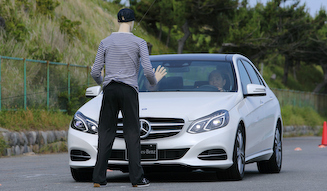
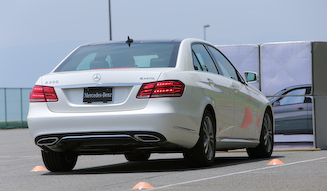
Of course, automatic braking can be achieved using only radar or stereo cameras. However, Mercedes' approach, which makes a decision based on multiple pieces of information and activates the brakes with absolute certainty, appears to be a more reliable system.
This isMercedes-Benz's characteristically cautious approach.
Mercedes-Benz E-Class
Test Drive: Mercedes-Benz E-Class (3)
Test Drive Begins with the E 250
Alongside these safety devices, the new engine lineup introduced in the new E-Class is also noteworthy.
While high-performance versions like the "E 550" and "E 63 AMG" continue to offer V8 engines, the core of the new E-Class lineup will likely consist of three engine types: a 3.5-liter V6 gasoline naturally aspirated, a 3.0-liter V6 diesel turbo, and a 2.0-liter inline-4 gasoline turbo.
Particularly noteworthy is the 2.0-liter inline-4 gasoline turbo. This engine employs the highly challenging technology of stratified lean-burn combustion, achieving a balance between fuel efficiency and excellent performance.
Stratified lean-burn combustion is a technology that creates both relatively rich and lean fuel-air mixture zones within the combustion chamber.
Ideally, leaner fuel-air mixtures improve fuel economy, but they make ignition difficult. Therefore, stratified lean-burn combustion aims to ignite the richer mixture first and then use that momentum to burn the leaner mixture.
However, rapidly and precisely creating these "rich" and "lean" zones within the combustion chamber is extremely difficult. Despite attempts by Japanese automakers and others, no successful implementation has been achieved until now.
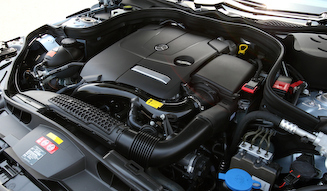
Mercedes-Benzproudly claims to have developed a highly refined stratified lean-burn engine by employing its unique combustion theory.
Driving the E 250 equipped with this engine makes you wonder, "Do we even need V6 or V8 engines anymore?" It performs that vigorously.
Admittedly, when revved to high RPMs, a slight vibration characteristic of a four-cylinder engine can be felt, making one miss the V6 or V8 in that regard. However, in all other aspects—torque, responsiveness, and quietness—it meets Mercedes-Benz's high standards.
Furthermore, its JC08 mode fuel economy is 15.5 km/ℓ, comparable to compact cars from a decade ago.
With a starting price of 5.95 million yen, it's an attractive model for those who previously could only afford the C-Class.
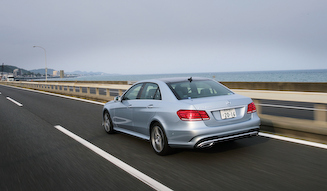
Mercedes-Benz E-Class
Test Drive: Mercedes-Benz E-Class (4)
You Might Not Realize It's a Diesel
We were also impressed by the refinement of the "E 350 BlueTEC," powered by a 3.0-liter V6 diesel turbo.
The noise and vibration are dramatically reduced compared to the pre-minor change model, making it so refined that many people likely wouldn't realize it's a diesel unless told beforehand.
Moreover, it offers excellent responsiveness at low RPMs and smooth acceleration at high RPMs. Additionally, being a diesel, fuel costs are lower, and the cruising range on a full tank is astonishingly long. For drivers who frequently use highways and are environmentally conscious, this is a highly recommended vehicle, especially considering its lower CO2 emissions.
What About the E-Class's First Hybrid?
The "E 400 HYBRID," the first hybrid model introduced in the E-Class, is also a noteworthy vehicle. In this class,BMWandAudiuse a parallel hybrid system, which Mercedes has adopted for the first time. Despite its compact system, it possesses the power to drive on electric motor alone. Combined with a 3.5-liter V6 gasoline engine, it achieves a fuel economy of 15.2 km/ℓ, comparable to the E 250.
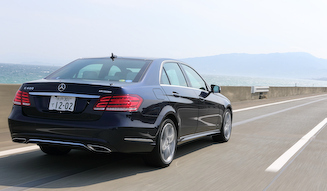
This model offers the smoothness of a V6 engine combined with the power of the hybrid system, making it an appealing powertrain. However, perhaps due to individual vehicle variations, we observed a slight jerkiness during transitions between the motor and engine operation. This might be a characteristic of early models, but we recommend experiencing it yourself to confirm its refinement.
Mercedes-Benz E-Class
Test Drive: Mercedes-Benz E-Class (5)
A Completely Different Car
Thus far, we've discussed the safety systems and powertrains. However, the most compelling aspect of the new Mercedes, in our opinion, is the refinement of its suspension. It offers a truly superior and comfortable ride, feeling entirely different from the previous E-Class.
The suppression of harshness, absorbing road imperfections, is excellent, and the overall slightly soft ride isMercedes-Benz's signature comfort.BMWandAudihave pursued a sporty direction, and at one point, Mercedes seemed to follow suit. However, Mercedes remains Mercedes. Especially for a luxury sedan like the E-Class, this kind of relaxed ride quality is most appropriate.
That said, being soft doesn't mean it lacks control, unlike some older American cars.
Despite its softness, it supports the car's movements firmly, like the supple muscles of a professional athlete, so you won't feel any awkwardness even when driving spiritedly through Hakone.
Furthermore, it's remarkable how the ride quality remains consistent even when encountering large undulations that utilize the full suspension travel, starting from just a slight compression. This is truly impressive.
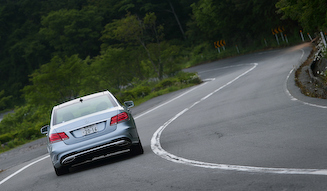
With improved quietness, the new E-Class gives the strong impression of having reached its ultimate form.
In 2011, the minor change to theC-Classwas marketed with the slogan "The finest 'C' in Mercedes history." This E-Class, having undergone a similarly extensive minor change, can also be called "The finest 'E' in Mercedes history."
We confidently recommend buying the E-Class "now."

Mercedes-Benz E 250 Avantgarde
Body Dimensions: Length 4,890 x Width 1,855 x Height 1,455 mm
Wheelbase: 2,875 mm
Tread (Front/Rear): 1,580 / 1,585 mm
Weight: 1,750 kg (1,790 kg with panoramic sliding roof)
Engine: 1,991 cc Inline-4 Direct Injection DOHC Turbo
Max. Output: 155 kW (211 ps) / 5,500 rpm
Max. Torque: 350 Nm (35.7 kgm) / 1,200-4,000 rpm
Transmission: 7-speed Automatic (7G-TRONIC PLUS)
Drivetrain: FR
Tires (Front/Rear): 245/40R18 / 265/35R18
Fuel Economy (JC08 mode): 15.5 km/ℓ
Price: 6.55 million yen
Mercedes-Benz E 350 BlueTEC Avantgarde
Body Dimensions: Length 4,879 x Width 1,854 x Height 1,475 mm
Wheelbase: - mm
Tread (Front/Rear): - mm
Weight: - kg
Engine: 2,987 cc V6 Direct Injection DOHC Turbo Diesel
Max. Output: 185 kW (252 ps) / 3,600 rpm
Max. Torque: 620 Nm (63.2 kgm) / 1,600-2,400 rpm
Transmission: 7-speed Automatic (7G-TRONIC PLUS)
Drivetrain: FR
Tires (Front/Rear): 245/45R17 / 245/45R17
Fuel Economy (JC08 mode): - km/ℓ
Price: 7.98 million yen
(Specifications are European reference values)
Mercedes-Benz E 400 Hybrid Avantgarde
Body Dimensions: Length 4,880 x Width 1,855 x Height 1,455 mm
Wheelbase: 2,875 mm
Tread (Front/Rear): 1,580 / 1,585 mm
Weight: 1,860 kg (1,900 kg with panoramic sliding roof)
Engine: 3,487 cc V6 Direct Injection DOHC
Engine Max. Output: 225 kW (306 ps) / 6,500 rpm
Engine Max. Torque: 370 Nm (37.7 kgm) / 3,500-5,250 rpm
Motor Max. Output: 20 kW (27 ps)
Motor Max. Torque: 250 Nm (25.5 kgm)
Transmission: 7-speed Automatic (7G-TRONIC PLUS)
Drivetrain: FR
Tires (Front/Rear): 245/40R18 / 265/35R18
Fuel Economy (JC08 mode): 15.2 km/ℓ
Price: 8.90 million yen