December 4, 2014
Ferrari FF Attacks Snowy Terrain | Ferrari
Ferrari FF | The Ferrari FF
An experience unlike any other Ferrari
Ferrari FF: Tackling the Snow
Geneva Motor ShowAtunveiledand captivated audiences, Ferrari's flagship supercar, the LaFerrari, made its Japan premiere.
Text by YAMAZAKI Motohiro
A Full-Size 2+2 Model
The designation "FF" stands for "Ferrari Four," so it's apparently unnecessary to write it as "Ferrari Ferrari FF." Incidentally, at the recent Geneva Show, the new special series, limited to 499 units,LaFerrariwas given the name, but the situation is the same.
The FF was born at the 2011 Geneva Motor Show. This means about two years have passed since its debut. This time, we had the opportunity to re-experience the FF's capabilities on snow-covered roads, and this report details that experience. First, as a refresher, we'll briefly introduce the FF's configuration and its on-road performance.
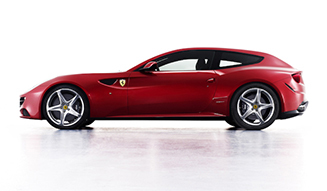
While the FF is indeed a successor to the 612 Scaglietti in the market, my personal impression is that there is no direct lineage between the two cars. The 612 Scaglietti was a full-size 2+2 model that had been a part of Ferrari's lineup since the "250 GTE 2+2" born in 1960. Maintaining a coupe style was also one of its traditional methods.
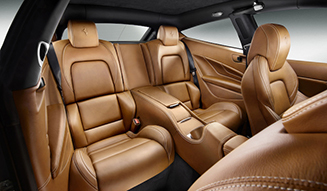
In contrast, Ferrari created the FF as a full four-seater hatchback model, so intuitively, its style leaves a stronger impression of functionality rather than flowing design. This means the concepts behind the creation of the 612 Scaglietti and the FF were fundamentally different. Therefore, the FF is not a successor to the 612 Scaglietti in the truest sense.
Ferrari FF | The Ferrari FF
An experience unlike any other Ferrari
Ferrari FF: Tackling the Snow (Part 2)
The "4RM" All-Wheel Drive System
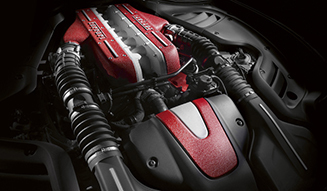
On the other hand, the basic design, centered around an aluminum space frame and featuring Ferrari's traditional V12 engine in a front-midship configuration, remained unchanged from the 612 Scaglietti. The 6,262cc, 65-degree V12 engine, designated "F140EB," produces a maximum output of 660 ps.
To optimize front-rear weight distribution, the transmission mounted at the rear is a 7-speed dual-clutch type. Up to this point, the engineering could be considered conventional for a Ferrari. However, the FF's mechanics held further surprises.
This was the "4RM" all-wheel drive system. Ferrari devised a system that directly draws torque to drive the front wheels from the front of the V12 engine, combined with a two-speed gearbox called the "PTU."
Incidentally, this two-speed gearbox changes its ratios when the 7-speed DCT is in 1st and 2nd gear, and again when in 3rd and 4th gear. However, it does not function in 5th gear and above, at which point the FF operates in RWD. The "Four" in FF refers to the full four-seater cabin design mentioned earlier, as well as this all-wheel drive system.
Ferrari FF | The Ferrari FF
An experience unlike any other Ferrari
Ferrari FF: Tackling the Snow (Part 3)
The FF's Greatest Strength
On-road, the FF exhibits overwhelming stability. The subsequent 12-cylinder, 2-seaterF12berlinettamanaged to produce an even higher output of 740 ps from the same displacement, but personally, I believe handling this power with RWD would have been impossible without the latest electronic control devices.
Conversely, this means that one can find greater appeal in the FF as a road model, capable of transmitting its 660 ps power to the road through all four wheels from 1st to 4th gear. You may interpret this as a valid perspective.
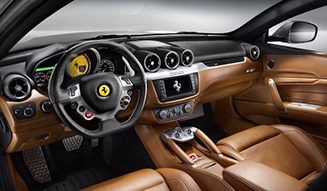
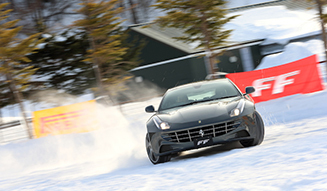
Of course, even the FF's 660 ps would likely make one hesitate with casual throttle inputs on wet surfaces by conventional standards. The traction control and stability systems constantly monitor the FF's performance to ensure optimal driving conditions, much like in the F12. However, the benefits of having less power and the all-wheel drive system are far greater than one might imagine.
Ferrari's concept for all-wheel drive, as suggested by its function only from 1st to 4th gear, is to ensure stability by transmitting torque to the front wheels when necessary. Considering the FF's performance, one could theoretically argue that all-wheel drive would be even more beneficial at higher speeds, beyond the 4th gear range. However, the FF does not inspire any concerns about stability even at its top speed.
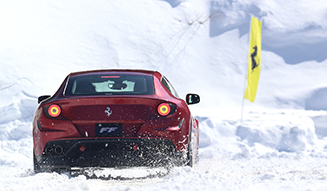
This is the FF's greatest strength, a synergy born from the rigidity of its aluminum space frame, the tuning of its magnetorheological adaptive suspension, and its exceptional aerodynamics.
On winding roads, the low center of gravity, combined with the 47:53 front-rear weight distribution, and the synergy of the "E-Diff" electronic differential and the "4RM" system, allows for a driving experience with natural and outstanding stability, thanks to true four-wheel torque vectoring.
Ferrari FF | The Ferrari FF
An experience unlike any other Ferrari
Ferrari FF: Tackling the Snow (Part 4)
Off-Road Capability in the Snow
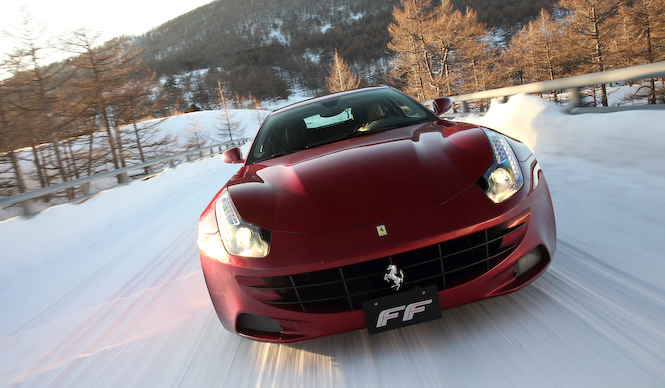
Now, let's move on to the main topic of this report: the FF's performance on snow-covered roads. The specially prepared test course at the Asama 2000 Ski Resort in Takamine Kogen, Nagano Prefecture, was the perfect environment to experience the FF's capability in the snow. While driving a Ferrari to a ski resort is hardly a common scenario in Japan, fitting the FF with studless tires is also unusual.
There were two specially prepared courses. One was set up in a parking lot with sections for slalom and steady-state cornering. Here, we experienced the FF's behavior by changing the Manettino's position, which allows for various electronic control modes linked to the shift program.
Slalom
Launch Control
The Manettino on the steering wheel has five positions: "Ice/Snow," "Wet," "Comfort," "Sport," and "ESC Off." In "Ice/Snow" mode, even with repeated rough throttle inputs, the FF shows no reaction, significantly reducing power and delivering purely traction-focused performance.
The ESC stability device also feels like it's constantly engaged. Even in situations like snow-covered roads, the FF does not cause mental strain for the driver or passengers.
Steady-State Cornering
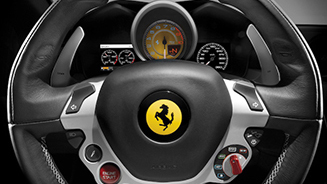
As we shifted the Manettino modes from "Wet" to "Comfort" and then to "Sport," the range of control available to the driver gradually expanded. What was impressive in every mode was the natural response to throttle inputs. In steady-state cornering, "Sport" mode, which offers greater freedom for the driver to control the car's attitude, proved to be the most appealing in terms of ease of handling.
Ferrari FF | The Ferrari FF
An experience unlike any other Ferrari
Ferrari FF: Tackling the Snow (Part 5)
The FF as a Lifestyle
Naturally, on the specially prepared course, we did not use gears beyond 5th, so the driving force from the V12 engine was reliably transmitted to the front wheels when needed, providing a high level of confidence.
Furthermore, the "ESC Off" mode is entirely at the driver's own risk. While there would be almost no opportunity to use it on-road, even in this mode, the FF's attitude changes remained mild and did not lose their natural feel.
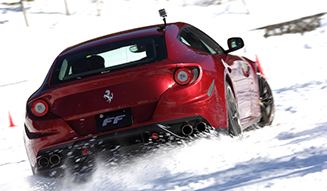
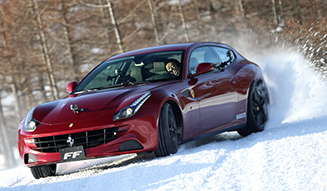
The other test course simulated a compact forest road. The FF's exceptional off-road capability left a favorable impression here as well. Another observation was the excellent visibility from the FF's hatchback body.
While the actual body size is by no means compact, this visibility—or, put another way, its functionality—serves as a significant driving force for the FF's more active applications.
The FF offers Ferrari customers a lifestyle that cannot be obtained with previous 2+2 models, and one that is absolutely impossible to experience with other Ferraris that lack an all-wheel drive system.
For customers who wish to newly incorporate the Ferrari brand into their lifestyle, it may very well be considered Ferrari's best model.
Ferrari FF | The Ferrari FF
Body Dimensions | Length 4,907 x Width 1,953 x Height 1,379 mm
Wheelbase | 2,990 mm
Tread Front/Rear | 1,676 / 1,660 mm
Trunk Capacity | 450-800 Liters
Weight | 1,790 kg
Engine | 6,262cc V12
Max Output | 486kW (660ps) / 8,000 rpm
Max Torque | 683Nm (40.8kgm) / 6,000 rpm
Transmission | 7-speed Dual-Clutch
Drivetrain | 4WD
Tires Front/Rear | 245/35ZR20 / 295/35ZR20
Top Speed | 335 km/h
0-100km/h Acceleration | 3.7 Seconds
0-200km/h Acceleration | 11 Seconds
Fuel Consumption | 15.4 L/100km
CO2 Emissions | 360 g/km
Fuel Tank Capacity | 91 L
Price | 32,000,000 Yen