
January 26, 2015
Test Drive the G65 AMG | Mercedes-Benz
Mercedes-Benz G65 AMG | メルセデス・ベンツ G65 AMG
Test Drive: Mercedes-Benz G65 AMG
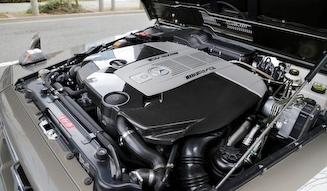
A cross-country 4WD vehicle designed over 30 years ago is now equipped with a 6-liter V12 twin-turbo engine producing a maximum output of 612 ps and a maximum torque of 1,000 Nm.G65 AMGWe asked Tatsuya Otani, a familiar face, to test drive this unique vehicle, for which there is no comparable car in existence today.
Text by OTANI TatsuyaPhotographs by MORIYAMA Toshikazu
A Special "G" Among the Special
G65 AMG.
It might seem absurd to state the car's name again at the beginning of an impression article where the model is already clearly indicated. Nevertheless, I felt compelled to use the model name, which the AMG staff must have bestowed with great emotion, at the start of this sentence.
Why?
Since August of this year, the Japanese specifications for the "G Class" will include three models: the "G550," G63 AMGand "G65 AMG." While it's obvious to anyone that the "G63 AMG" and "G65 AMG," bearing the "AMG" name, are special models compared to the "G550" which only carries the Mercedes brand, there is only a "two" digit difference between these two. Although the actual engine displacement is slightly larger than what the model names suggest, at 5.5 liters and 6.0 liters respectively, this is a negligible difference for this class.
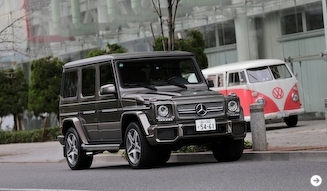
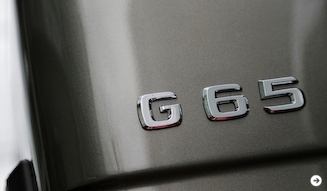
However, there is a decisive difference between the two. The most obvious illustration of this is likely the price of the two vehicles.
G63 AMG: 17.8 million yen
G65 AMG: 32.5 million yen
Despite a mere 500cc difference in displacement, there is nearly a twofold gap in price. It is likely that the G65 has been fundamentally re-engineered from its core. Yet, even so, AMG has given them only a "two" digit difference.
There is no doubt that AMG's pride and confidence are embedded in this subtle naming. The reason I placed this simple car name at the beginning of the impression was to pay homage to their pride, which speaks volumes without saying much.
The origins of the "G65 AMG" can be explained relatively simply. It is the "G65 AMG" that mounts AMG's meticulously assembled V12 6.0-liter twin-turbo engine onto the robust "G Class" body, which debuted in 1979, and drives all four wheels in conjunction with the "AMG Speedshift" 7-speed automatic transmission, also specially developed by AMG. This is the outline of the "G65 AMG."
Mercedes-Benz G65 AMG | メルセデス・ベンツ G65 AMG
Test Drive: Mercedes-Benz G65 AMG (2)
The Engineers of 33 Years Ago Never Dreamed of This
The "G Class," originally developed for military use, is fundamentally different from the trendy luxury SUVs of today.
This is immediately apparent when looking at the underside of the vehicle. The ladder frame, assembled from robust steel beams (you'll want to call them that when you see them), is fitted with a rigid axle of exceptionally strong design via equally thick steel trailing arms. The joints of the driveshaft and hub are also substantial, perhaps 20 cm in diameter. It's clear that the intended strength and durability are on a completely different order of magnitude than those of a passenger car.
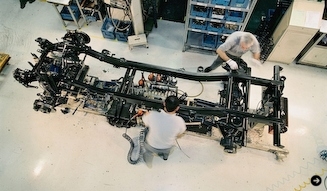
The ladder frame, which Mr. Otani referred to as "robust steel beams."
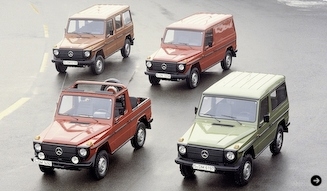
The first generation G Class debuted in 1979. Also known as the "Geländewagen."
However, these designs were adopted to ensure reliability on any terrain, not to achieve high performance like a supercar. After all, when it debuted in 1979, the most powerful "G Class" was equipped with a 2.8-liter inline-6 gasoline engine producing a maximum output of 156 ps.
The "G65 AMG's" V12 6.0-liter twin-turbo engine, on the other hand, delivers approximately four times that power at 612 ps. Its maximum torque reaches an astonishing 1,000 Nm. As a result, its 0-100 km/h acceleration is a mere 5.3 seconds, truly sports-car territory. The engineers who designed the "G Class" over 30 years ago could never have imagined achieving such high performance.
Mercedes-Benz G65 AMG | メルセデス・ベンツ G65 AMG
Test Drive: Mercedes-Benz G65 AMG (3)
A Crystal of Meticulous Tuning
The engine bay of the "G Class" is not large enough to accommodate a massive V12 engine. While an inline-6 engine could be placed low between the wheel wells, AMG's pride and joy, the V12 engine, appears to be mounted slightly higher to avoid the left and right wheel wells. This surely raises the center of gravity.
Despite this, the "G65 AMG" does not suffer from any breakdown in ride comfort or handling. First, one is surprised by the minimal harshness (road shock) when going over road imperfections. While the stiffness of the suspension is noticeable during moments of significant wheel travel, this is likely essential for stably supporting the 2,590 kg body, which does not have a low center of gravity, even at high speeds. Nevertheless, the dampers are of exceptionally high quality, providing a smooth ride within a solid feel. It's mind-boggling to consider the meticulous tuning that must have gone into achieving this.
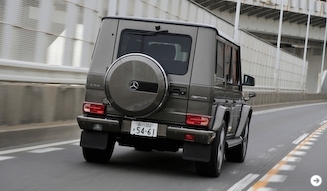
Even when testing high-speed cornering, the "G65 AMG" was straightforward and easy to control. Admittedly, when encountering road joints under significant lateral G-force, there was a slight sideways hop, but it was very mild. Any driver with sufficient skill should be able to handle it.
Some might worry about handling difficulties with an engine exceeding 600 ps, but selecting the "C" (Comfort) shift mode prevents sudden power delivery from the initial pedal press, allowing for relaxed driving. Switching to "Sport" and pressing the throttle deeply initiates a fierce acceleration, but even without doing so, the luxurious ride and exceptionally smooth engine operation constantly remind you that you are driving something special.
Indeed, it is when driving in this more subdued manner that the "G65 AMG's" inherent dignity is most clearly felt.
Mercedes-Benz G65 AMG | メルセデス・ベンツ G65 AMG
Test Drive: Mercedes-Benz G65 AMG (4)
The Traditions of Good Old Mercedes Live On
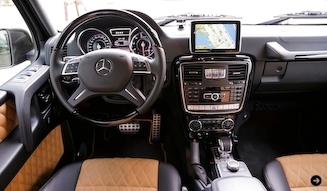
As mentioned earlier, the chassis, which is not a new design, harmonizes wonderfully with the 612 ps power output. The same can be said for the interior design. The upright, flat windshield and compact dashboard are testaments to the "G Class's" 30-plus year history, yet their design, quality, and operability have all been updated to modern standards.
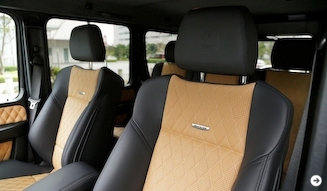
In particular, the "designo" bespoke interior program, standard on the "G65 AMG," uses abundant amounts of the finest leather, creating a luxurious atmosphere befitting a vehicle exceeding 30 million yen. The colors, available in six choices, are all vibrant and richly adorn the cabin. The seats, which are somewhat flat with thin cushioning, are likely packed with AMG's know-how; they not only hold the driver securely during hard cornering but also offer a good degree of comfort.
While possessing these modern facets, the "G65 AMG" also embodies the traditions of good old Mercedes. The solid, crisp sound when closing the doors is a characteristic shared by Mercedes vehicles up to around the "W124" era.
Speaking of which, the "clunk" sound when locking the doors with the remote was also a common feature of "three-pointed star" vehicles up until about 20 years ago.
But it's not just superficial aspects. The excellent craftsmanship evident in every detail of the interior, the sharp steering with a tight turning radius, and the excellent visibility and clear sightlines are all qualities that have long been praised as Mercedes' strengths. Furthermore, good visibility and clear sightlines are essential conditions for off-road driving.
The "G65 AMG," a refinement of the "three-pointed star" that practiced "perfection or nothing," is a vehicle whose true charm cannot be fully captured by the mere phrase "the most powerful cross-country vehicle ever."

Mercedes-Benz G65 AMG | メルセデス・ベンツ G65 AMG
Body Size | Length 4,763 x Width 1,855 x Height 1,938 mm
Wheelbase | 2,850 mm
Tread Front / Rear | 1,500 / 1,500 mm
Ground Clearance | 215 mm
Turning Radius | 6.2 meters
Trunk Capacity | 480-2,250 liters
Weight | 2,590 kg
Engine | 5,980 cc V12 SOHC Twin-Turbo
Maximum Output | 450 kW (612 ps) / 4,300-5,600 rpm
Maximum Torque | 1,000 Nm (102.0 kgm) / 2,300-4,300 rpm
Transmission | 7-speed Automatic
Drivetrain | 4WD
Tires Front/Rear | 275/50R20 / 275/50R20
Fuel Consumption (NEDC) | 17.0 L / 100 km
Price | 32.5 million yen