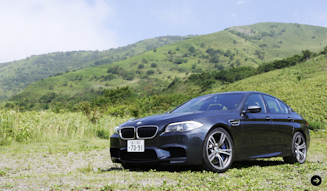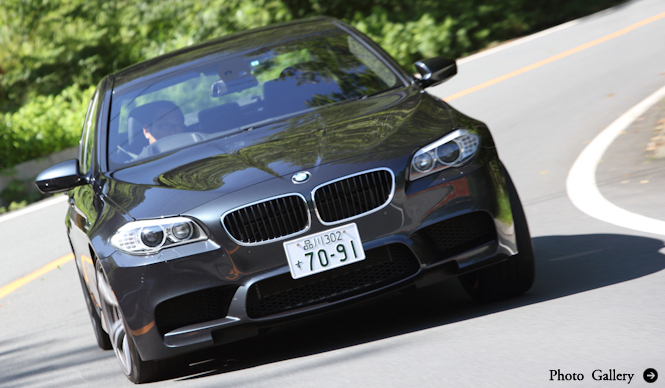
Test Drive: The Monster Sedan, BMW M5
BMW M5 | BMW M5
A Monster Machine in the Guise of a Luxury Sedan
Test Drive of the BMW M5
Previously,we brought you a report from an overseas test drive., we had the opportunity to test the BMW high-performance sports sedan, theM5again, this time in Japan. The current M5's most significant feature is its replacement of the naturally aspirated 5-liter V10 engine, derived from F1 engines, with a smaller 4.4-liter V8 engine, which is then boosted by BMW's proprietary turbo technology to achieve specifications exceeding its predecessor. So, what is the true capability of this monster machine disguised as a luxury sedan? Tatsuya Otani reports!
Text by OTANI Tatsuya
Photographs by ARAKAWA Masayuki
Evolution? Or Regression?
Finally, I had the chance to get behind the wheel.
I was fortunate enough to test drive BMW's super sports sedan, the M5, in Hakone.
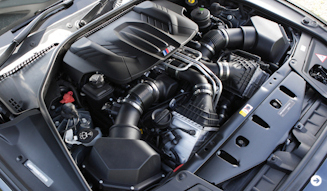
To briefly recap, the new M5, completely redesigned for the first time in about seven years, was announced domestically in July of last year. It replaces the previous model's 5.0-liter V10 naturally aspirated engine with a 4.4-liter V8 twin-scroll twin-turbo, in line with the latest trends.
While reducing displacement by 12 percent, it increases maximum output by approximately 10 percent to 560 ps and boosts maximum torque by about 31 percent to 680 Nm, debuting with the latest technology and pride of BMW M GmbH.
While I, generally positive about technological advancements, accept such changes as a matter of course, some people who are unable to break free from conventional thinking reportedly reject this, saying, "Replacing a V10 with a V8 is nothing short of regression!"
But, please wait a moment. Is this truly regression?
The downsizing concept, which reduces displacement and cylinder count, then combines them with high-precision direct injection and forced induction to improve the balance between fuel economy and performance, is a state-of-the-art technical trend that virtually every European manufacturer now adopts as a matter of course.
However, its primary objective is the reduction of carbon dioxide emissions.
The EU has introduced regulations mandating CO2 emissions of 130g/km or less per vehicle. While penalties are not yet imposed, a system of fines will be gradually introduced from 2015 to 2020, and if standards are not met, even highly fuel-efficient cars could result in automotive manufacturers paying tens of thousands of yen per vehicle in fines.
This is the main reason why automotive manufacturers are desperately working on fuel-saving technologies.
Consequently, BMW is also diligently developing fuel-saving technologies. Their twin-scroll turbo technology has an outstanding effect on improving engine response, rendering the term "turbo lag" completely obsolete.
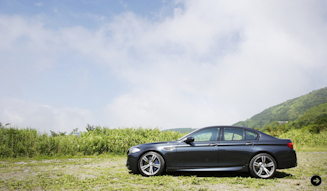
BMW M5 | BMW M5
A Monster Machine in the Guise of a Luxury Sedan
Test Drive of the BMW M5 (2)
The Engine Has Three Personalities
Even with reduced displacement, the maximum output is equivalent or greater. Conversely, maximum torque has increased, and the torque characteristics are overwhelmingly more manageable, meaning the total amount of power that ordinary users can actually utilize on public roads has definitively increased. In other words, more powerful driving is possible. Furthermore, with fuel economy improved by about 30 percent, there is nothing to complain about. Therefore, I believe there is no need to lament even if two or four cylinders are reduced.
However, the 560 ps output from the M5's 4.4-liter turbo engine is far more convincing than such pedantic logic.
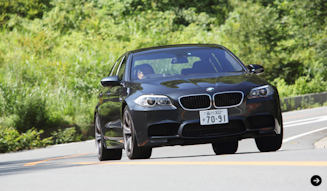
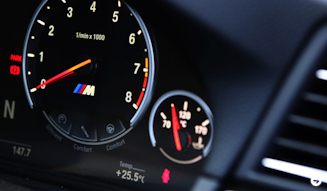
This engine reveals three distinct personalities depending on the RPM.
Up to around 3,000 rpm, you will likely only perceive it as a slightly powerful engine. The response to throttle input is docile, allowing the driver to control speed with confidence.
In the range from 3,000 rpm to 5,000 rpm, you will feel a sense of awe towards the Bavarian engineers. This power unit, demonstrating overwhelming acceleration without any perceptible turbo lag, can be described as the perfection only BMW M, unrivaled in creating sporty engines, can achieve.
And the world that awaits beyond 5,500 rpm... Honestly, this should not be tested on public roads.
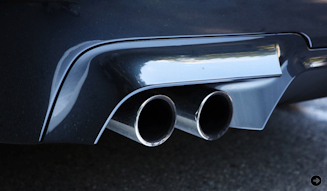
The needles on the speedometer and tachometer begin to climb at an unbelievable rate, and you start to feel an overwhelming speed difference between yourself and your surroundings. The 4.4-liter turbo engine sheds its gentlemanly facade and begins a violent acceleration, accompanied by a ferocious exhaust note.
It would be prudent for any sensible driver to stay away.
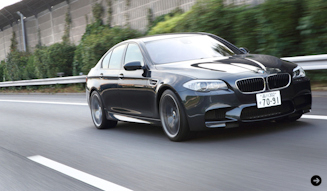
BMW M5 | BMW M5
A Monster Machine in the Guise of a Luxury Sedan
Test Drive of the BMW M5 (3)
Isn't it Okay to Have Cars Like This?
Yes, this M5 retains the raw character that past sporty models possessed. While the dual-clutch 7-speed gearbox offers a captivating direct feel, it also transmits slight jolts during shifts. The electronically controlled dampers, with their three adjustable damping levels, can sometimes deliver a jarringly firm ride even in the softest "Comfort" setting, making one inclined to select the "Sport Plus" mode, with its strongest damping and crisp response, even for city driving.
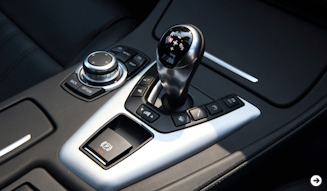
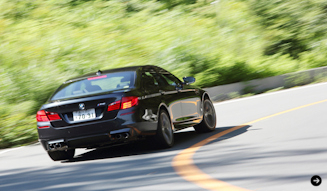
On the winding roads of Hakone, I felt I was somewhat overwhelming the 560 ps power. With the stability control set to normal, the rear tires would lose grip every time I applied throttle, causing the engine output to be reduced. It felt considerably easier to engage in a dialogue with the car when I recently test drove the6 Series Gran Coupéthan this.
But no, I don't intend to blame the M5 for everything. If my skills were on par with a racing driver, I would have turned off the stability control and utilized the full 560 ps, sliding the rear wheels left and right. Or, if the location were a circuit rather than a public road...
No, such fantasies are futile.
What I am confident about now is that in an era where high-performance cars are universally heading towards a "refined" and "herbivorous" path, it is perfectly fine to have at least one masculine, raw car like the M5 remaining.

BMW M5 | BMW M5
Body Dimensions | Length 4,920 x Width 1,890 x Height 1,470mm
Wheelbase | 2,965mm
Vehicle Weight | 1,980kg
Engine | 4.4-liter V8 Twin-Scroll Twin-Turbo
Maximum Output | 412kW (560ps) / 6,000rpm
Maximum Torque | 680Nm / 1,500-5,750rpm
Fuel Economy | 9.0km/ℓ (JC08 mode)
CO2 Emissions | 232g/km
Price | ¥14,950,000