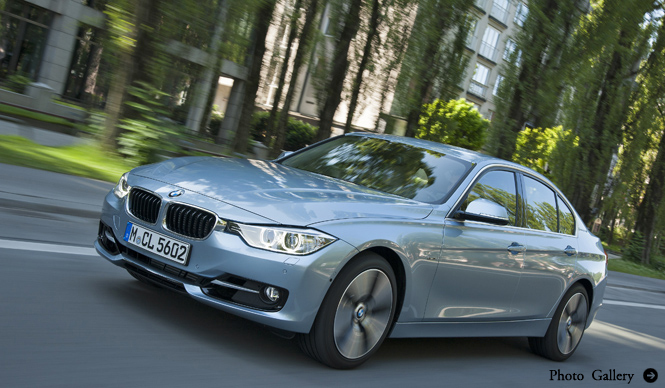
A Test Drive of the BMW ActiveHybrid 3.
BMW ActiveHybrid 3 | BMW
The Sweetness of Hybrid Power Isn't Just About Fuel Economy
Test Drive: BMW ActiveHybrid 3
The "BMW ActiveHybrid 3" is the only hybrid car in the 3 Series lineup available in Japan, featuring a straight-six engine paired with an electric motor.Now accepting orders in JapanYasuhisa Shimashita test drove this first-ever hybrid model in the 3 Series. Despite a curb weight of 1,740kg due to the electric motor and battery, it boasts a rapid 0-100km/h acceleration of 5.3 seconds and claims fuel economy comparable to a 2-liter engine car. What is the true value of the ActiveHybrid? We bring you this report from Munich, BMW's home turf.
Text by Yasuhisa Shimashita
BMW's Answer
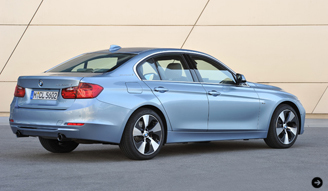
The "New BMW 3 Series" announced this Januaryis set to aggressively expand its lineup towards the latter half of 2012. The biggest highlight is undoubtedly the "ActiveHybrid 3," the first hybrid in the 3 Series and the first in a mid-size sedan from a premium brand. Officially announced in Japan on July 25th, we had an early test drive of this highly anticipated model. The setting was near Munich, BMW's home ground.
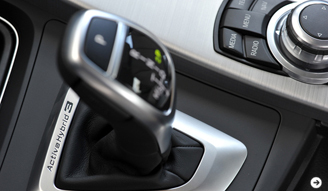
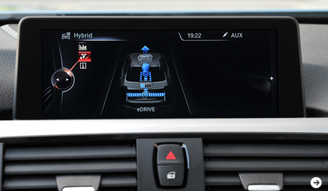
BMW, a German premium brand, is actively pursuing hybrid technology. They have already introduced "ActiveHybrid" models in the7 Series,X6,5 Series, but perhaps the technology was still in an exploratory phase. In fact, all three used different engines and hybrid systems. However, the ActiveHybrid 3 largely adopts the components used in the ActiveHybrid 5.
Incidentally, the recently announced facelifted7 Series in its home marketwas also updated to use the same system. This suggests that BMW's hybrid strategy has now solidified.
BMW ActiveHybrid 3 | BMW
The Sweetness of Hybrid Power Isn't Just About Fuel Economy
Test Drive: BMW ActiveHybrid 3 (Part 2)
Fuel Economy Comparable to a 2-Liter Engine
Simply put, the hybrid powertrain consists of a 3.0-liter turbocharged inline-six engine and an 8-speed automatic transmission, with an electric motor sandwiched between them. A clutch between the engine and electric motor (not a separate addition, but using the AT's internal clutch) allows them to be disengaged. This means the car can run solely on electric power with the engine off.
The engine produces a maximum output of 306ps and a peak torque of 400Nm (approx. 40.8kgm). The electric motor delivers 55ps and 210Nm (approx. 21.4kgm), bringing the system's total maximum output to 340ps and peak torque to 450Nm (approx. 45.9kgm). While the addition of the electric motor and battery brings the vehicle's weight to 1,740kg, it achieves 0-100km/h in a swift 5.3 seconds. Furthermore, its fuel efficiency is an impressive 5.9ℓ/100km (approx. 16.9km/ℓ) in the EU combined cycle, with CO2 emissions of 139g/km. Although the official JC08 mode fuel economy for the Japanese specification is still pending, it is advertised as "comparable to a 2-liter engine car," suggesting at least 15-16km/ℓ is likely.
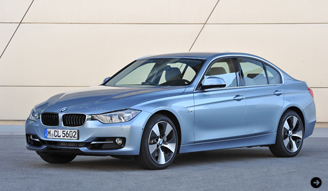
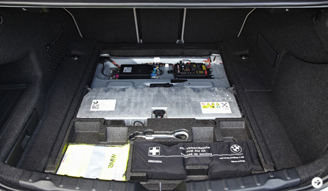
The biggest difference compared to the ActiveHybrid 5 is the trunk space. Unlike the 5 Series, the new 3 Series was designed with hybrid integration in mind from the development stage, minimizing intrusion into the luggage compartment by the lithium-ion battery. By housing the battery under the floor (though the floor is raised), a capacity of 390 liters is secured. While this is 90 liters less than other 3 Series grades, it's a significant improvement considering the ActiveHybrid 5's capacity is only 375 liters. Moreover, with the 40:20:40 split-folding rear seats, the trunk can be extended, sacrificing almost no practicality.
BMW ActiveHybrid 3 | BMW
The Sweetness of Hybrid Power Isn't Just About Fuel Economy
Test Drive: BMW ActiveHybrid 3 (Part 3)
Utilizing Coasting
Given that it uses the same system and battery as the ActiveHybrid 5, despite a 220kg difference in weight, the power reserve feels ample. Upon starting, the car pulls away using only the electric motor for a while without the engine engaging. While it's claimed to run up to 75km/h or for 3-4km on electric power alone if conditions permit, it's true that the engine doesn't engage until around 50km/h without conscious effort. In simpler terms, the electric-only driving range is longer compared to cars like the Prius.
Conversely, when accelerating hard, the engine, which produces its peak torque of 400Nm (approx. 40.8kgm) at a low 1,200rpm, is joined by the electric motor in a boost mode, providing powerful acceleration that pushes you back into your seat. The "Active" hybrid name is truly earned, offering an exhilarating experience that could become addictive. The appeal of hybrid technology extends beyond mere fuel efficiency.
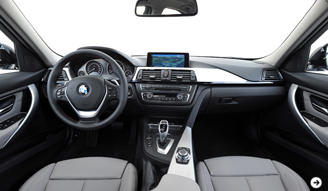
During normal driving, the engine is supposed to shut off simultaneously with accelerator release up to 80km/h to enter energy regeneration mode. However, during our test drive, perhaps due to the hot weather and driving conditions, the engine didn't shut off readily. Yet, by setting the Driving Dynamics Control to "ECO PRO," the engine shutdown threshold is lowered, enabling engine-off coasting at speeds up to a remarkable 160km/h. By gliding without engine power, significant fuel economy improvements are possible, especially on flat highways with gentle undulations.
On a test route with a mix of highways and general roads, the onboard fuel economy meter showed 7.4ℓ/100km (approx. 13.5km/ℓ) with fuel-efficient driving. After trying various driving styles, including full acceleration up to nearly 230km/h and cruising over 200km/h, the displayed figure was 8.6ℓ/100km (approx. 11.6km/ℓ).
Considering Japanese expectations for hybrid vehicles, this might seem slightly underwhelming. However, given the powertrain's 340ps maximum output and its ability to easily reach speeds approaching 250km/h on the Autobahn, the fuel economy is certainly commendable.
BMW ActiveHybrid 3 | BMW
The Sweetness of Hybrid Power Isn't Just About Fuel Economy
Test Drive: BMW ActiveHybrid 3 (Part 4)
Its Reason for Being as the Top-Tier Grade
However, it's not all positive. The 180kg increase in weight compared to the 328i results in a firmer ride, with noticeable jolts over larger bumps, undeniably diminishing the sense of agility. For those who consider lightness the true essence of the 3 Series, this might be a concern.
Nevertheless, the overall refinement is excellent. In fact, there are no plans to introduce the previous 335i model in Japan; the ActiveHybrid 3 will be the top-grade 3 Series available. It is more than capable of fulfilling that role.
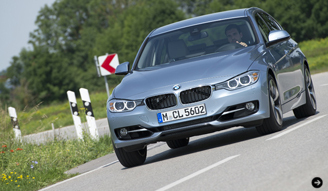
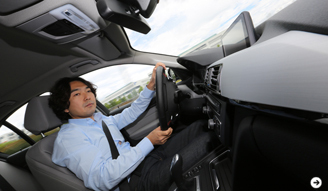
The price is 6.99 million yen. This is a remarkably competitive price, only 130,000 yen higher than the previous 335i. Buyers can choose from three trims: Sport, Modern, and Luxury. Notably, the popular M Sport package is available, preceding its introduction on other 3 Series grades.
Sales begin in October. It will be fascinating to see how this segment's first hybrid model is received in the market, and particularly how the fans of the sporty 3 Series will react.

BMW ActiveHybrid 3 |
BMW
Body (Right-hand drive) | Length 4,624 x Width 1,800 x Height 1,429 mm
Body (Left-hand drive) | Length 4,624 x Width 1,810 x Height 1,429 mm
Wheelbase | 2,810 mm
Tread Front/Rear | 1,531 / 1,572 mm
Minimum Ground Clearance | 140 mm
Vehicle Weight (DIN) | 1,655 kg
Trunk Capacity | 390 Liters
Engine | Inline 6-cylinder DOHC 24-valve Turbocharged
Displacement | 2,993 cc
Maximum Output | 306ps (225kW) / 5,800-6,000 rpm
Maximum Torque | 40.8kgm (400Nm) / 1,200-5,000 rpm
Motor Output | 54ps (40kW)
Motor Torque | 21.4kgm (210Nm)
System Maximum Output | 340ps (250kW)
System Maximum Torque | 45.9kgm (450Nm)
Transmission | 8-speed Automatic
Drivetrain | Rear-wheel Drive
0-100km/h Acceleration | 5.3 seconds